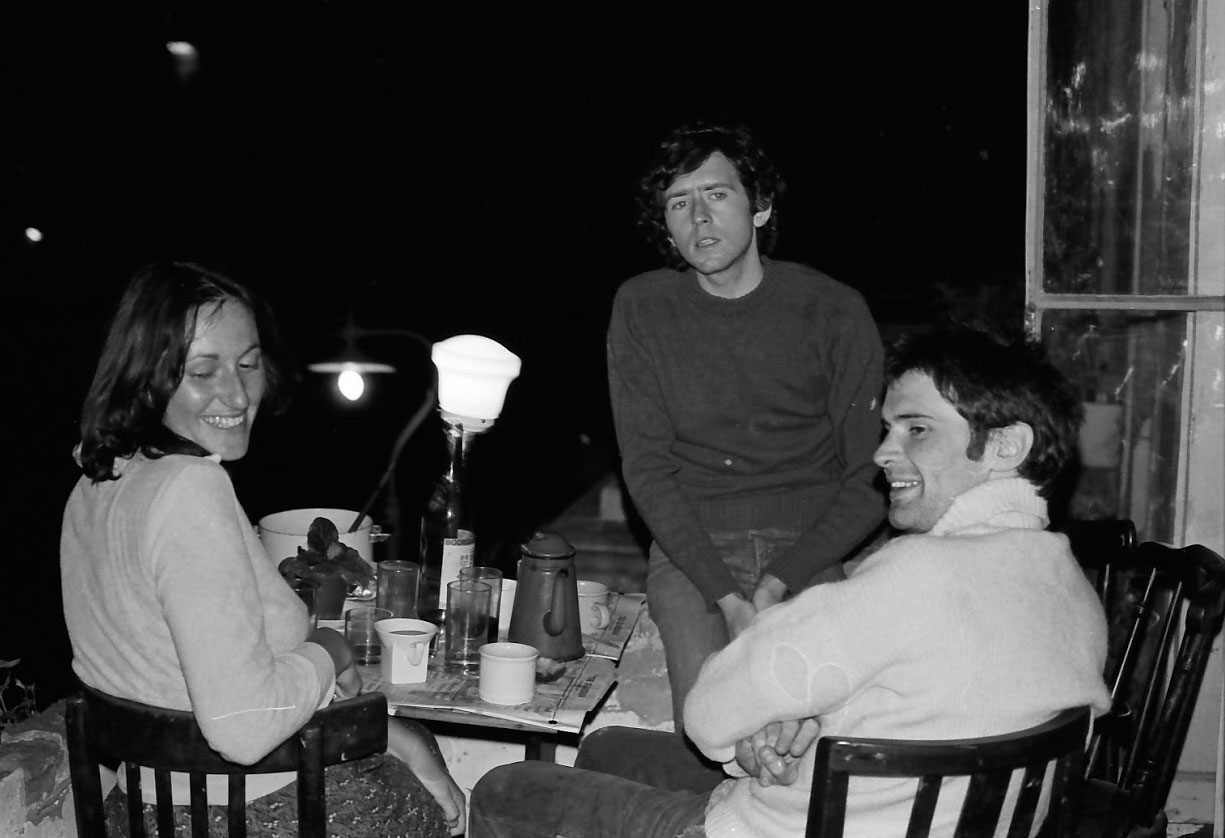
Survivor
As told to Moyra Ashford
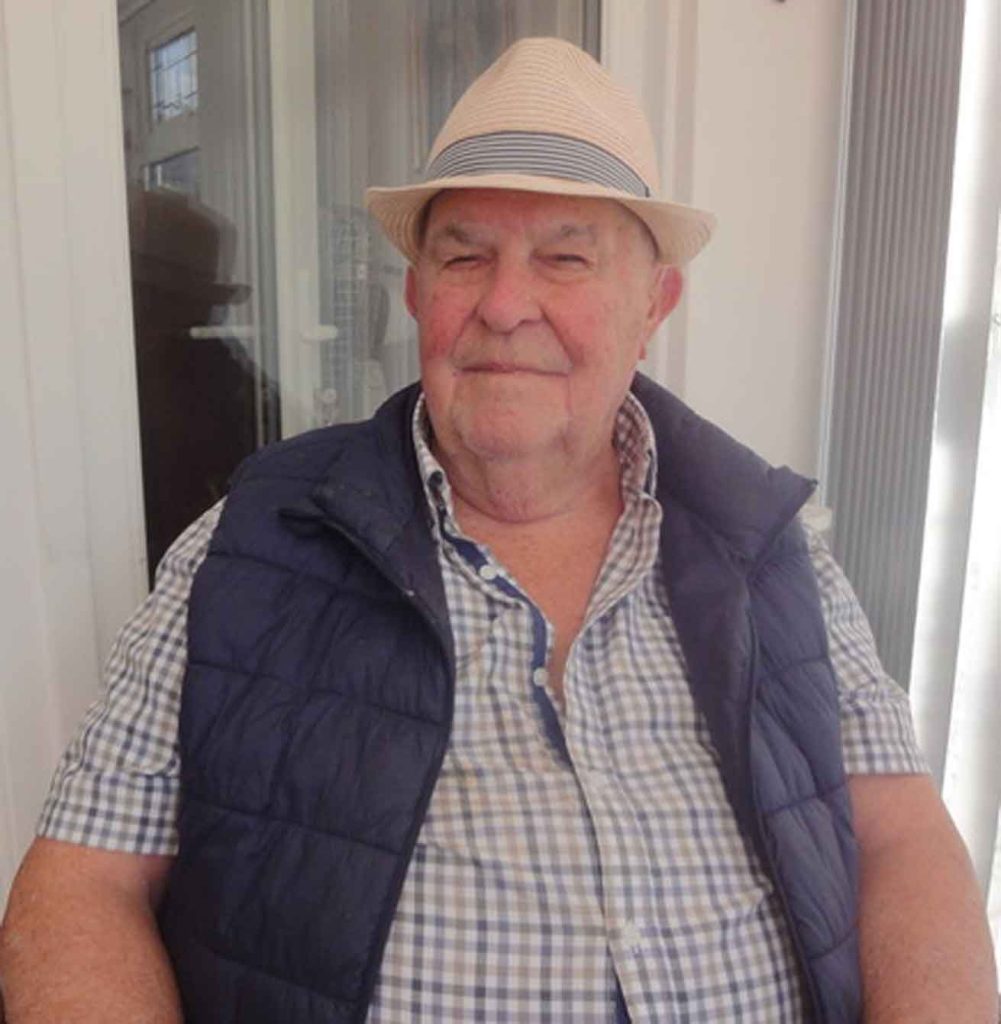
I was born in Portugal in 1935. I am 90 years old.
In 1966 I was living in Montagu Square, London when I found a job through an advert in the Evening Standard. A company in Wolverhampton was looking for a caretaker to manage the building and the tenants at 56 Hampstead Road. There were six flats. They offered accommodation and a small wage. I took the job and was there from 1966 to 1973 with my wife Cecilia and our two young children, Mark and Lisa.
In about 1971, Stock Conversion bought the building and everything went downhill after this. They never did repairs. They wrote to us and said they wanted us all out. Some tenants left of their own accord and only the single people remained – a girl from Egypt and two lads, one from Venezuela and one from Portugal. I stopped paying the rent. I borrowed money to buy a house in Acton and although the house was in a poor state of repair, Cecilia and the children moved in.
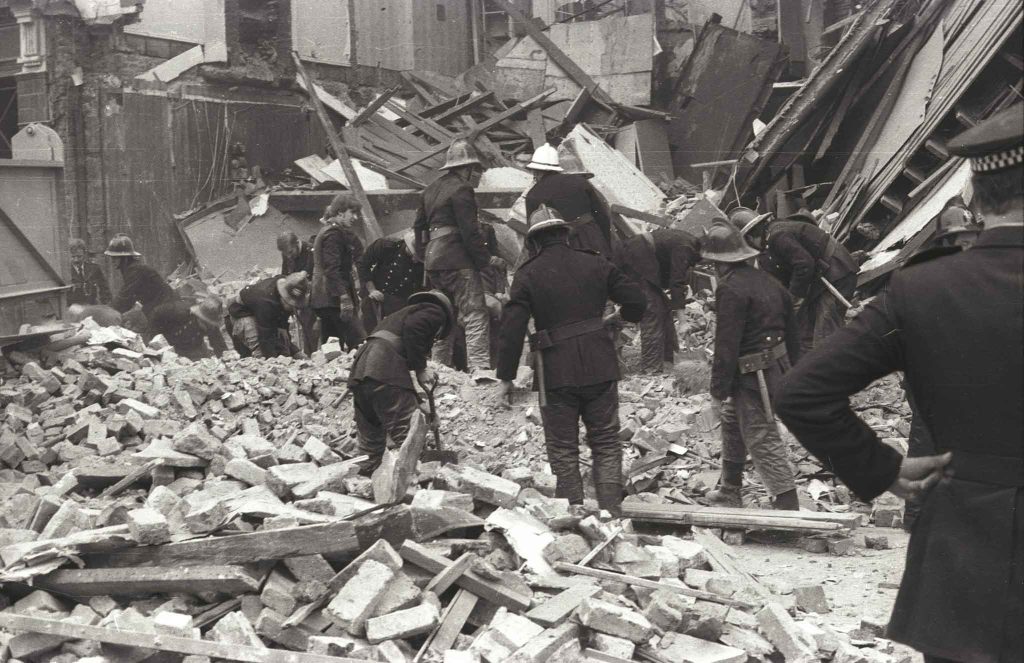
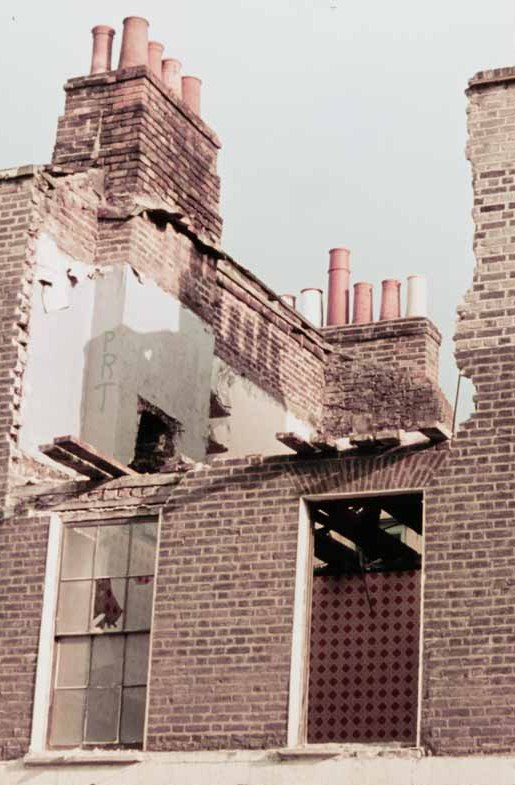
On the morning of Saturday 13th October 1973, the Egyptian girl left early for work. She was a chambermaid at the Cumberland Hotel and started her shift at 7 am. At around 7.30 am I was talking with the lads, standing near a back window. We heard a loud rumbling, like an earthquake. We opened the window and flung ourselves onto a flat roof below. The front of the building collapsed like a pack of cards.
The emergency services were called. A firemen came up a ladder and got us down. A policeman held my shoulder and said, ‘It’s understandable that you are shaky’. The ambulance wanted to take us to hospital, but I said, ‘I just want a cup of tea’. I’d only bruised my arm.
I believe Stock Conversion were responsible. In the days before the collapse Stock Conversion workmen were in the basement. I heard a lot of banging. I think they weakened the structure. The basement was empty because the caravan shop that stored their stock there had closed down.
About two weeks later a letter came from Stock Conversion calling us for a meeting. They offered me £1,000 compensation. I said, ‘That’s peanuts’. They said, ‘That’s all we can afford’. What could I do? We all accepted. The lads got £750 each and the girl, £500. We never saw each other again.
I am a Catholic and believe Nossa Senhora de Fatima lent us a hand. It was on October 13th (1917) that the Virgin Mary appeared for the last time to the three children, the three little shepherds, on the hillside.
Fifty one years later I am still bitter; I still have anxiety attacks. I used to love the Warren Street area, but I haven’t been back there since 1973. It was full of life until Stock Conversion built that tower. The shopkeepers and residents complained, but it didn’t make any difference.
See the Collapse collection for more photographs and some press cuttings of the sudden collapse of 56-58 Hampstead Road.
Traveller’s tale
As told to Patrick Allen

In 1972 I was living in Osney Lane, Oxford with two friends. I was having fun playing in bands and doing odd jobs. Work was easy to get at that time. I was about to go to London in 1973 to do a music degree at the Institute of Education.
Jamie Gough was my next door neighbour in Osney Lane. He was a piano player like me. Jamie had quite extravagant people calling round, he was a great cook and good company so we became friends and things took off from there. It was a lively social scene. Through Jamie I met Sacha Craddock and often went to her house at St Frideswides in North Oxford.
When I came to London I needed somewhere to live. For a while I lived in the basement of a Nash terrace in Regents Park. Then in 1975, Jamie and Sacha invited me to move into number 12 Tolmers Square, sharing the house with them, Colin, Cora and Pedro.
I was studying pretty hard and doing teaching practice in Limehouse and Mile End. I used to hang out with Colin who was a medical student at that time at Barts Hospital. We were students with a fairly heavy workload but hanging out and enjoying the ambience of Tolmers Square.
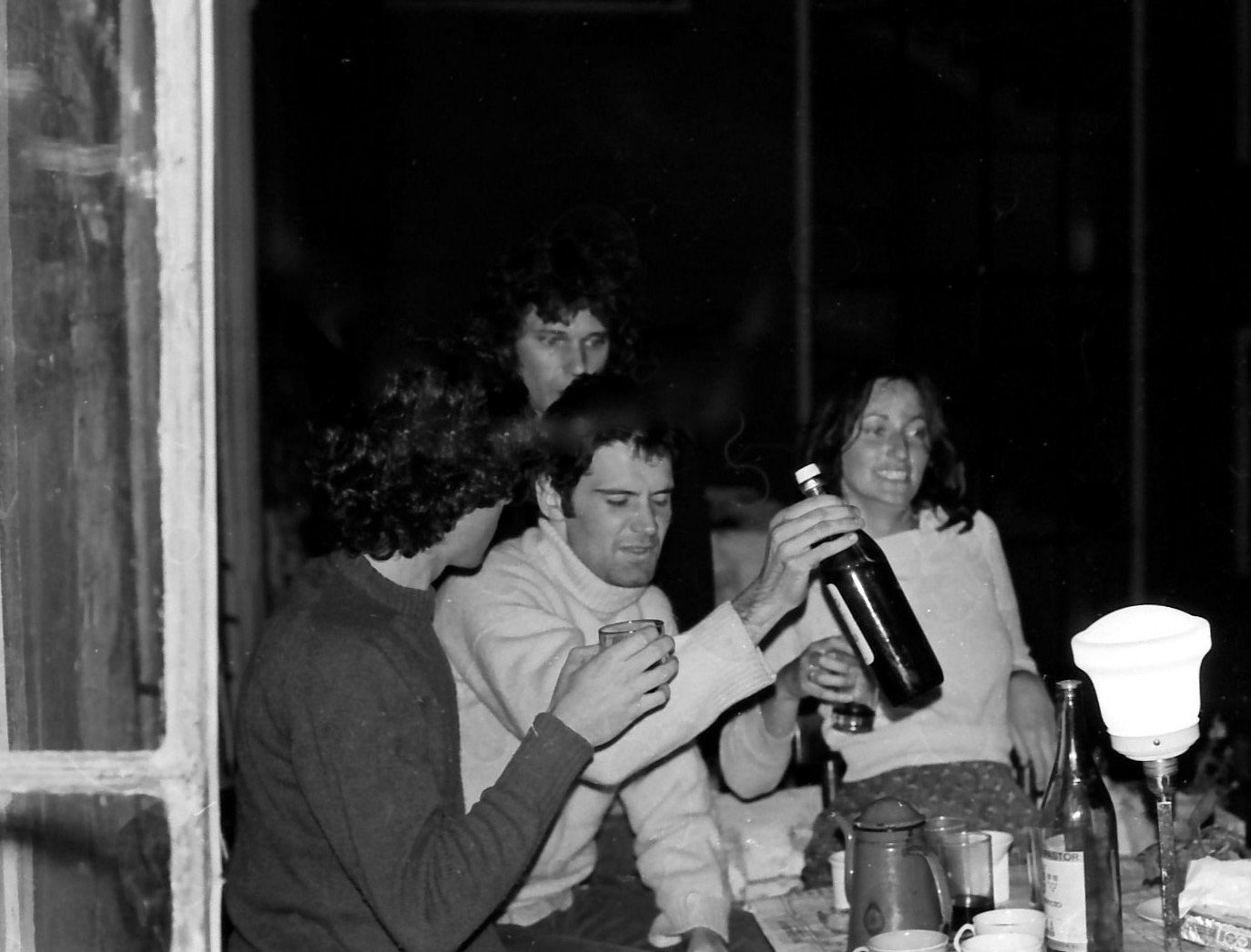
I was involved in the music at the carnivals in the Square.

There was a piano at number 12 which Jamie played a lot – we sang Cole Porter songs round the piano after dinner. Jamie was an excellent Elvis Presley impersonator and sang a memorable ‘All shook up’.
I accompanied Patrick Allen (who lived next door at no 11 ) on the flute. We played Bach and Handel flute sonatas. We made trips to Fenton House, Hampstead where there was a harpsichord collection and were allowed to play while visitors wandered around us.
In 1977 I was working like mad for my BA honours when I had the offer of an MPhil in Oxford from the education department in Norham Gardens and an MA at Kings College to study mediaeval education.
I decided against both! Instead I went on a ‘teaching English as a foreign language ‘ course so I could travel the world. The only other option was teaching music in the state school system which I didn’t fancy.

In 1979, when I had my qualification, I went abroad, initially to Kuwait, then Spain, Sweden, France and Portugal. My best experience was in Spain which was like a paradise for me. I lived in Madrid, then Seville and Granada.
I met Blanca in Spain where we married and had two children. We travelled to Paraguay, then to Canada as a result of a project that Blanca was doing with the United Nations’ World Meteorological Organisation, ending up in Toronto in 1999.
Since then, I’ve been back to Europe several times, mainly to Spain where I walk the Camino de Santiago pilgrim trail. I visited Great Russell Street in the 1980s, catching up with Jamie and Sacha.
I now live in Wolfville, Nova Scotia, a university town and a lovely place. I examine the English abilities of foreign students for St Mary’s University in Halifax and I grow vegetables. The Annapolis Valley, where I live, is extremely fertile and has its own temperate micro-climate. It is particularly famous for its apples and there are many vineyards producing excellent white wine.
I still do some work for the British Council as an educational consultant travelling all over Canada giving presentations and training workshops.
My son Harold and his best friend have a farm on Cape Breton, although they’re not doing any farming… They have a cabin with no running water. Harold is finishing a physics degree at Dalhousie University in Halifax.
Charlotte is completing a science degree at Western University in London, Ontario, and has managed to get an internship with the Canadian Space Agency.
I’ve kept up with music and do an enormous amount of hiking – Nova Scotia is very conducive to hiking. I still play the piano and have just finished a novel, a murder mystery set in Oxford in 1929.
My musical interests suddenly took a vocal turn recently when I took an introductory singing lesson from a well-known teacher and operatic soprano.
I hope that as soon as I can get over to England we can all get together round a piano, make music, and relive those wonderful old times at 12 Tolmers Square, singing Cole Porter songs.
Escape from America
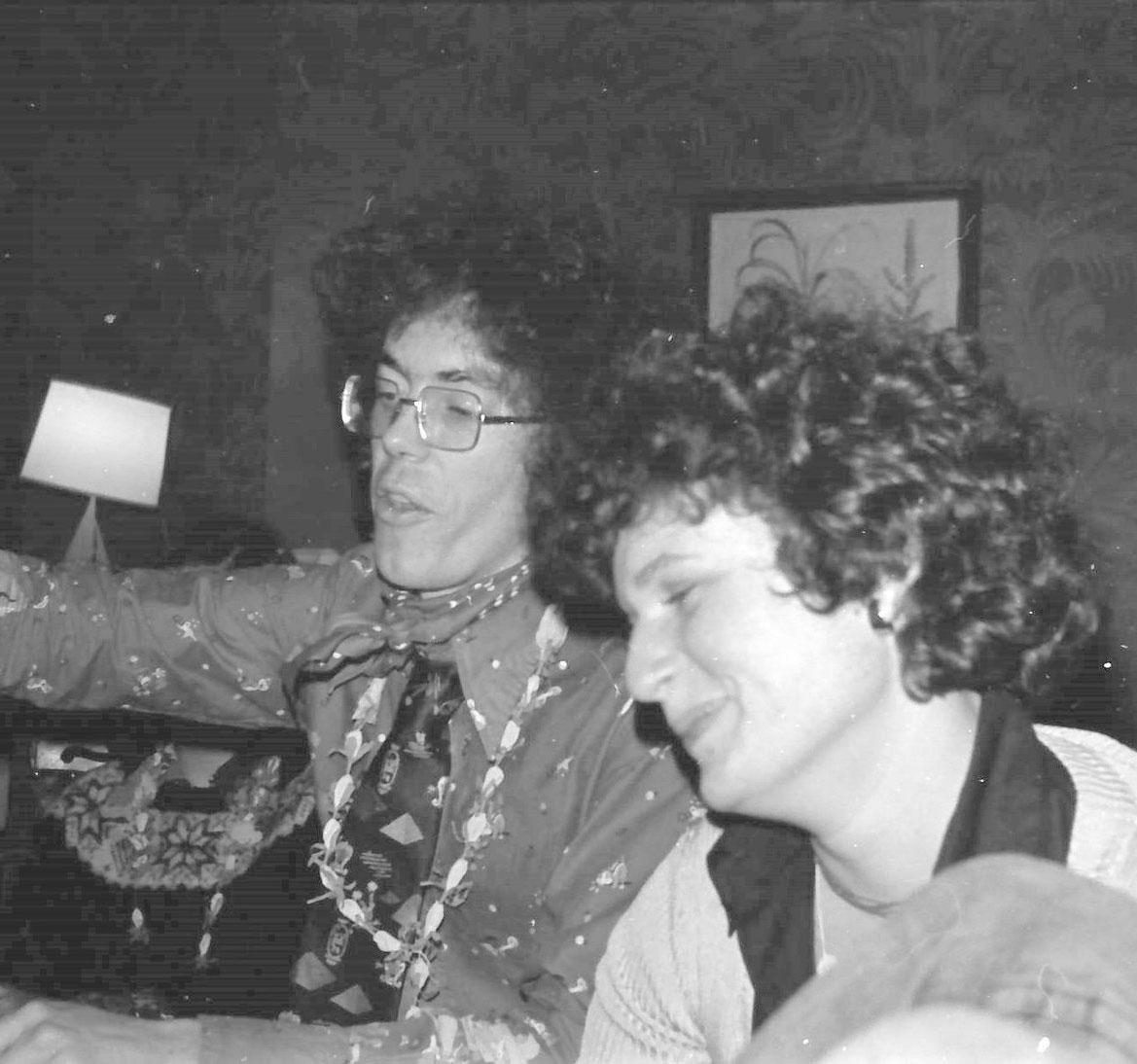
I moved from Boston to London to go to St Martin’s for a year in 1976. The flat I found was on Delancey Street in Camden with a young architect, Doug Smith. His ex-girlfriend (Sacha Craddock), as well as most of his friends, lived in Tolmers Square nearby.
I’d grown up in the suburbs of Boston and spent three miserable years at Harvard studying English and longing to be somewhere else. I finally left before getting my degree and applied to St Martin’s to do a year of sculpture in 1977-78. I was twenty, incredibly naïve, and had no idea how to find a place to live in London. Time Out was on strike. I had a week booked in a B&B. Someone suggested I look at the notice board at UCL, which is how I ended up living with Doug. I liked him a lot more than the driving instructors in Dollis Hill who invited me to a Yes concert. That was my only other option.
Through Doug I met Sacha, Cora, Dave, Patrick, Nick and Caroline, Barry and Atalia, Jamie, Orlando and by extension, Dominie, Sally, John Craddock and about a hundred other peripheral Tolmers-related people. I couldn’t believe my luck and spent the rest of that year in a kind of happy daze. All those amazing people. And best of all, I could be friends with them without actually having to live in a squat.
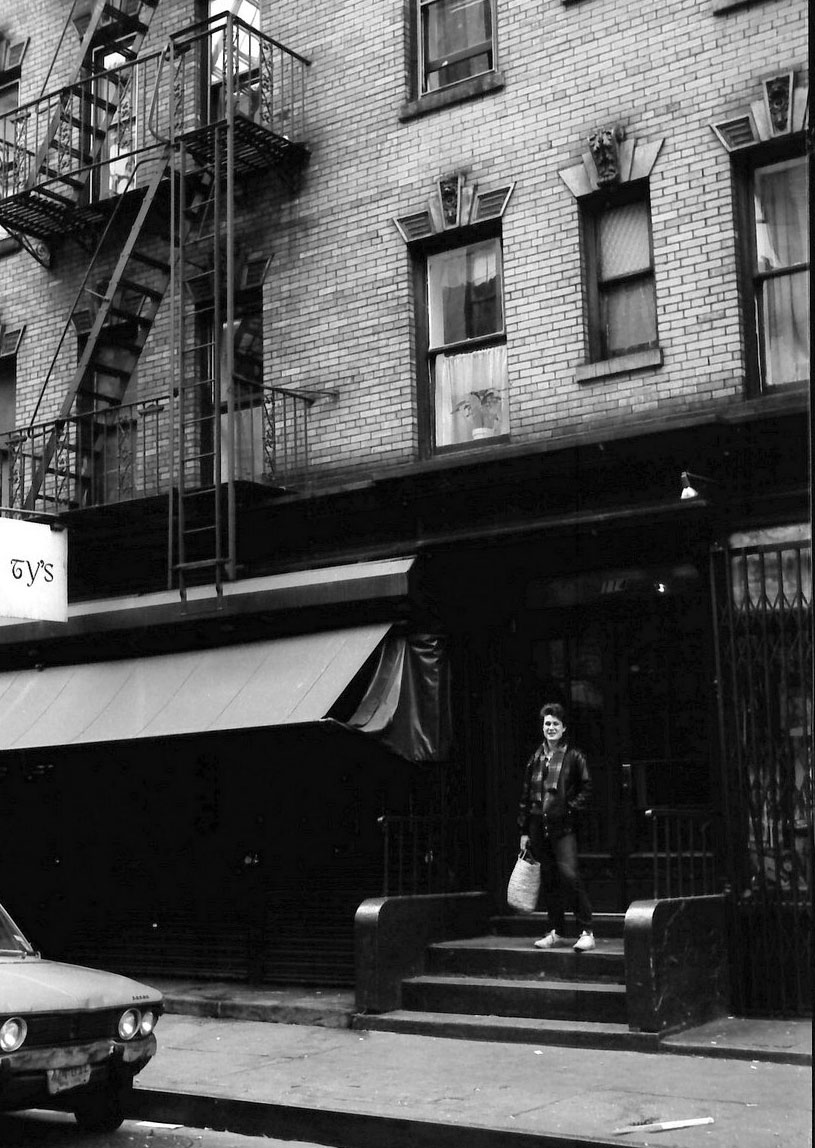
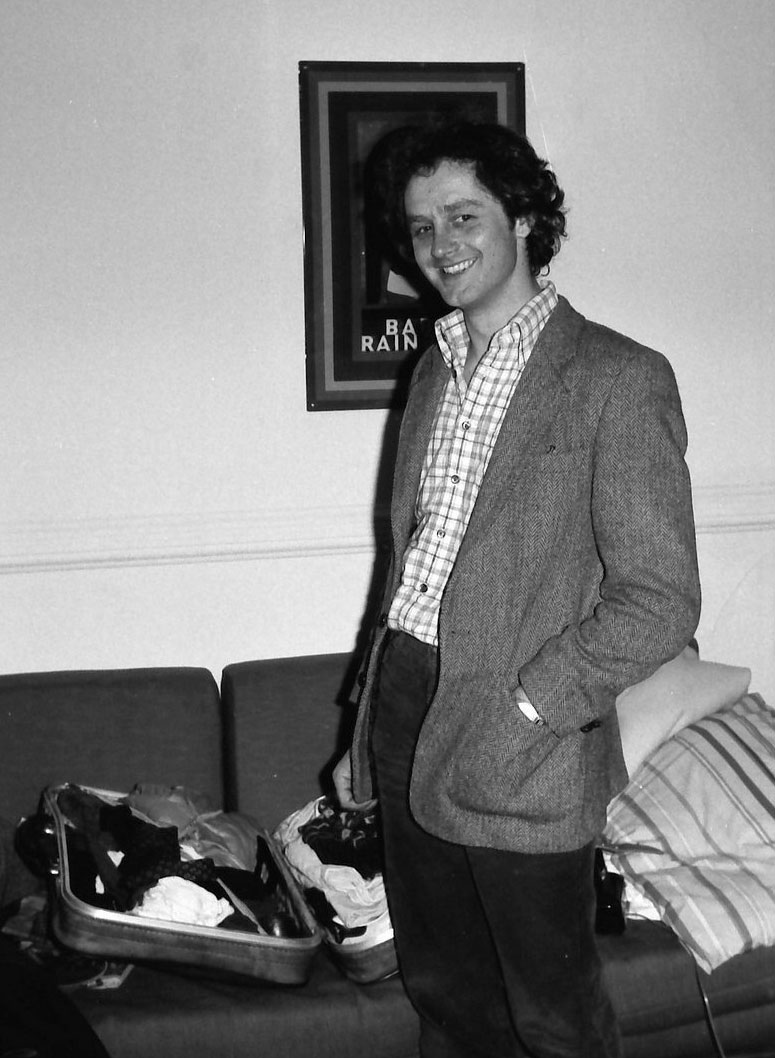
In 1979 I moved back to Boston to finish my degree and then to a slum on Christopher Street in New York City. Patrick came and stayed on my couch. This was in a grim corridor called the kitchen where there was just enough room for him, the couch and the fridge. He demanded an adventure so I fixed him up with my best friend, a gorgeous Jewish girl from the Upper West Side. They checked into a seedy hotel in Times Square. A very drunk Dave Taylor and I broke into the closed penthouse floor of a Hyatt Hotel a year or two later and were arrested for trespassing. Dominie lived with me in the Village. Doug came to a Talking Heads concert on the upper west side. Barry visited my other slum on 10th street. Patrick and Penny stayed with me in Gramercy Park and brought their own tea.
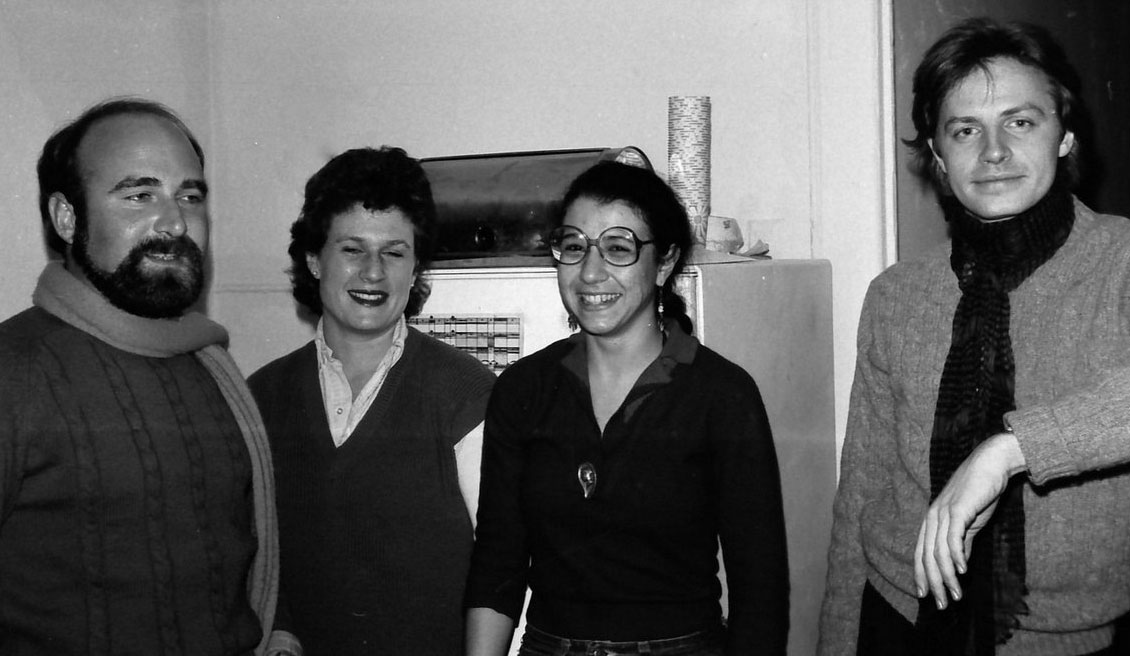
I finally moved back to London in 1989 and met my husband the following day at Sacha’s 34th birthday party in Great Russell Street. Jamie cooked one of his special Tolmers style dinners a few days later at GRS and invited us both. It was rabbit stew, and he dished up a horrible big furry ear in Paul’s portion (lest anyone over-romanticise his style of cooking). Almost fifty years later, I’m still friends with most of the people I met that year, at least the ones who are still alive.

Rebirth through fire
as told to Patrick Allen
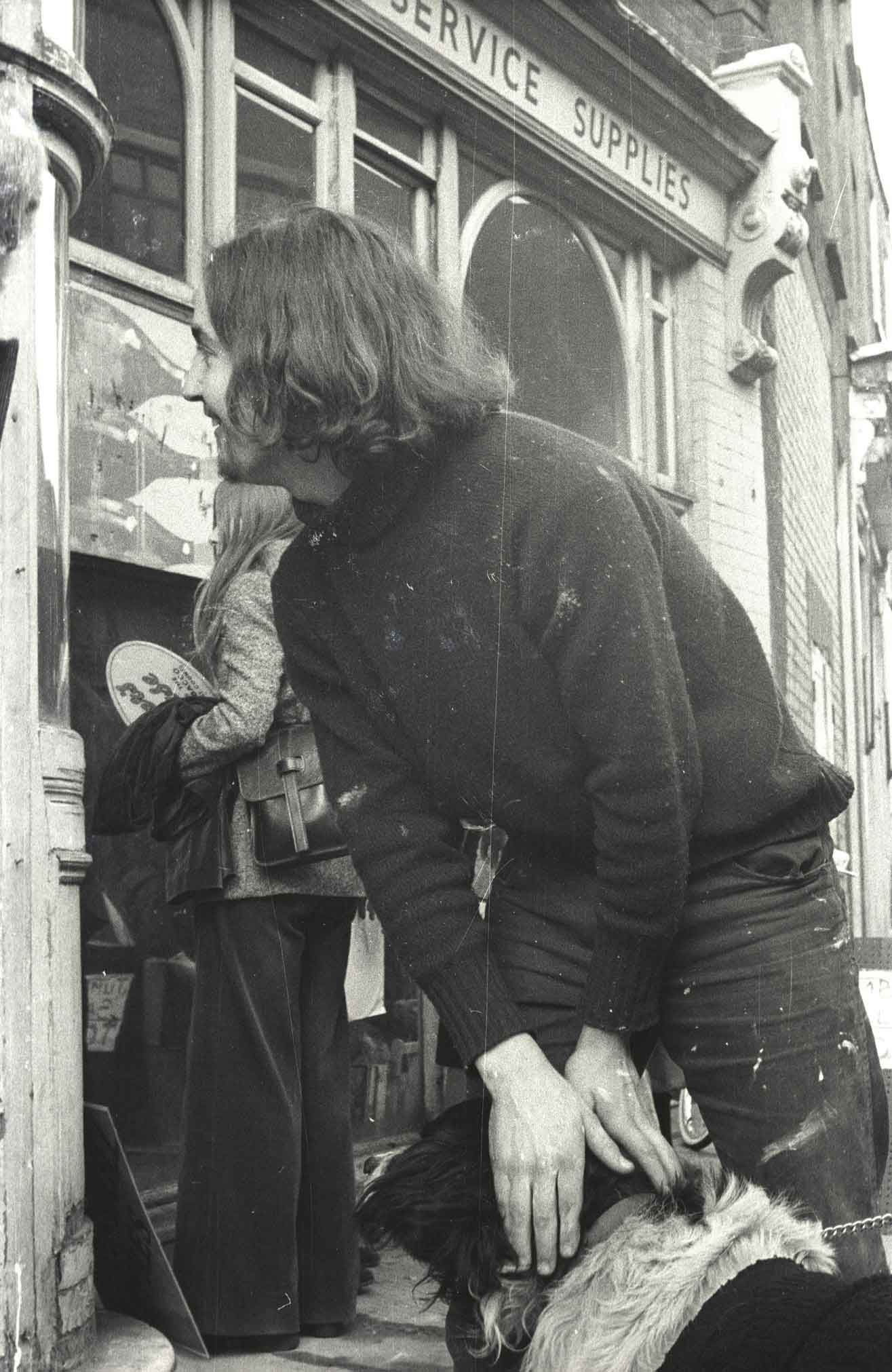
After leaving school I spent a year on a boat in the Pacific fishing with a rod for salmon and tuna. I managed to save about £10,000 in 6 months allowing me to be financially independent from the age of 18.
In September 1972 I came to London to begin my architecture studies at the Bartlett School of Architecture, University College London. I had nowhere to live so I stayed in a hotel in Bayswater. I talked to Nick Wates and Barry Shaw who were students on the same course. They were squatting in Tolmers Square. This sounded like a great idea and much better to have my own room than sharing a grotty room in a Bayswater Hotel so I decided to follow their example.
In January 1974 I opened up a house at 4 Tolmers Square. I could see that it was empty as it had corrugated iron on the basement window. I climbed into the basement and jemmied off the corrugated iron. Then I got in through the window and opened the front door. I got rid of all the rubbish and managed to fix the leaking roof where some tiles had been displaced. I worked out how to get the water and electricity connected. The water was turned off at the stopcock in the basement and all the internal piping had been removed. For electricity I had to apply to the electricity board and give them a deposit. Then I had to do some internal wiring to provide sockets and lights.
For a while I lived on my own in number 4. Then Debbie Banham, her partner Allan Arditi, and their 4 year old child Oli moved in. I had the top floor and they had the first floor front room with the balcony. We had a communal kitchen in the back room on the first floor. Oli called me Alex Dragon because I used to smoke a lot of weed and I could breathe it out of my mouth and circulate it up through my nose which fascinated him. I stayed at number 4 for about a year. I had been at the Bartlett school for about six months but then I dropped out. This was my first dropping out; there were several more. At the time it felt silly to be at the Bartlett learning how to build buildings when there were masses of buildings empty and waiting to be used.
I fell in love with Ruth Ingham and moved out of number 4 to a squat in Euston Street to be with her. That was quite an avant-garde place. There were eight or nine of us sleeping in just one bed including a Thaddeus, a Franciscan monk. This was a bit much for me, a young lad up from the country.
I started living with another Ruth, Ruth Milburn, in the house next door in Euston Street. This house was in a terrible state. Here, we never had mains water or electricity. I built a Savonius rotor on the roof to make electricity which I constructed from a 50-gallon oil barrel. The rotor made enough electricity to power a car headlight and charge a battery in the workshop. We trapped rainwater which provided our drinking water.
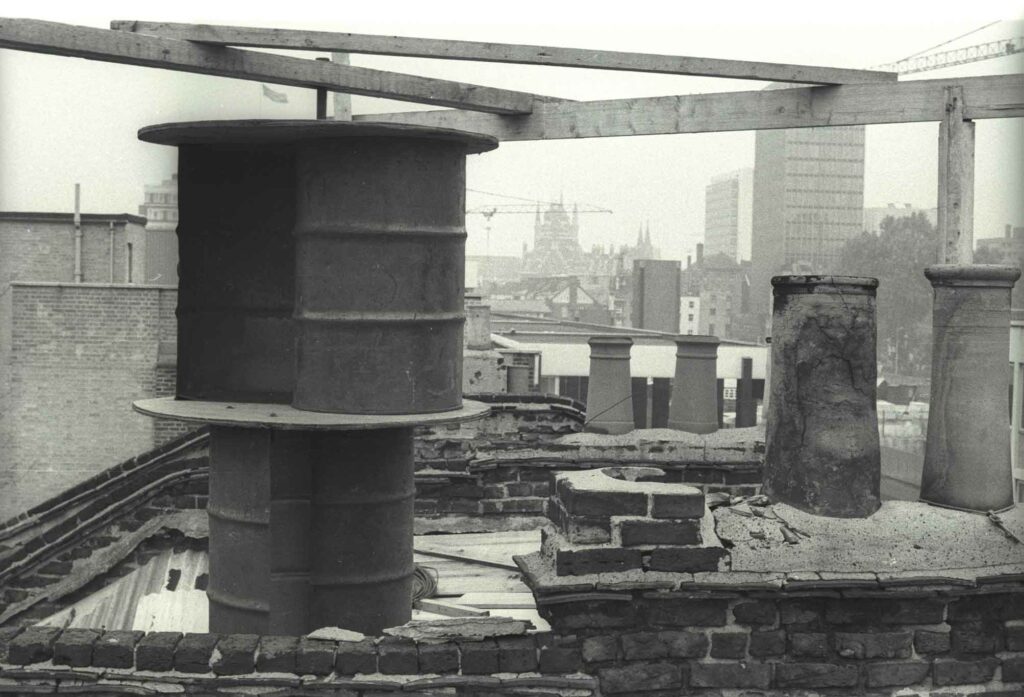
Most of our cooking was on a wood range, burning coal or wood and we had paraffin lamps for lighting.
The Camden planning department had offices next door to us. They saw the Savonius rotor on the roof, thought it wasn’t compliant with planning regulations (!) and came round to ask me about it. I explained what it was and they said ‘okay, its ‘plant’ and doesn’t need to comply with planning regulations’.
I was in Euston Street for about six months then ran short of money so went back to the Pacific for more fishing – two-man trolling with hook and line for salmon and Albacore tuna.
I returned to Europe and met up with Ruth Milburn in Finland where we stayed for a while. Then we came back and lived in Euston Street for about a year, once again without electricity or water.

Ruth and I separated and I moved to 19 Tolmers Square, a large semi-commercial building on the south side of the square which was ‘managed’ by another squatter, Vince Hetreed. I had spent all my fishing money and decided that the best way to morally oppose Stock Conversion and its property development was to live without money. In fact my father gave me a £5 note and I used it to light a fire.
I lived without money for about nine months and found this quite easy. For food I used to walk to the Covent Garden market with a pram and pick up fruit and vegetables which had been thrown away. When the market moved to Wandsworth, I went there by bicycle, a 30-minute ride, and again picked up thrown away fruit and veg.
Community Foods, suppliers of organic and natural dried foods, had leased warehouse premises on the corner of Tolmers Square. I used to sweep up for them and they allowed me to keep the sweepings which included rice and grains.
The other place for free food was the Eden Vale distribution centre near Regents Park. There was a skip where they threw away yoghurt and cream which had passed its sell by date. I helped myself to as much as I needed.
I gathered water from the roof of number 19 and filtered it with sand for washing and sand and charcoal for drinking. The water supplied a sauna bath in the basement which was heated using wood in an oil drum.
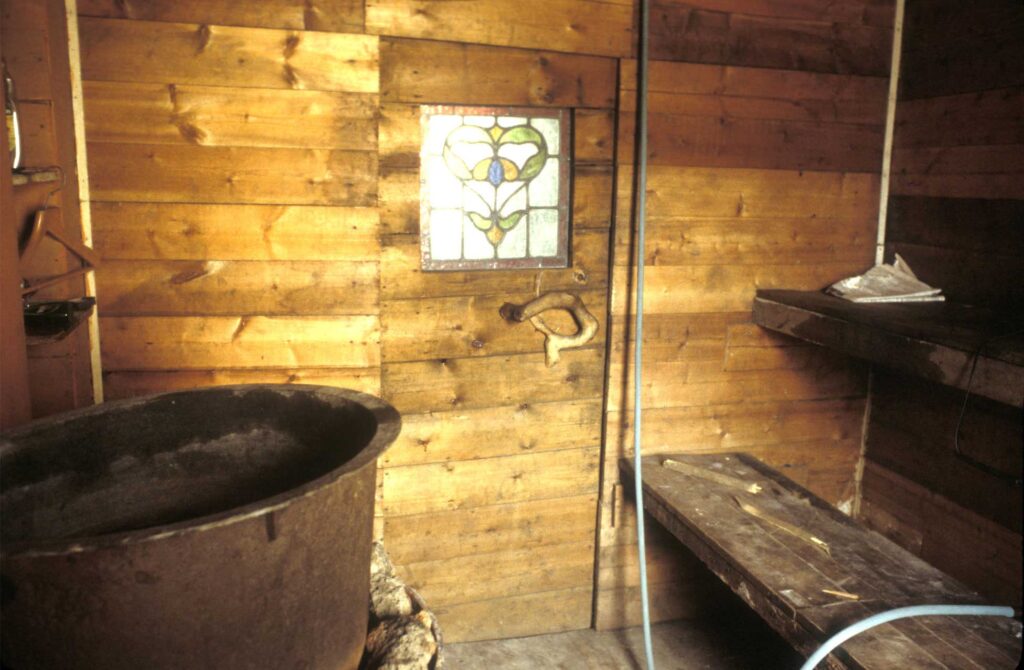
I directed the water into a 100-gallon storage tank for washing, then the overflow went into a small swimming pool which I created in the basement and from there it overflowed into the drains. The pool wasn’t very big – the size of two sofas and thigh deep, but good enough for a dip. It was more like a baptism. Heating and lighting was provided by wood found in skips. I made a bed inspired by the Arabian nights from an old parachute. I draped this around my bed on the floor.
I liked the dynamics of Tolmers Square. I was now on the South side where we were eccentric and unconventional, a bit wacky. I saw the North side squatters as the professionals – doctors, lawyers, architects, planners. However, we all came together as a community, especially for the carnivals.
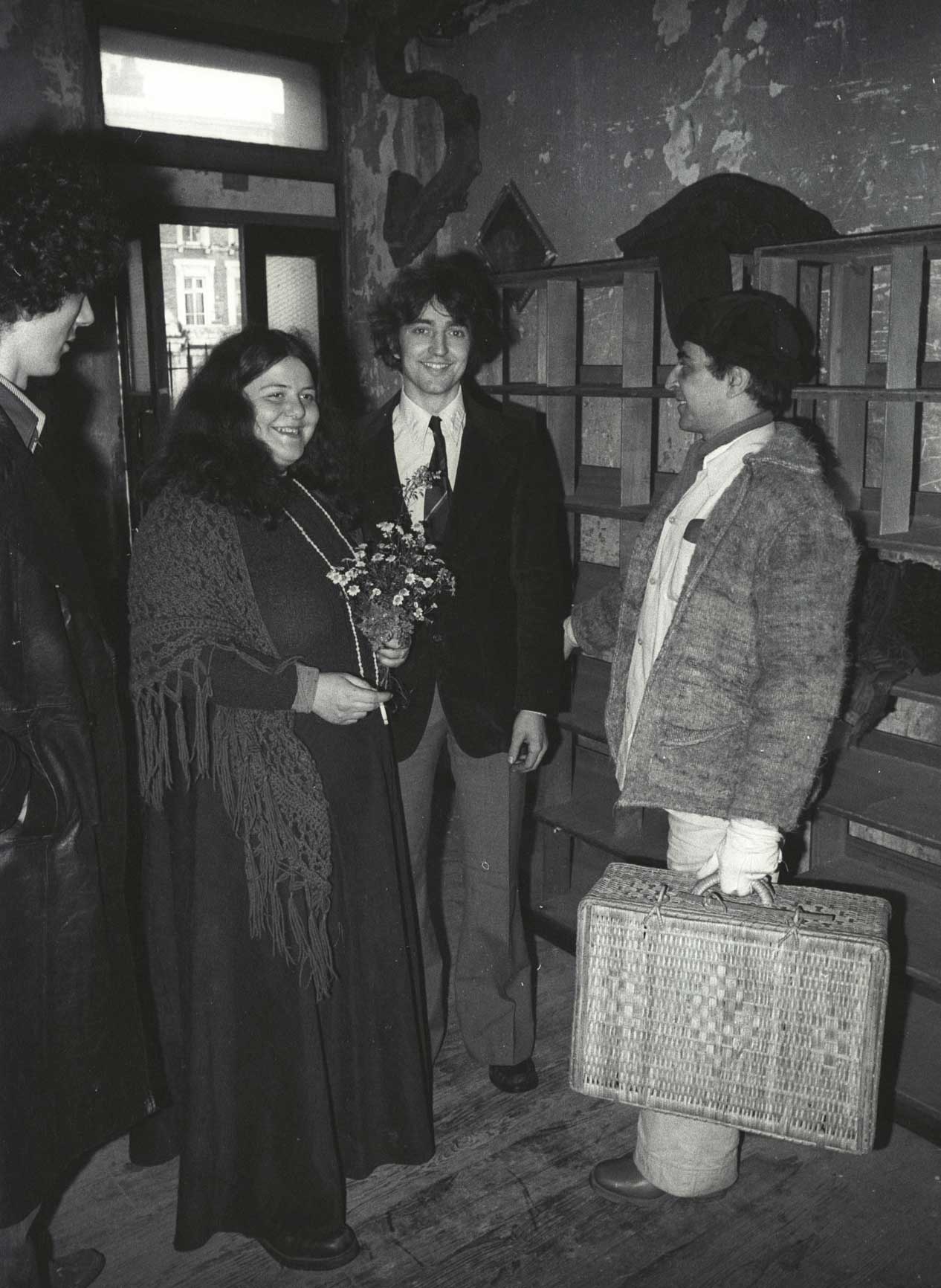
It was at this time that I met Chiara and we married in Tolmers Square about 18 months later. The two of us lived together without money for a while but Chiara got fed up with this so we started to use money again. This was Chiara’s idea as I quite liked living without money.
We started our first shop after I found £2 in the street. This was our start-up capital. I borrowed a Morris Minor pick-up truck and drove to Covent Garden market. It cost exactly £2 to get the van into the Market. I worked hard and picked up discarded fruit and vegetables and put them in the back of the van. We squatted an old dairy shop at 191 North Gower Street on the corner of the passage to Tolmers Square where we sold the fruit and vegetables.
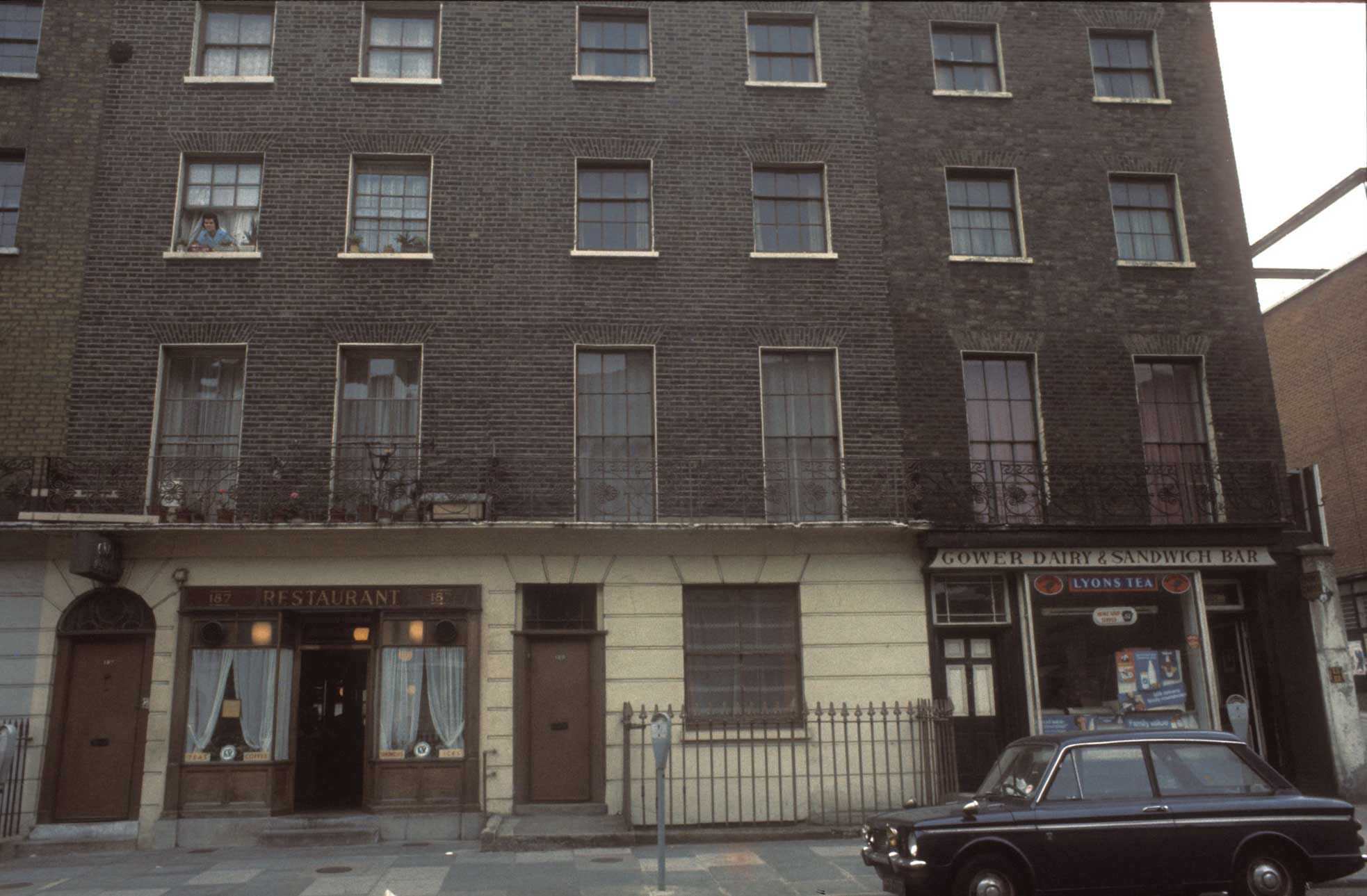
At the end of day one we had turned £2 into £4, doubling our capital! We carried on selling discarded vegetables for a couple of months then bought two bags of flour from Community Foods, bagged it up and sold it on. We weren’t competing with them as they were wholesalers and we were retailers.
There was an old gas oven in the dairy and I started making bread – about 15 loaves a day. We slowly turned the dairy into a wholefoods shop. We had no overheads and hardly any living costs.
We tried to open a bank account but the bank refused us (Nat West Tottenham Court Road, I think). After 6 months they relented and allowed us to open an account. We were evicted from the dairy as they were going to renovate it so we set up a shop in the ground floor of number 20 Tolmers Square.
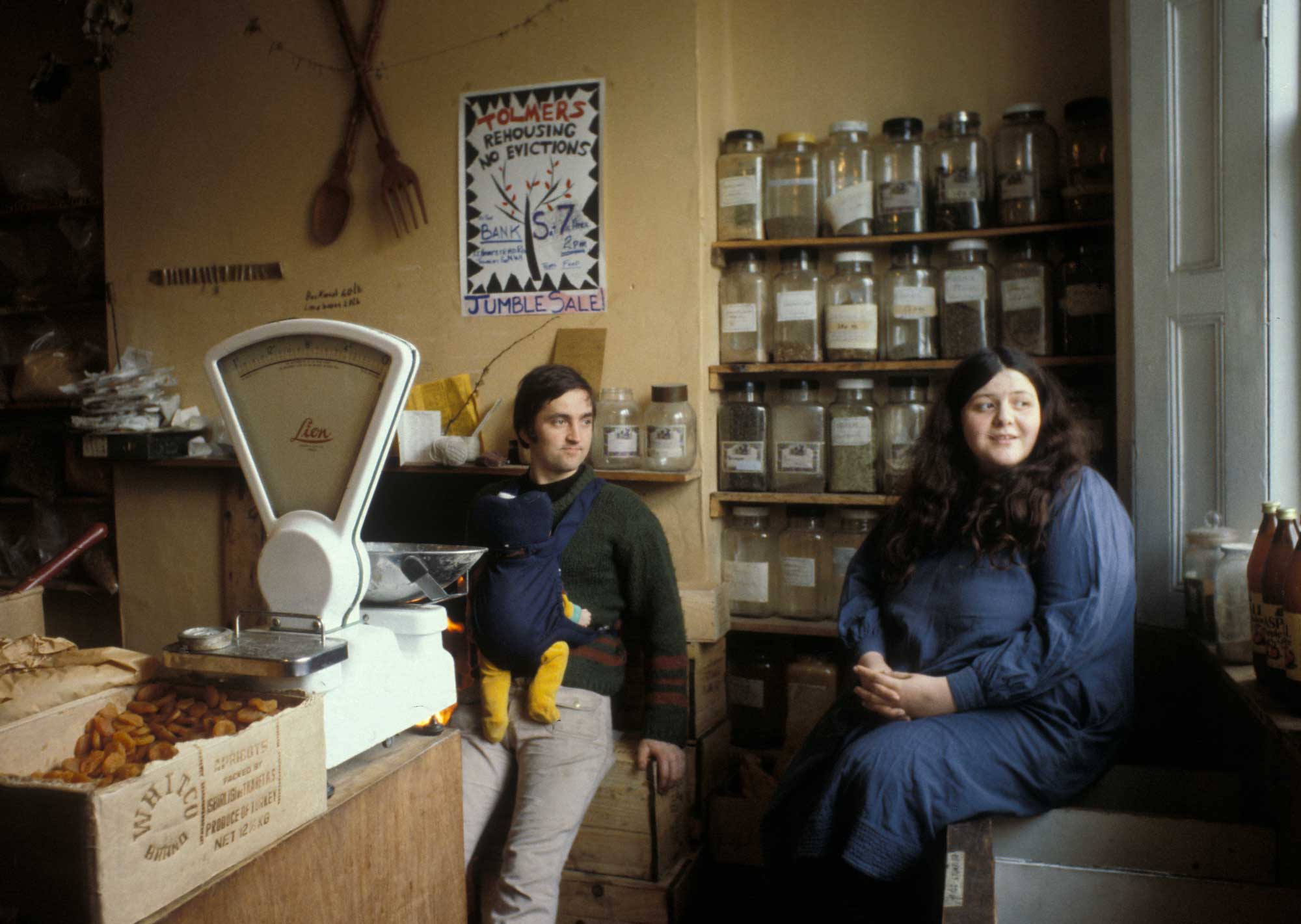
The business was now taking shape. We had a proper shop with scales and stock. We started selling muesli in bulk, mixing it up in a 500 gallon storage tank, then bagging it in 25kg sacks. We sold this to customers of Community Wholesale as they did not sell muesli.
John and Vera Wood had been squatting at 213 North Gower Street where they sold wholefoods and muesli and recycled materials. When they were evicted we inherited their muesli recipe. One of the recipes that my current business uses is based on that recipe.
We ran the shop in 20 Tolmers Square until we were evicted in 1979. We then moved to a little corner shop in Cromer Street behind Camden Town Hall which was vacant. We bought the tail end of the lease for £500. We were there for two or three years before moving to a bigger shop in Marchmont Street. We bought a muesli mixing machine and put it in the basement of the shop. The shop was called Alara (from Alex and Chiara).
We transported the muesli in bulk in the back of an old ambulance. We drove to Community Foods who had moved from Tolmers to Brent Cross, collected other bulk items from them and delivered them around North London.
I kept an interest in the Marchmont shop for 20 years until my divorce from Chiara in 1997. At this point we split our assets. Chiara got the shop then promptly sold it. It is still going as a wholefoods shop called Alara so our name lives on.
I kept the muesli mixing and wholesale business which was now operating from premises in Camley Street. Eventually I stopped wholesale sales and concentrated entirely on muesli.
My muesli business, the first manufacturer to make no added sugar muesli, now employs 55 people and has an annual turnover of £7 million. My staff include a technical team looking after quality, accounts, logistics, buying, sales, and production. We have 6 mixing machines and 600 recipes. All the machines work on gravity, aided by compressed air. There are no tubes or channels and this makes it easy to switch from one recipe to another which only takes 10 minutes. We sell muesli, porridge and ‘super‘ foods. We buy the ingredients from all over the world – Peru, the Middle East, China and the Ukraine.
We grow grapes in our vineyard next to our office and factory. The grapes go to a wine maker and we get wine in return, this year 20 bottles of rosé. Next year we hope for 40 bottles.
We have 6 volunteers who help look after the garden. There are 200 fruit trees – grapes, mulberry, pineapple, guava, figs, pomegranates, Chinese pears, apples.
Community Foods is still in existence in Essex. It was bought by a dairy coop, then sold to the management team. We still do some business with them.
What did Tolmers mean to me? Did it change my life?
I wouldn’t be the person I am today but for Tolmers. Tolmers gave me the ability to go out on a limb – I could get up in the morning, put on my white rabbit suit and lounge around in the sun. I could live without money for a year.
It was an extreme form of freedom giving me the chance to experiment with life. It gave me the opportunity to understand things and to grow and to do things.
I learned how to start and run a wholefoods and grain business using the free premises we had access to in Tolmers. This was the foundation of my successful business today.
Quite a lot of the things I used to do in Tolmers, I have managed to recreate here in my factory. For instance we used to have big fires in the Square. We now have big fires and parties in the yard at Camley Street.
If I was to make any analogy, Tolmers was was like a fire which burnt off my childhood more than anything else could have done. I feel almost like a phoenix arising from that fire, a rebirth through fire.
My previous life was conventional with conventional aims. I was expected to qualify as a respectable architect, have a professional career, have 1.8 children and a good mortgage, be happy and comfortable ever after.
I have done this but in a different way. It hasn’t been all stress free but it has all worked out well. I feel very blessed with my life.
From Lisbon to Tolmers
As told to Patrick Allen in 2021
I come from Portugal and was brought up in Lisbon. My father was an architect and I planned to follow the same career. In 1969 I came to London. This was partly to avoid being drafted into the Portuguese army and being sent to fight colonial wars in Angola and Mozambique on behalf of the state. I enrolled on a degree course at the Bartlett School of Architecture, University College, London.
I was on the same course in the same group and year as Nick Wates and Hugh Anderson. The three of us conceived the idea of arranging an event at the school of activities with visiting speakers. We spoke to our tutor Llewellyn-Davies, the head of school. He gave us the go-ahead. We called it ‘Xses Week’ (see programme). It was open to anyone and there were many debates. A guy called Andy Milburn took part, a self-styled anarchist who lived in North Gower Street nearby. He was sharing a rented flat, but spread the word around that there were many houses empty in the area which could be squatted. I had heard about squatters in the press, but had never been in close contact with the movement.
Nick and I talked this over with other friends on the course – Barry, Doug and Caroline. We decided that after we graduated we would take one of the empty houses in Tolmers Square. We fixed a date to go in. We went with some tools to number 12 Tolmers Square. Two people, Barry and Nick, went round the back to gain entry through the basement window and then once inside they opened the front door for Doug and myself.
On our first night we cleaned the first floor room very well, made tea and settled in. The house had electricity and water which we connected around the house. I was familiar with Tolmers Square because I had often been to the cinema there. I recall seeing the film Once upon a time in the West directed by Sergio Leone starring Claudia Cardinale. The cinema closed shortly afterwards, in 1972, which was a great shame. I liked to go to the cinema on my way home from the Bartlett school.

I quickly moved my things into the house with help from Nick who had an open top Morris 1000. We gathered items of furniture, buying some from Simmonds, the second hand furniture shop in North Gower Street a few yards away. Others moved in. The initial household was me, Nick, Doug, Barry and myself but we were soon joined by Caroline and Atalia.
I took the ground floor front room. We removed the breeze blocks from the window. I decorated the room in egg yolk yellow with Chairman Mao and Portuguese posters on the walls. My girlfriend Christine Rieger moved in with me. We had met at the French Lycée in Lisbon, and in August 1972 she joined me in London.
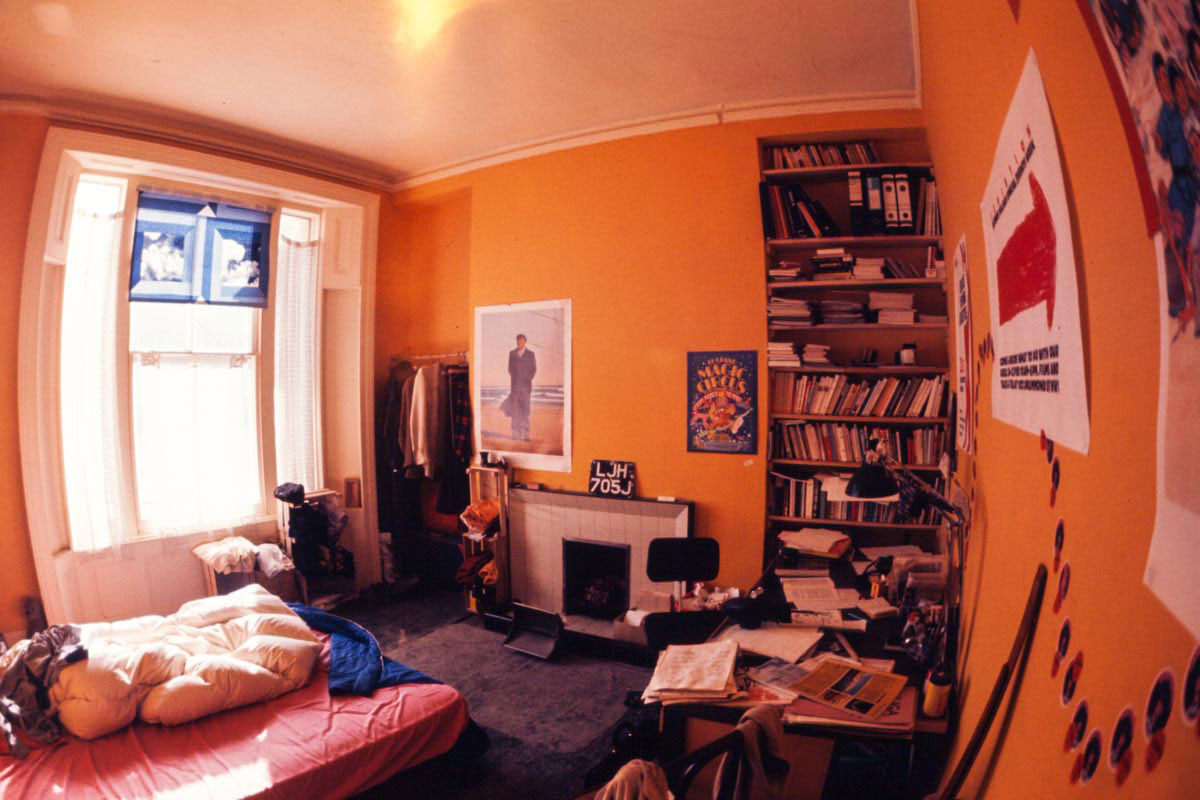

I maintained a keen interest in Portuguese and Spanish politics. The Portuguese revolution swept aside the fascist regime on 25th April 1974 thus ending my concerns about the draft, and in November 1975 the dictator of Spain, Franco, died. In his last days I remember organising a sweepstake, the prize going to the person who most closely predicted the date and time of his death.

In 1975 there was a change in the house – Jamie, Sacha and Cora moved in, and at the same time Barry and Atalia moved out to number 6 Tolmers Square. Jamie made his room in the basement, and I would have frequent talks with him about politics as we agreed about many things. Then my new girlfriend Sonia, from Brazil, moved in.
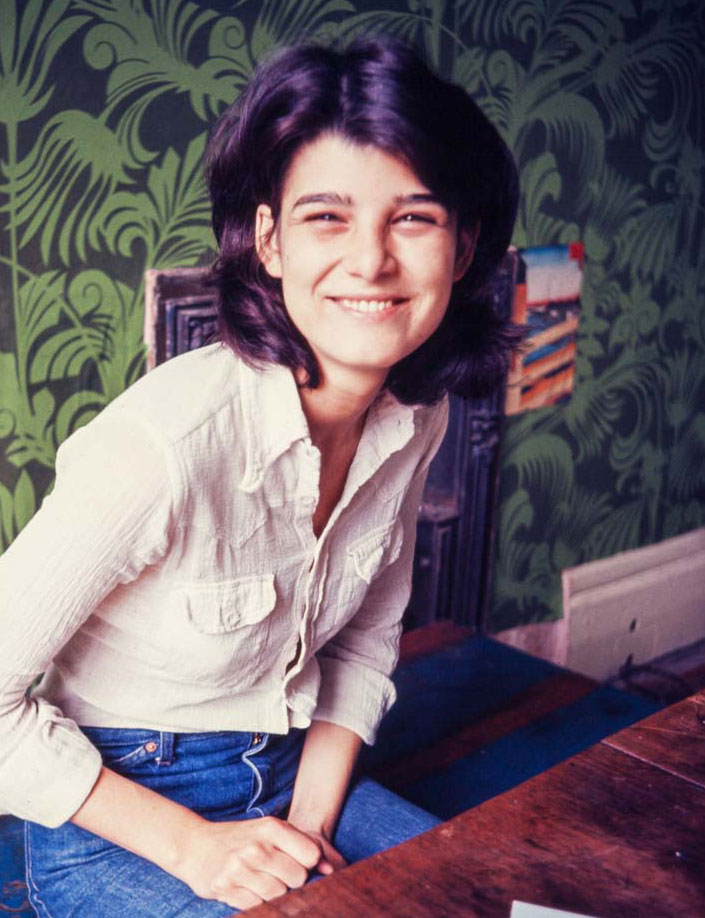
Everybody fitted in well with the new arrangements. The house specialised in producing big communal meals, everyone taking a turn to cook. Sonia and I produced the classic Brazilian dish, Feijoada – pork and beans. For this you boil the black beans, roast the pork with onions using all the cheap cuts like the head, ears, trotters and belly, combine with the beans, macerate some of it so it is thick then serve with white rice, fried manioc mixed with bacon, thinly shredded cabbage greens fried with garlic and onion and slices of orange. This took all day to cook of course.
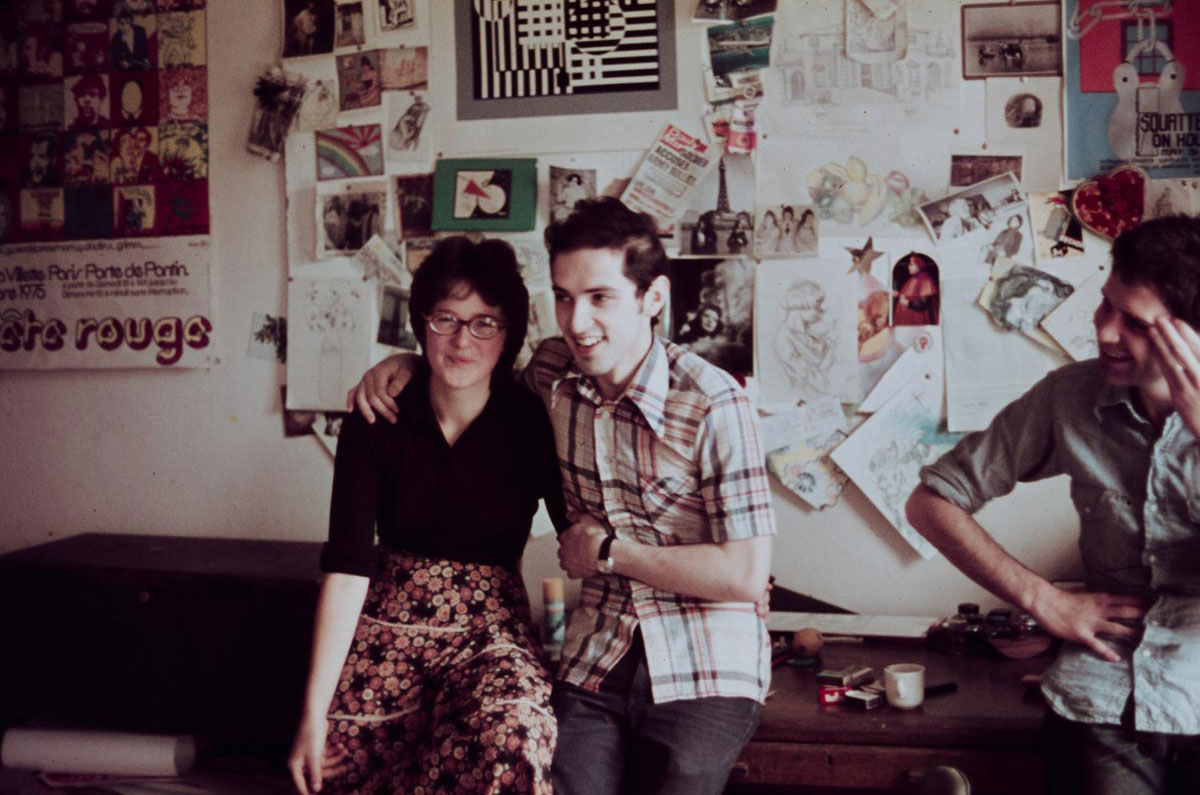
In September 1976 Sonia and I left 12 Tolmers Square to travel to South America. The photographs on the steps of number 12 were taken on the day of our departure. We left when the house was still in full swing. I kept in touch, and Nick would send me news and photographs.
We spent four years in South America, initially staying with Sonia‘s family and then in an apartment. I was a researcher for the state of São Paulo doing research into urban questions of policy. Then we returned to Lisbon where I practice and teach architecture and planning, but I have been back many times to London since. I have kept in touch with my Tolmers friends and seen the rather disappointing new Tolmers development which did not keep the square…. Even so it is a hundred times better than it would have been in the hands of Joe Levy.
What was special about living in Tolmers Square:
Firstly it changed my view in my professional sector of architecture and planning. Tolmers made me realise that people are important in planning, you have to involve communities in decisions. If you fight a good fight, collectively, people can change their environment (to a certain extent). This revolutionised my way of thinking about the profession of urban planner/designer, which I had by then adopted.
Next it revolutionised the way that I related to people. This started with my move to England as I had had a traditional upbringing in Portugal. The communal house in Tolmers Square helped me to develop a much healthier relationship with men and women. I am quite sure that I would not think as I do now if I it had not been for Tolmers.
Also, it changed my attitude to property, that you didn’t necessarily have to be the owner. The use of the property was more important than ownership.
Some changes happened almost without me noticing, like absorbing the British pragmatic spirit of doing things. We started a newspaper, Tolmers News. I still have copies and show them to my students. We had to do the writing, get the paper and do the offset printing. It got done and it was important to realise that you could do these things, a fantastic feeling. I had a go at the electricity in the house and on one occasion I crossed two wires together, there was a huge flash, and I was nearly killed – but I survived, and I learned something from this! Yes, that you must be careful with electricity, but, most of all, that you can do things with your hands and tools, something that was absent in the education of a French culture semi-aristocratic upper-class intellectual…! Manual and practical things were to be left to servants…
My life was affected in the way that I thought about many things, and it happened via practice not theory. I became a completely different person from what I had been. Things happened, and surreptitiously induced change. The British people didn’t need to change so much perhaps. I made long-lasting and deep friendships in Tolmers. I arrived at the Bartlett school in 1970 but for the first two years I did not have deep friendships, just hello, how are you. Then Nick Wates invited me to join his family for Christmas in Cumbria when he realized I could not go back to Portugal. At Tolmers I was lucky to be able to “break the ice” and form close relationships with many British people who lived in the house and the square.
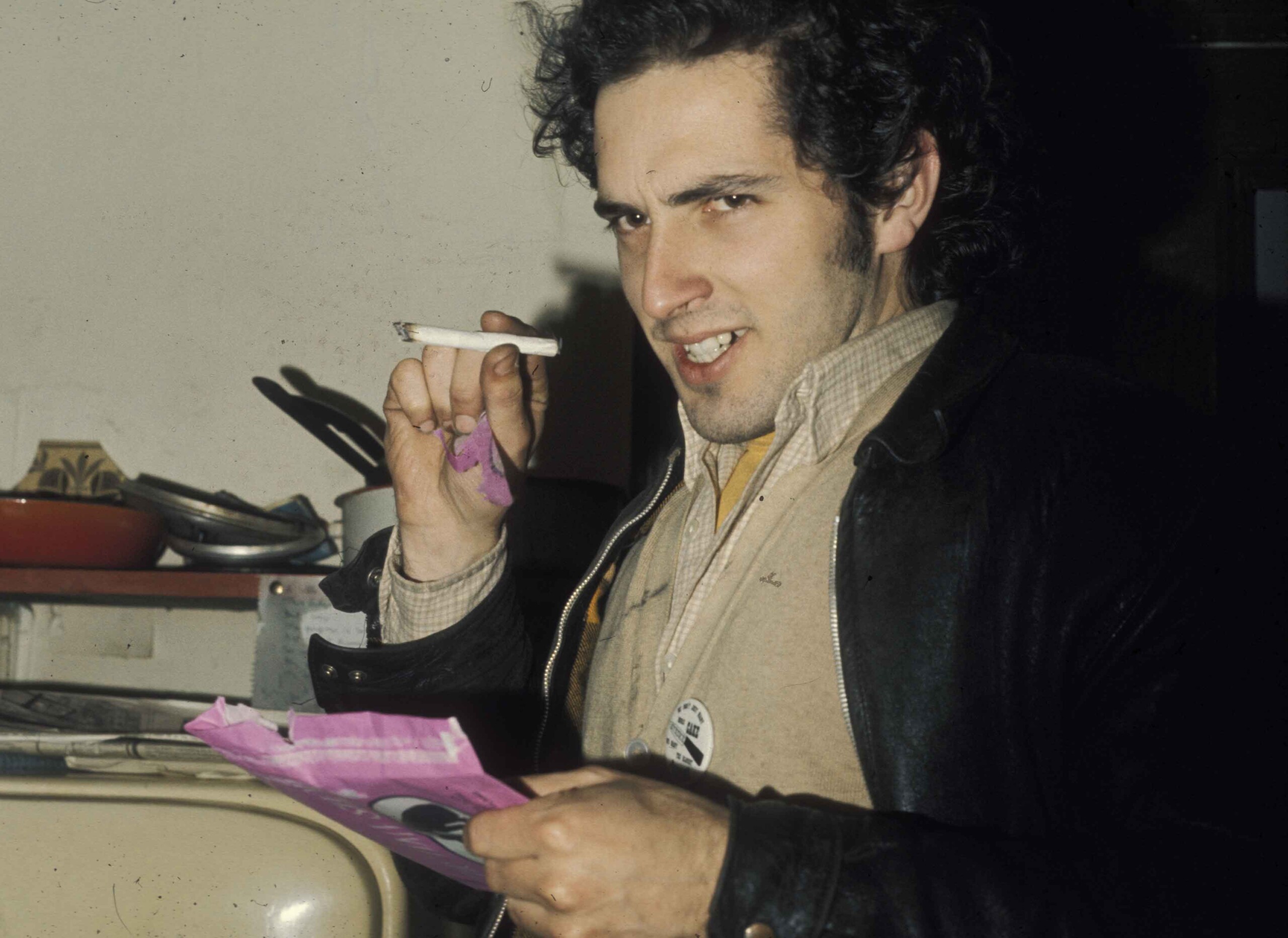
I would not have become the person I am without my experience of Tolmers. It had an enormous influence on my development and my view of the world, and of people and relationships and, indeed, sex. Nowadays, my wife sometimes says to me ‘you’re not a squatter any more’, but I still act like one, on occasions… and that is good.
PS Pedro retained an archive of 500 colour slides of Tolmers which he digitised and made available to this website in March 2021.
The best thing I ever did
As told to Patrick Allen in 2021
In 1973 I was studying architecture at the Bartlett School, University College London (UCL). Barry Shaw and Nick Wates were friends on the same course. When I went back to UCL for my postgraduate course, I had nowhere to live, so I was ‘camping’ with Barry in his friend’s flat in Islington. Then Nick Wates and Pedro George contacted us also looking for somewhere to live. They suggested that we move into an empty house in Tolmers Square. Nick and Pedro had done a project on Tolmers Square, so they were aware that many houses were empty and derelict pending a commercial redevelopment.
Nick knew we would have to occupy the house as squatters, and we all agreed. We needed somewhere to live, and there were empty houses sitting (and rotting) in Tolmers Square. We identified number 12 as the best choice and decided to move in. The four of us went along one Saturday morning. Barry and Nick were going to go in from round the back and Pedro and I would stay outside, with some mattresses and chairs in a van, keeping watch. We changed the lock to make the house secure, moved in the mattresses and chairs, and that was it. The whole thing probably took ten minutes. We stayed the night, and next day set about cleaning and making the house more habitable.

Number 12 was the first squat in Tolmers Square. A few of the houses were still tenanted, but Joe Levy’s company, Stock Conversion, had deliberately let the houses get into an extremely poor condition in order to force the tenants to move out. Once all the houses were empty he would have a clear path to demolition and redevelopment.
The house was damp and stank of cats, the ground floor window was bricked up and there was water but no plumbing. For the first few weeks we just had a cold tap on the end of a hosepipe.
We got the London Electricity Board to switch on our supply. In those days they had a statutory duty to supply to anybody. The wiring hadn’t been ripped out so we were able to adapt it and make it work.
We had an old WC, but no bathroom so I went to the public baths at the Oasis, near Shaftesbury Avenue. This was a fantastic set up. You would go into a cubicle with a big tub then somebody from the outside would fill it up with hot water. It was so deep you could almost swim in it.
Later, Ches constructed a shower in number 12. It was never a great success because it was in a space at the bottom of the stairs, very draughty, dark, with a very claggy curtain, and people walking around all the time. It wasn’t very nice, but at least it worked. It was a cheap way of improvising a shower, with a second-hand Sadia, a shower tray and curtain. We became quite good at reclaiming and re-using discarded furniture and fixtures.
I took the second floor at number 12, and removed the lath and plaster from the dividing wall to join the two rooms together. One room had an enormous reclaimed desk for working and a sofa, and the other room had a mattress on the floor.
We set up a kitchen and dining room on the first floor. It took a few months to get the house straight. In time, number 12 became quite habitable… the kitchen was always a bit Heath Robinson but it functioned.
The first occupants were me, Nick, Barry and Pedro, all architecture students in our fourth year at the Bartlett except Nick who had decided not to continue with the course and was working as the coordinator for the Tolmers Village Association.
To fight the redevelopment, Nick wanted to develop a sense of community and a collective voice in opposition to the development. He headed the publicity campaigns and formed a community association encompassing the ‘legitimate’ tenants and businesses in the area. We all supported this and joined in.
Tolmers Square was getting noticed, and quite soon people would come to us saying “we’ve heard about you, we can’t find anywhere to live, and would like to join you and be part of the squatting movement” and they would often ask where they should go, because obviously we knew the lay of the land.
After a few months, a good number of houses in Tolmers Square and Drummond Street were occupied, and we set up the community office there. We got on very well with the local Indian shopkeepers and restaurateurs. They joined up with us because they were also worried about being thrown out by the redevelopment, so they had an interest in being part of the movement. We held social events, and were developing the sense of community that we had aimed for.
By July 1974, only about nine months after we moved in, things seemed to be quite well-organised socially and as a community and our campaign was getting noticed nationally. In fact one of the tabloids made an attack on the “Squatters Army” with a photographs of number 12 (and me) on the front page. The article was total nonsense, of course, and missed the whole point of our campaign.
There was some reshuffling as houses became full. People opened up another house, often next door, or moved in to another house. Each house seemed to develop its own distinct character. There was the one across the square where all the heavy politicos lived. We were less ideological and more practical than than they were. But we all got on well together.
In 1975, the Drummond Street houses came to an end because they were earmarked for early redevelopment. There was a changeover where Sacha, Corinne and Jamie moved into 12 Tolmers Square. Nick and Caroline went off travelling in America, and Barry moved out to number 6.

The change of people brought a change of culture to Number 12, most noticeably focussed on very social dinners, with the whole house and visitors sitting down together most evenings to a well-prepared meal. Every one took turns to cook, and it became a bit competitive. We continued our house improvements and put up smart wallpaper in the living room. As more people moved into the area, the social, the political and the community side of it flourished, with events like carnivals and large banquets.

The people across the square were in contact with a number of the leaders of the anti-Communist Party regime in Czechoslvakia, who were organising the resistance from London. They came to me and asked whether I would be interested in taking a free ‘holiday’ in Czechoslovakia, and while I was there, I could do a few little errands for them. We had a camper van, with hidden compartments and went first to Vienna where we changed number plates, then went into Czechoslovakia through a classic No Mans Land with barbed wire and watch towers in a forest clearing. Once in Prague, we dropped documents off and picked documents up according to a pre-determined schedule. And we enjoyed some of the excellent pilsner.
I remember standing under St Wenceslas’ Cathedral clock and waiting for it to ring twice on midday and move away, all that sort of stuff. It was just like in the films, and hardly feels real anymore. We were not told much about the mission in case we were caught and questioned. If we had been caught, we thought we might have been held and thrown out of the country. Luckily, that didn’t happen.
We were in Prague for about four days, and left after all the drops and pick-ups were done. Much later, in 1989 when the Communist Party regime eventually collapsed, the director of the operation in London became Foreign Minister, I think. So perhaps it helped achieve something.
One of the important things about squatting is that you take direct action, focussing on the potential gains without fear of the consequences, perhaps even recklessly at times. I was young and and felt invulnerable, and if I hadn’t been like that, I probably wouldn’t have gone squatting in the first place.
In 1975, Barry Shaw and I finished our studies and went to work at Camden Council architects department. Then in 1976, as I was no longer a student and was earning a salary I moved out of number 12 into a flat I had bought in Delancey Street, Camden Town. But I kept in touch, and number 12 was still the centre of my social life. We went on trips together, most notably to Italy, had lavish picnics on Hampstead Heath in the hot summer of 1976, and many parties. I still felt part of the set-up, the institution. Even now my best, closest friends are from that time, no doubt about it.
What made it special was the sense of purpose, and I think that was important. We all needed somewhere to live, but it wasn’t just a bunch of people doing it for themselves. We all passionately believed that demolishing low-cost housing in central London for yet another anonymous office block was morally wrong and possibly economically suspect. We wanted to make it a political issue, sought publicity and appealed to Camden Council. Our local council leader, Frank Dobson, supported us and eventually, the campaign was successful. Camden Council bought the land, the squatters left and the council built the housing that is there now.
The mixing of very different people in those circumstances was also enjoyable, and worked remarkably well. I don’t think we had too many clashes of personality. There were many different characters, but we all got on very well because of a common interest and the common enemy – Stock Conversion – and the threat of being thrown out. We all had a personal interest, and having a campaign solidified the group. That was an unbeatable combination.
There was room to be yourself too. One of the squatters, Alex decided to give up money. He burned a five pound note and declared that he was going to live on no money for a year. That’s kind of eccentric but also very entrepreneurial – he found that you could go down to Covent Garden, which was still a vegetable market, and get all the left over vegetables. They were perfectly edible, and he would give them away in return for meals.
Squatting was a kind of entrepreneurial act as well. There was a need and there was a place to go, we put the two together and made it happen. I think that’s the other side of it, we were all used to making things happen. We didn’t sit there and wait for somebody to do it for us, we went in and did it. That has stayed with me ever since. I like to be positive, and tend to say ‘yes’ to things, even if there are risks.
Looking back it was one of the best things I ever did. It was definitely one of the most developmental phases of my life experiences. I enjoyed it, and it formed me, and formed my relationships with many people. There are still a number of good friends from that time who I feel very, very comfortable with even after living abroad for over 30 years. I always enjoy seeing them when I go to London and feel that deep down we are still the same people as when we were squatting in Tolmers Square.
Singsongs, meals and Marxism
In September 1973 I was intending to move to London from Oxford where I had lived for the previous six years. I was hugely excited to start living in the metropolis – an ambition since I was a child. I was looking for a house to share with my friends – Corinne Pearlman, Sacha Craddock and Rod Smith. We were all moving to London for different reasons. It was hard to find an affordable house for four people to rent in London. I would go down to the Evening Standard offices at 6am to get the paper fresh off the press to find the adverts for rented housing, then I would run to the phone box and ring the number of possible houses. Invariably they had gone. Meanwhile, I was living with my boyfriend Richard Krupp, in Maida Vale.
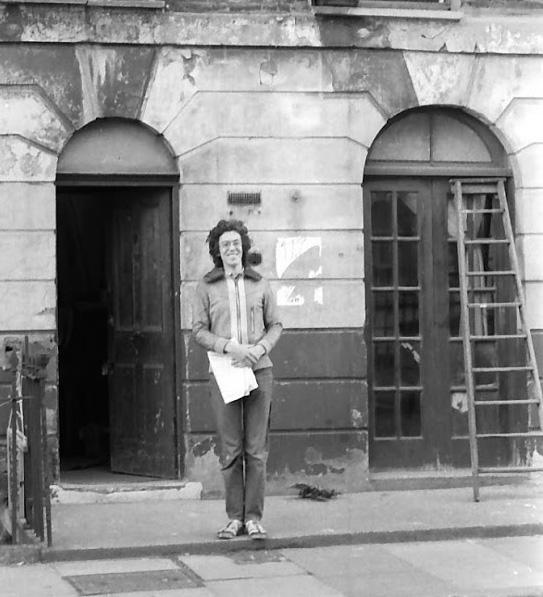
The reason for coming to London was to do a master’s degree in Town Planning at University College London (UCL). At UCL I met an architecture student, Nick Wates, who came to a session of my course to talk about Tolmers Square where he and some others were squatting. This was a short distance from University College, just over the Euston Road. He gave an account of what was going on there, the property speculation that was happening, how lots of houses were empty and that many people had already started squatting them. I was intrigued. At that moment I hadn’t even heard of squatting or thought of it as something I might do.
Shortly afterwards I went to Tolmers Square with Nick. He gave me a tour. We walked down Drummond Street and he pointed to 117 and 119, two adjacent houses next to the Diwana Restaurant. He said “those two houses are still empty, nobody has squatted them, why don’t you come and live there?” I can still remember that moment. I was absolutely amazed. I just thought “this is a Georgian house in the West End of London, and I can live there?”. It had corrugated iron on the front, but the front door was swinging on its hinges and you could walk in, because homeless people had sometimes used it. So, I got on the phone to Corinne, Sacha and Rod. They came round and had a look and we decided to give it a go.
On the moving in day, Sacha’s father John Craddock, drove to London from Oxford. He had a crowbar and he quickly demolished the hoarding in front. So in we went. We subsequently learned that the house had been empty for at least 20 years. We started to clean it out. John Craddock gave us some coal so we made fires in the lovely grate. Actually the coal was coking coal so it didn’t really burn but just smouldered.
On the first night we slept in the downstairs room which we had cleaned up – me, Sacha and Sacha’s mother Sally. The next day we climbed out of a window into the back yard which was 2 metres deep in junk. From there we could view the back of the house. The gutter had been leaking and the water running down the back wall. It was bulging out and looked about to collapse. So we did a shuffle into the next door house, 117, whose back wall looked better. This meant abandoning all the cleaning up that we had done in 119 (much to the advantage of Patrick Allen who moved into 119 not long after! He wasn’t bothered about the wall.)
So, the four of us started moving into our house and doing it up. No water, no electricity, no gas. The plumbing had been pinched, but there was a gas cooker on the first floor. But in those days, the utilities were willing to connect squatters. I knew about electricity so I wired up the house; it took me three days work because I absurdly did it to building regs standard. We believed there was no water for these houses, but the resourceful Barry Brookshaw, who was now living in 119 pulled up the plate in front of 117 and found a perfectly respectable Water Board stopcock. He used a large spanner to turn it on – a moment of rejoicing. He connected some plastic pipe into 119, and connected their toilet and kitchen sink to the water, then kindly brought plastic pipe across the back wall into our kitchen in the first floor back room.
The Tolmers Village Association had set itself up in a house immediately opposite across Drummond Street which happily had a bathroom with a bath in it, to which hot water was connected. So we were able to cross the road and have a bath. We subsequently cleaned out the back yard and found the toilet there in working order.

Jeyant Patel, the owner of the famous Diwana Bhel Poori House next door, was a tremendous support in our early time in Drummond Street. The moment we appeared Jeyant came out and said “Ah this is wonderful, I support what you’re doing, it’s great that you’re squatting these houses. I am a Ghandian, I believe that property is there to be used, not there to make money”. He added “well, you don’t have anywhere to eat, so you must just come in and eat whenever you want”, which we did. Sometimes three meals a day, breakfast, lunch and dinner in the Diwana, fabulous food which he gave to us. He also allowed us to use the customer toilet in his front area. The only problem was that the toilet was plagued with the biggest slugs the world has ever known. I don’t know how we would have survived without Jeyant. Very sadly, he died young of a heart attack a few years later.

We put up some smart wallpaper in our living room from Habitat, a trellis-like design. It was the most beautiful Georgian room. All the woodwork had been painted dark green, which we kept. The two windows had shutters that went back into the wall between the two windows. The rest of the decoration in the house was a bit more approximate – a lot of white emulsion as I remember it. I had a piano in that draughty hall. I think we got it with other furniture from Simmonds, the second-hand furniture place which very conveniently was located round the corner in North Gower Street (now Patrick’s law office).
We had a problem with the roof. All the houses had shallow slate roofs which go into a gutter running from front to back, and the gutter leaked. Cora and I had our bedrooms at the top of the house underneath this roof, and we had buckets ready when it rained. We kept going up onto the roof putting more bitumen onto the gutter, but to zero effect.
The first three months after we moved in I largely spent doing up the house – a very bad start to my studies. Although it felt good to be restoring a beautiful house, it was also a chore. Once we had converted the basement by putting pallets on the mud floor, other people came to live with us, including my brother Orlando and his partner Celia.
A great thing about living in Drummond Street was getting to know people from the Bangladeshi community. I became close friends with a young man; he liked to hug and kiss me, and said that I was his boyfriend, though he didn’t present himself as gay in the sense that I was. To put it in academic terms, we had different socially-constructed sexual identities. In normal language, it was just lovely.
Eighteen months after we moved in, I was in bed late in the morning and I woke to find two guys in suits and ties with clip boards standing in my bedroom on the top floor. I said “Who are you?” and they said “Who are you? We are from London Transport, we own this house, you can’t live here”. That was very interesting because we had no idea who owned it. We had been there all this that time and had heard nothing from any landlord. I said, “we’re squatting here, and we’re going to stay.” I didn’t give them our names, to make it harder for them to get an eviction order. They slunk off.
It transpired that London Transport bought those houses when they were building the Victoria Line in the 1960s. We always heard the Victoria Line rumbling under the house. They bought these houses in Drummond Street as a job lot, and because they didn’t need them, they just left them empty to fall down and didn’t do any repairs.
After six months or so they did get round to evicting us, at which point Sacha and Cora and I moved to 12 Tolmers Square where Nick and a big household were already living. We were in there for four years before the final evictions in 1979.
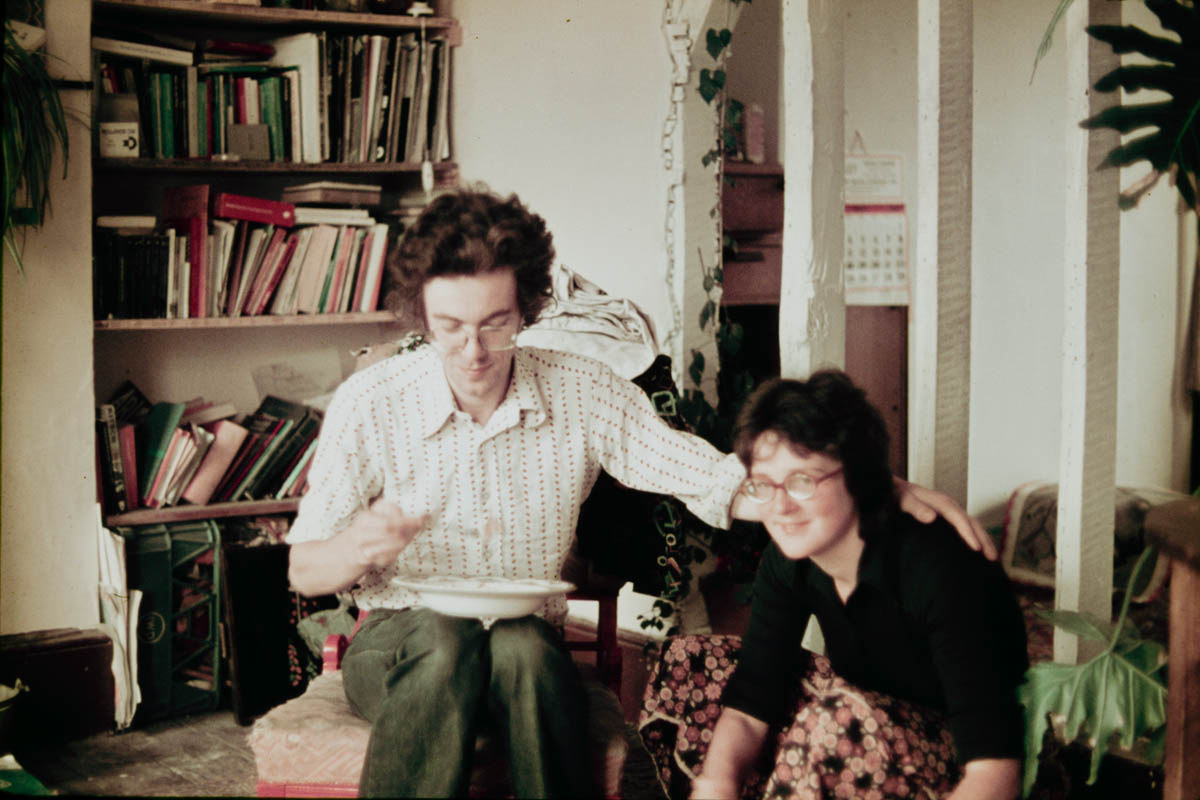
I moved the piano from Drummond Street to Tolmers Square and installed it on the first floor in our huge living room, where we had many sing-songs. We would have dinner together, all ten of us or however many were in the house, plus visitors; we had an informal rota for cooking. Then as often as not I would get out the Cole Porter and My Fair Lady songs. That was a lovely aspect of life which I really miss now.
In number 12, there was a green dragon wallpaper from Colefax and Fowler, really dramatic, which made the room look sensational. In 1979 I moved from the basement of number 12 to the first-floor front room next door at 11 when Patrick moved out. I did a home-made version of the dragon wallpaper, using green paint and a mop, Jackson Pollock style, great green splashes going across the walls. Communication with number 12 was via the crumbling balcony – scary when I think of it now!
The last year I lived in Oxford, a Gay Liberation Front group started. I became involved in it, and I came out as gay through the wonderful solidarity of that group. When I came to London I asked around, and the most active Gay Liberation Front group in London was in Brixton, so I joined it. For the next 20 years, my main political thing was the gay movement.
The 1970s were a period of enormous political conflicts: not only trade union struggles such as the 1973 miners’ strike but also the women’s and gay movements, and struggles over housing and public services. Initially through my studies at UCL, I was introduced to Marxism. Its first appeal to me was that it had a deeper analysis of homophobia and sexual identities than the ideas then current in the gay movement.
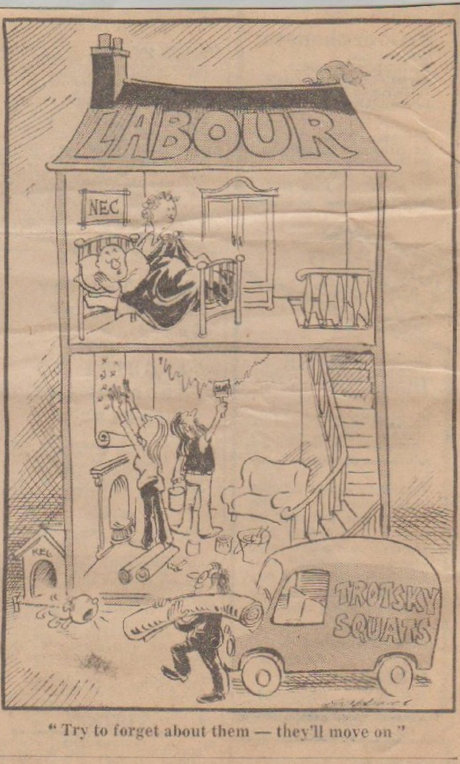
There were a lot of Marxist activists and intellectuals squatting in the Tolmers triangle, including across the square at number 14.
Sacha and I started going to local Marxist meetings. We were a bit overwhelmed at first, as there were people who had read the whole of Marx, Lenin and Trotsky. There were amazing discussions about capitalist history and the current situation in Britain. It was a great education. I became a Marxist writer, and over the next 50 years worked as a researcher and social science lecturer.
When we were evicted, Sacha, Cora, Dave Taylor and I wanted to continue living together. Sacha was insistent that we should stay in the West End and not move to the ‘suburbs’, meaning Hackney or Bethnal Green. This seemed utopian, until Dave saw an ad in the Evening Standard for a house to let in Central London. So we ended up in a five storey Georgian house next to the British Museum. Sacha and Cora are still there.
What was the best thing for me about Tolmers? Living in a neighbourhood with so many forms of cooperation, social and political; I’ve never experienced that kind of community living since. And living in a large household, with its everyday easy sociability. For the last thirty years I have lived either alone or in a couple, and I have great nostalgia for those collective households.
Jamie Gough
March 2021
Tolmers united
First published in ‘Goodbye to London: radical art & politics in the 70s‘, edited by Astrid Proll, published by Hatje Cantze, 2010.
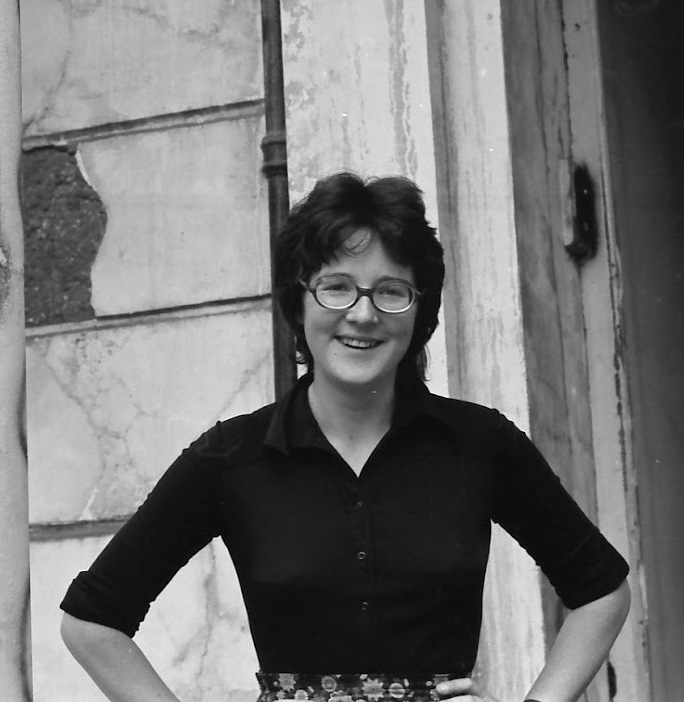
We broke into our house with a “jemmy” crowbar, but it was easy, as it had been used as a sort of doss house anyway. We never locked the door once we took possession, but left the door open in honour of the people that used to crash down there. My bedroom was on the ground floor. We had no water, at least we thought we had no water, until someone “discovered” it for us a few weeks later. We tried in the beginning to boil water brought in a pitcher over the road on sub standard coal dust in the grate.

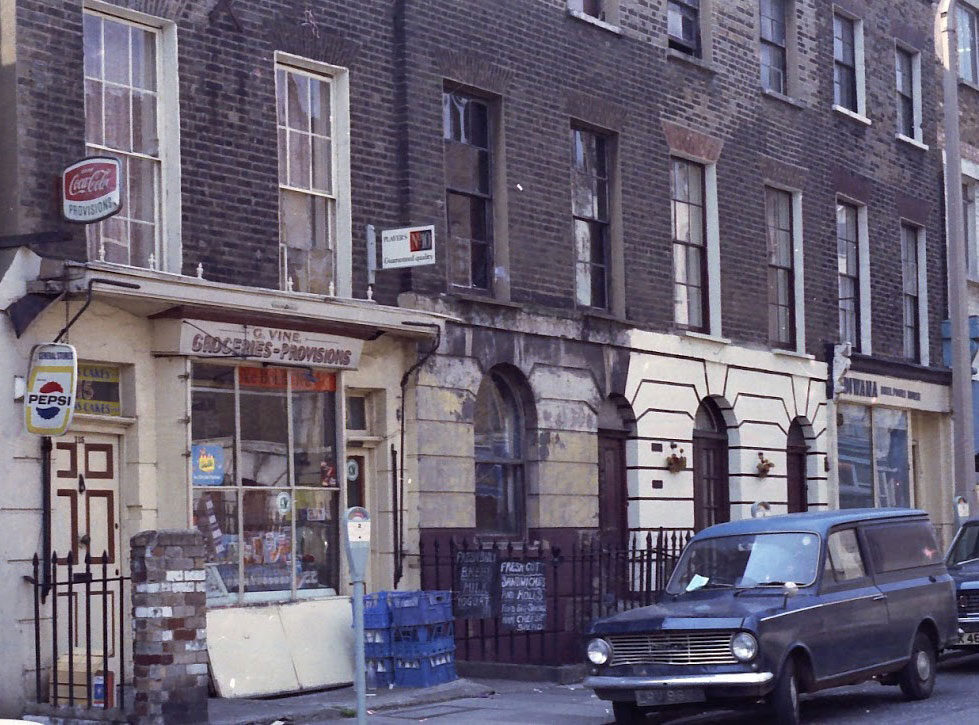
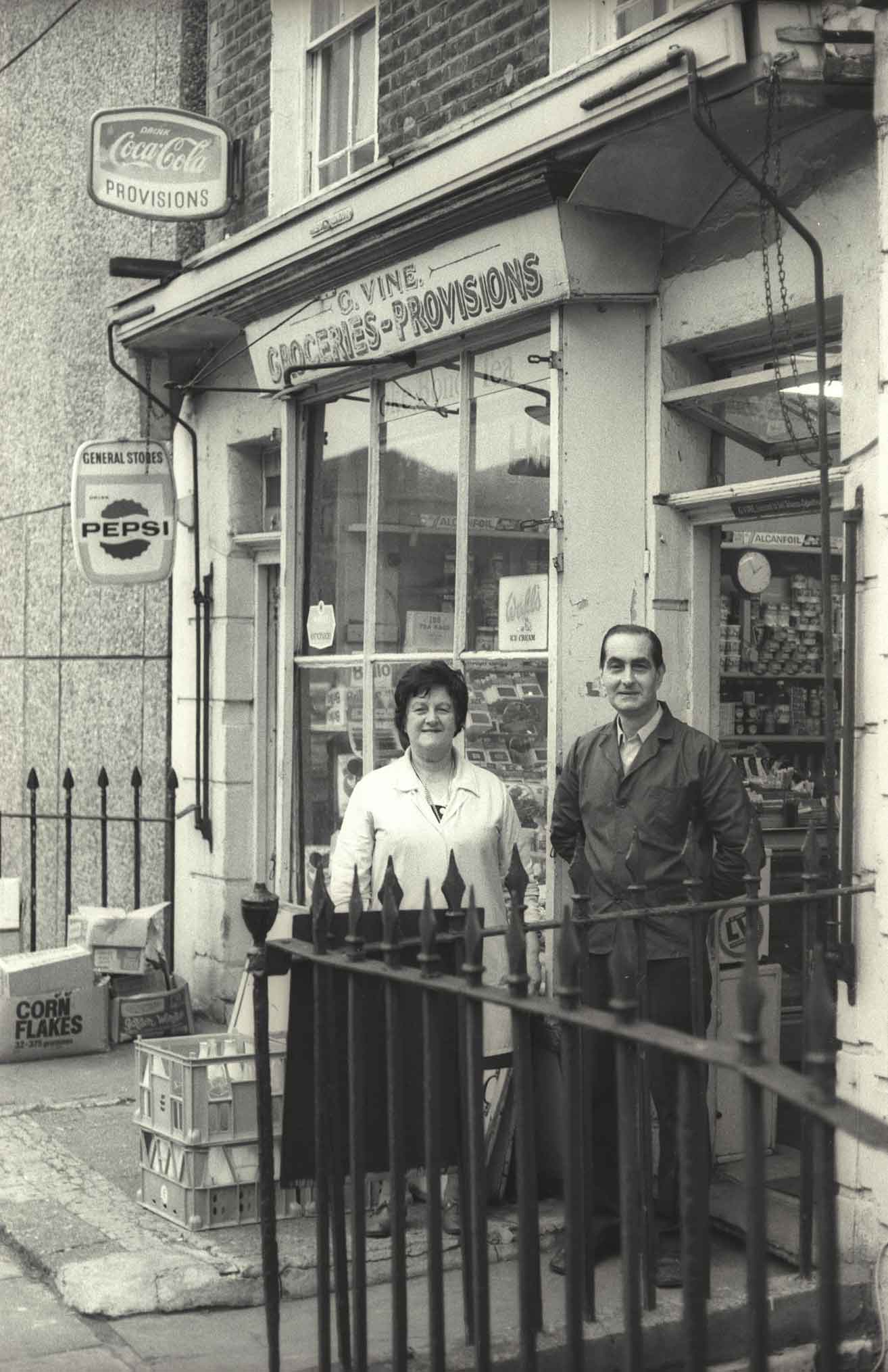
I had decided I wanted to move to London when very young in fact, just about to leave home. My friend Jamie Gough, whom I knew in Oxford, had a Ph.D. from Corpus Christi College while I had just done A levels at Oxford College of Further Education. Jamie had heard about people who had moved into buildings just north of the architecture school they were attending. Only a few had moved there then; we went to Drummond Street, a small street running between Euston Station and Hampstead Road and chose a house between Diwana, the first and only vegetarian Indian restaurant in London, and a small corner grocer’s shop called Vines. With Corinne Pearlman, an old friend of Jamie’s, we chose a house because it was pretty; most of the other squatters were around the corner in Tolmers Square.
We felt safe in our house almost immediately after gaining access. The fact that there was starting to be many of us in the area made us feel much more protected. The squats developed, opening up fast. Soon even North Gower Street seemed to have squatters; each road had its separate logic, its mini identity within the whole. While nobody mapped out the limits and edges to our community, we still knew exactly where it was, where it stopped; the space had its own natural triangle edged by main roads and station.
We were afraid of the police and we were not. At one level we were unrealistic and almost naive about the way the full force of the law could affect us. At another level we had experienced battles with the police at Troops Out demos, for instance. Much time was spent in anticipation of confrontation.
Other groups seemed more continually at battle. Tolmers felt safe for the most part. In a way we felt we had control over our patch, again somewhat naive, in retrospect. The Dawn Patrol was an early-warning system, run on strict rota, where almost all of us would take it in turns to scour the streets from very early in morning to look for bailiffs. But this only happened at very high points of expected and imminent peril and towards the end of our time there. All was somehow protected by our own organization, contained within our own sense of control.
We felt protected by the law of squatting; at least we were always reciting that particular part of the law. Once we had claimed occupancy, a very formal procedure would have to be carried out by the bailiffs in order to get us out. We knew our relationship to the court and the various stages we had to go through. All that changed in the early eighties. Also we were very young, on the whole without children, and the relation to permanence was not quite the same; in the beginning it was not the home it eventually became.
At Tolmers people arrived, friends of friends; it expanded through and by word of mouth. As explained, we had a sort of monopoly, at best naive, at worst natural and unruled. I really did tell the people who wanted to move into the house next door to us in Drummond Street that it was “already bagged”; schoolgirl slang for taken. There were no real rules, but a protective naturalness dominated. Be yourself, have faith in the moment. Much of this for me was to do with my extreme youth; I was seventeen when I moved in, so I grew up with the squat, gaining politics, knowledge, and organizational ability over seven years.
The groups: Trotskyists, Eastern European sophisticates, community types, architects, lawyers’ friends, trainee lawyers. But a real homeless person? There was help and advice but, as now, the face of homelessness is often hidden by practical dependence on friends and family. When are you officially homeless? When you have been evicted? But were you homeless before? When is the caring member of the family actually a carer? For us instead it was a way to be away from home, a place to think, to live, to organize, and to discuss; all in the very center of London. Of course it would be punitive, impossible, to pay rent and study in the same way, almost impossible to embark on a poorly paid beginning of an eventual career.
The first people in the band of squatters, the students at the Bartlett, were ambitious, idealistic, making real life part of their studies and the other way around. Then others, individuals, great friends, total strangers, would move in. Even control over who was to share a house would crumble. The two graduates from Oxford, for instance, who rightly ignored my claim to the house next door, moved in with a total stranger and we all soon became friends.
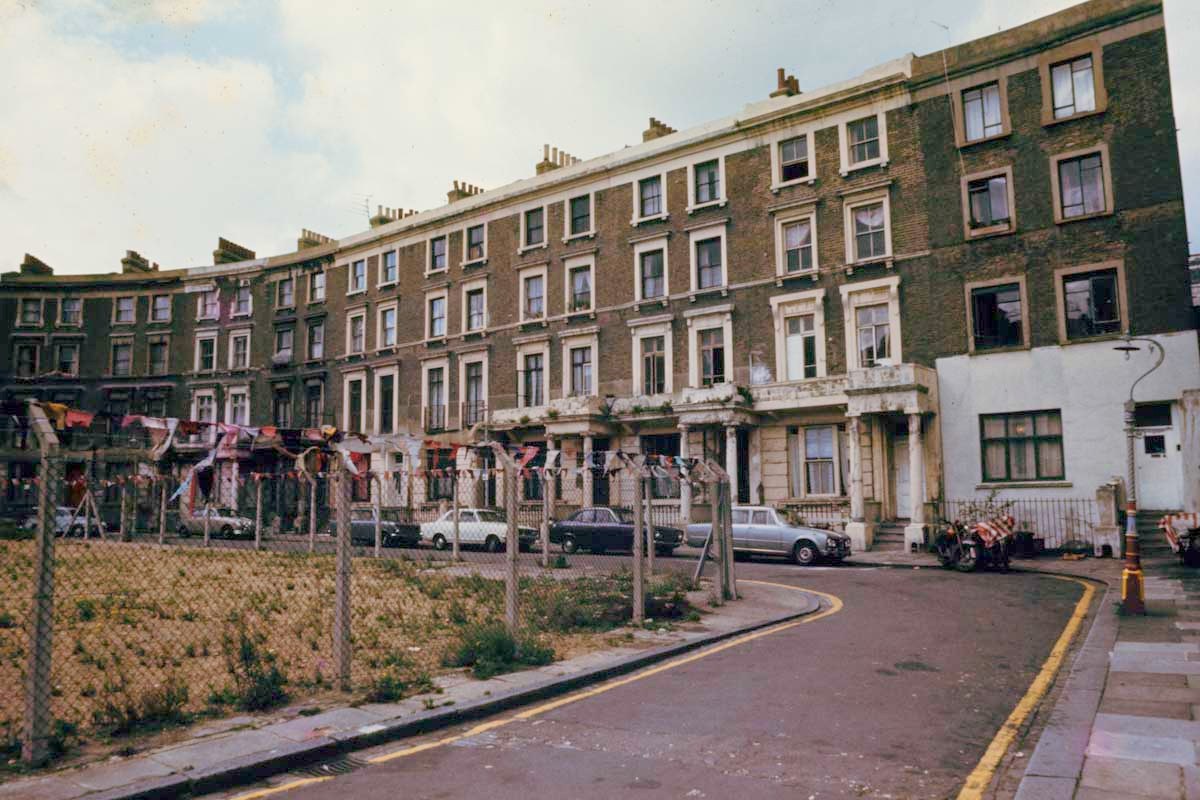
After a short time you got used to people’s fascinations, the different politics, which seemed so very intense at the time. Apparently minuscule differences between us could, and would, be acted out in life. We learnt the difference between theoretical positions, for real. Factions, splinters, nuances, differences, those who chose to enter the system by stealth against those who wanted to confront it directly. Being pushed to support the miners’ strike versus a campaign to stop the closure of the Women’s Hospital. Single issue versus total overview. Meetings, meetings, all the time – well, for some of us, for others just a hanging-out sense of difference, a lethargic, stoned, amorphousness. From communal type to local activist, from trainee solicitor with social democratic leaning to anarchist, it was a privilege to be in a playground where reality and belief could be tested and tried. Instead of virtual reality, it was reality, yet all with the air of a game about it.
The pleasure of living freely in a world within a world was palpable. The seventies seemed to be very much about differences, collecting together, allowing, encouraging, and tolerating. Different gangs, sexualities, different approaches to property and the state. These were liberal times both sexually and emotionally, but revolutionary times, we hoped, politically. The security this approach allowed made safe and cozy sense. Returning home was always a relief; Tolmers provided an alternative security within London.
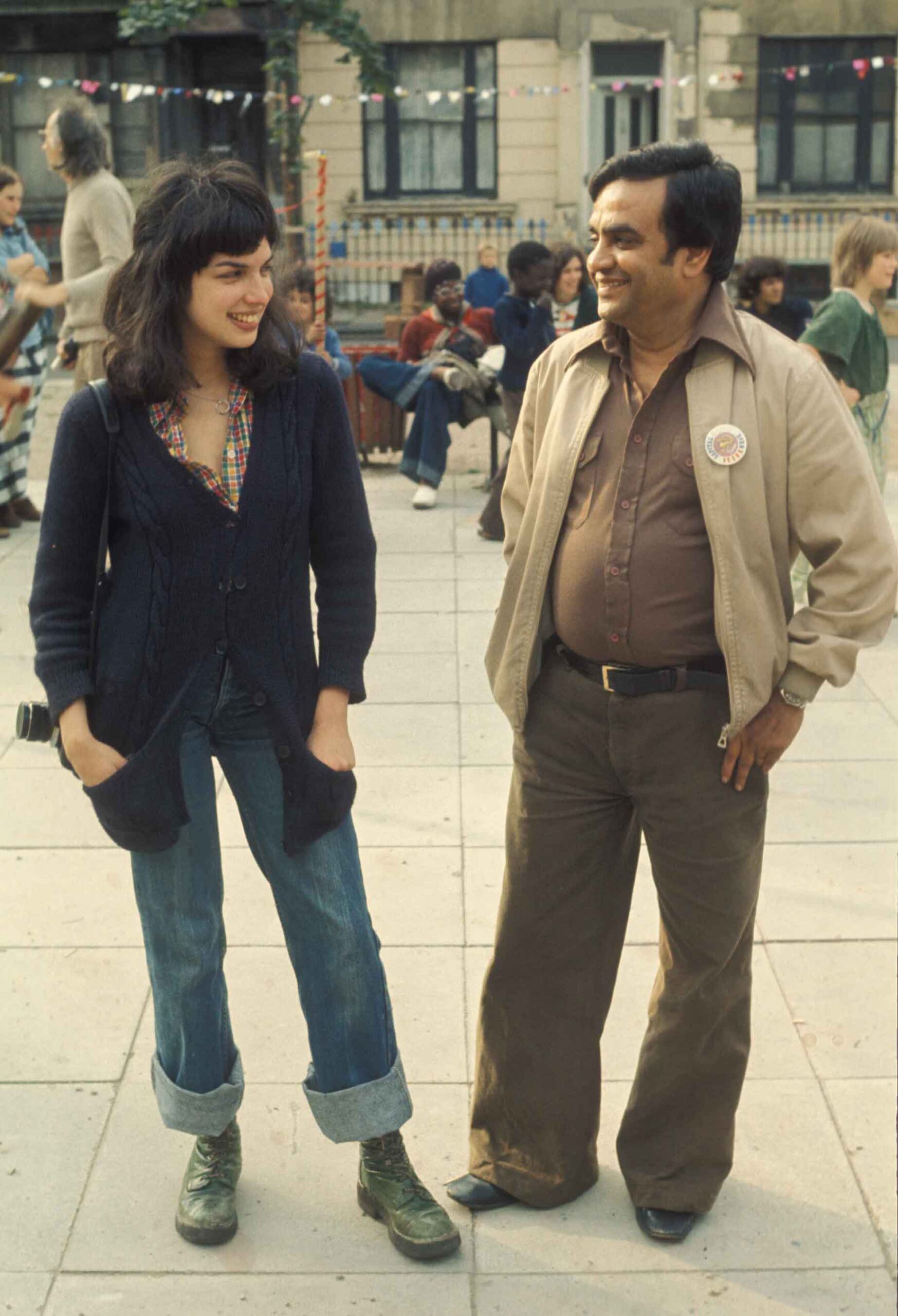
Squatting gave us the chance to study, work, think, and do nothing, without worrying about rent. This made such a difference, it created a great deal of time for work, repairs, political action, and festive celebration. How did we get to understand so much? There were negotiations with local councillors, people still politically active starting on their own political careers. The community of Tolmers broadly covered the strange, almost forgotten, triangle above Euston Road and between Euston Station and the Hampstead Road, Despite some building, it is still a quiet, separate comer, albeit in the middle of the city. There had been a housing struggle in the area before, the architects knew that, but this involved local people, while our movement came from outside, on the whole, bringing a sort of earnest “goodness” about it. People who lived there were welcoming. The halal butcher, the sweet shop, the fancy dress and army surplus and, of course, the pub or pubs. People were kind and giving, and we were polite on the whole.
lt was one of the original Central London immigrant patches, sporting a range of Indian shops and restaurants; the relation between squatters and locals was absolutely fine, as far as I can remember. We formed close everyday friendships. Jeyant Patel’s first and only vegetarian Indian restaurant in London was next-door and he often fed us for free.
John and Ethel Vine on the other side of us ran a very small corner shop.
The main point in terms of people who were already living there was that Joe Levy, the speculator, was leaving houses empty, preferring to remove property from its function, apart from an ability to gain financial value. Rents were never enough, tenants meant trouble, so he just sat on the empty land. The fact that we moved into the buildings and did them up to a point was enough to endear us.
All was predominantly sociable. There were those who felt it their sole responsibility to organize parties and fetes, to liaise with bands, to coordinate with Jeyant Patel on the vats of Indian food, to set up the sound system for the dancing and, of course, assemble the random classical quartet to play in the street.
It became fashionable for visitors, especially radical lawyers, to say they had had dinner at number 12 Tolmers Square, the house we moved into after Drummond Street. We had wallpaper from the smart, high-bourgeois wallpaper shop in Kings Road. A piano, a basic kitchen, a nice range of disparate china, and large-scale cooking equipment.
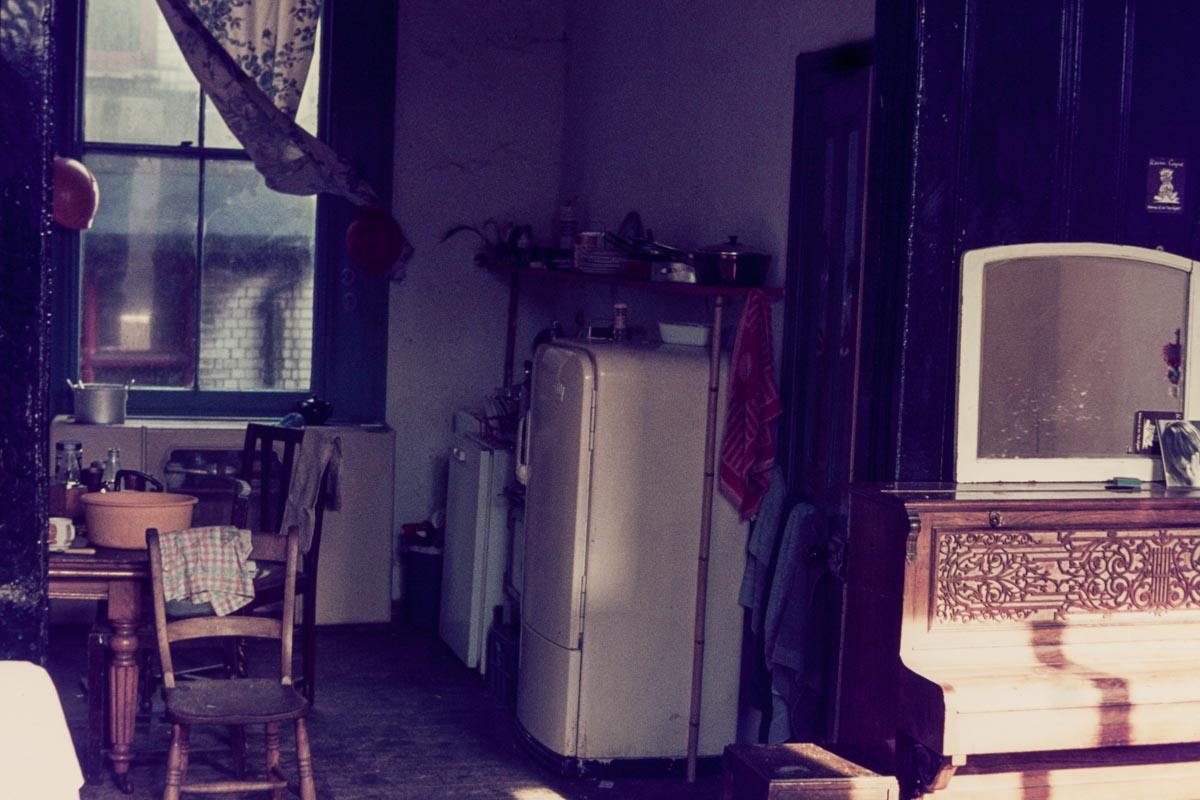
All very cold, though, rough, but all pulled together everyday by and for meals and, almost continual, wine. We did do repairs on the near-derelict building, but we never exactly made it in any way comfortable; we could never attempt that. Our conditions were basic, there was water, once found, but no bath or shower or sink other than the one in the kitchen. The drainage system in Drummond Street had been more than basic in that we would pour all slops into a giant tin bath which we would then empty out into the backyard from the first floor window, but in Tolmers there were drains. Floorboards were missing from the stairs. The norm was to expand space rather than block it in. Knocking through walls in my case, in 12 Tolmers, leaving the supports, to take over the whole floor of the substantial Victorian town house.
We did sometimes have gas; people became excellent at simply plumbing both gas and water; hooking up and turning on.
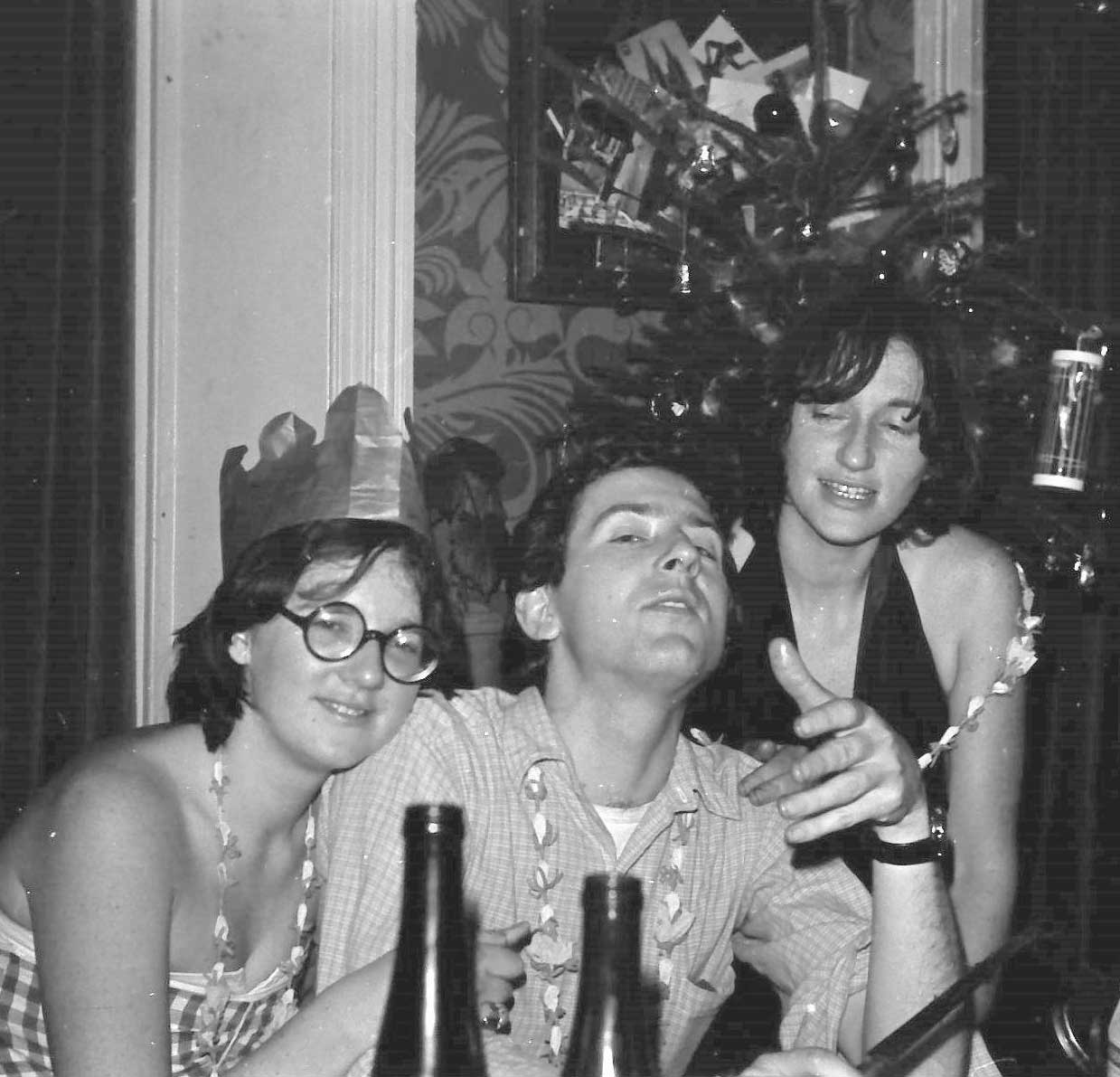
We had parties in the square, in each others’ houses, and in empty shops taken over specifically for the purpose. Almost every house became squatted in the square, and you would stand on the crumbling, dilapidated balconies there to wave to friends in number 6, for instance.

We would head to Hampstead Heath on the 24 bus with saucepans straight from the stove. Friends visiting from Italy would sing old resistance songs all the time; a complete caricature of a seventies notion of struggle.
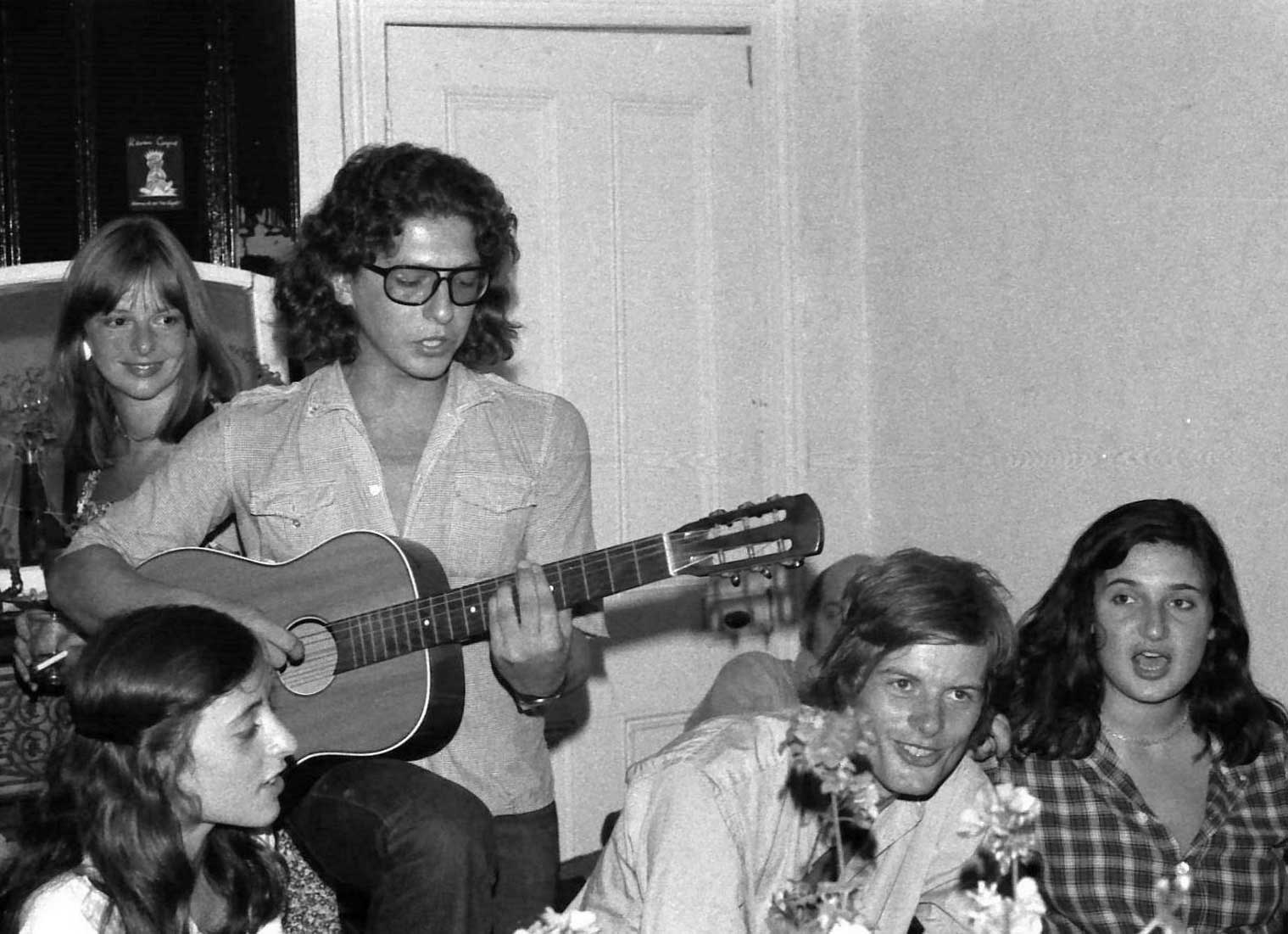
We would take the ferry and train to Paris for the Festa de l’Unita and get excited about the imminent revolution on the Iberian Peninsula, often all at the same time as a proper job, teaching at college, studying, signing on, being a trainee solicitor, organizing a poster collective, and starting what turned out to be a major food empire.

Men and women lived together normally. Obviously, not all the men did a massive amount of work, but the split between lazy person and active domestic person was a split along very different lines from the sexual divide. My great friend Jamie would overreach himself by starting on some elaborate cooking, having called a Gay Liberation Front meeting, and someone like me would end up finishing what he started; letting people in, stirring the pot. Some people were super-practical and others seriously challenged; it was often best not to know how to do something because you would then have to do it. We made places lovely but in a stylish, povera way. It was the eclectic aesthetic of the time, a desire for elaborate retro design, lovely old found furniture.
We could live in different groups and relationships, men and women would live apart and together; it was always sensible to have a room of your own, though, whatever your sexual expectation and reality. My household remained consistent, in that some of us stayed together all the way through, but it expanded and changed as well. Friends moved in and out, couples split up, necessitating a move by one to another house. Couples existed within an already individual culture and this made a difference. We cooked together, taking it in turns and usually catering for more than just the people in the household. Food then was far less varied, the range and choice limited by the era as well as a lack of money. A man called Jo the Meat Man would bring us meat from an undisclosed source. It was good, once thrashed by the end of a rolling pin and fried in garlic and oil. We had bread from the normal corner shop, bought at the same time as a pint of milk and ten Woodbines. But then the Bakery opened in North Gower Street, providing the beginning of alternative food. We, on the whole, were not quite so breathlessly reverent about this kind of thing, but John and Vera really did care about the field the wheat had come from, which made us laugh. A sort of religious silence seemed to surround their place.
We smoked dope, of course. Drink was then, as now, the most important and overriding force. We went to the pub all the time, drank wine at home, and had enough money for this.
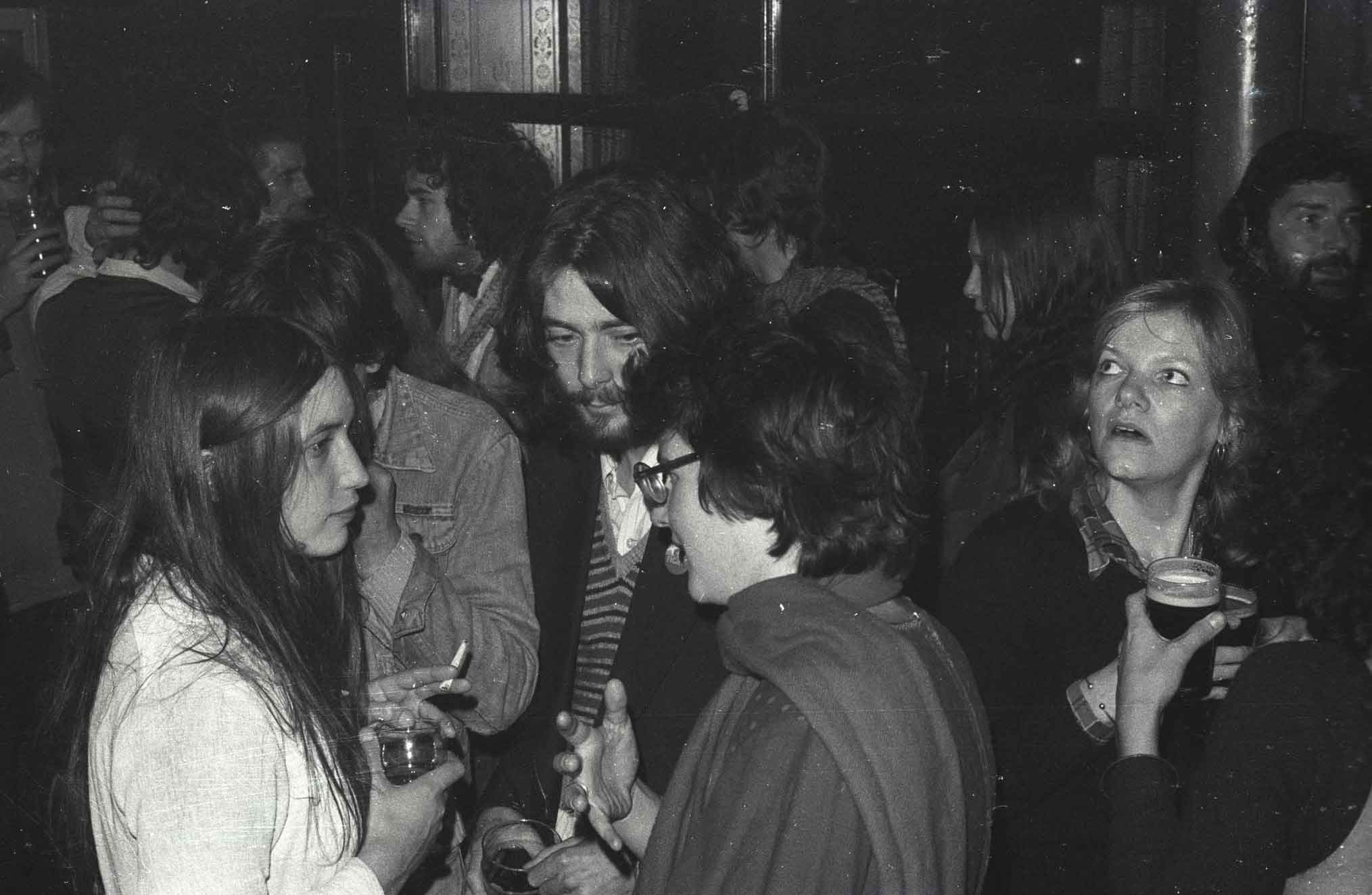
We lived together easily because we did not do what is expected in a communal situation. Some people might be encouraged to tell the truth, but we have always tended to be economical with it. If someone irritated you, you did not immediately say what you thought; this, in retrospect, is probably the most English, repressed, middle-class way to go about things, but it also did some good. A few of us ended up living together for much longer than the average marriage, and Corinne and I, who moved in together in 1973, still do. I suppose we used to think that things would change somehow anyway, that life both outside and inside is always so eventful and exciting that annoying individuals could be overlooked for the time being.
Democracy in living conditions was not always the point, because in a way we already had it. Politeness ruled; manners, kindness, greetings, sharing rather than principled stands and discussions. Probably we were so involved in the very complexity of political change and action to precipitate it outside that we tended to err towards something else at home. The personal/political split was constantly discussed and debated, but home was not a theoretical battleground. We were in a position to grab an overview, pull ourselves up in a very real way, to try to grasp what was happening to us.
The squat was always a struggle against new development and speculation. We went through many struggles and campaigns between 1973 and 1979. We managed, somehow, to force the Council to compulsorily purchase one side of the square to ensure Council housing there when we leave; we fought Levy; we fought a campaign for housing for single people; we talked of planning, of the height of prospective development on the other side of the square. I know it made a great difference to that corner of central London. There is new housing there, a strangely un-majestic, more enclosed square, but definitely not what would have been if we had not been there.
I remember doing the rounds of houses with Community Jo, as we called him. As I asked for 50 pence per household towards the struggle against Levy – a levy on Levy -, Jo was just asking for pulses, for food in kind, to aid the struggle. We worked well together in this way, at that point.
Just before the eviction in 1979 we ended up with a large picture across the very front of the Observer Sunday newspaper. “London’s oldest squat evicted.” A line-up of those left, along the balcony. Leaving was very sad, It was not a shock, we had organized and prepared, and symbolically as well as actually fought this moment. Loyalty to a place is as strong as anything, I feel. The piano was brought down and a friend still played it in the square. It was heartbreaking passing on a bus a few days later to see our smart wallpaper exposed to London. Everything turned out, inside out.
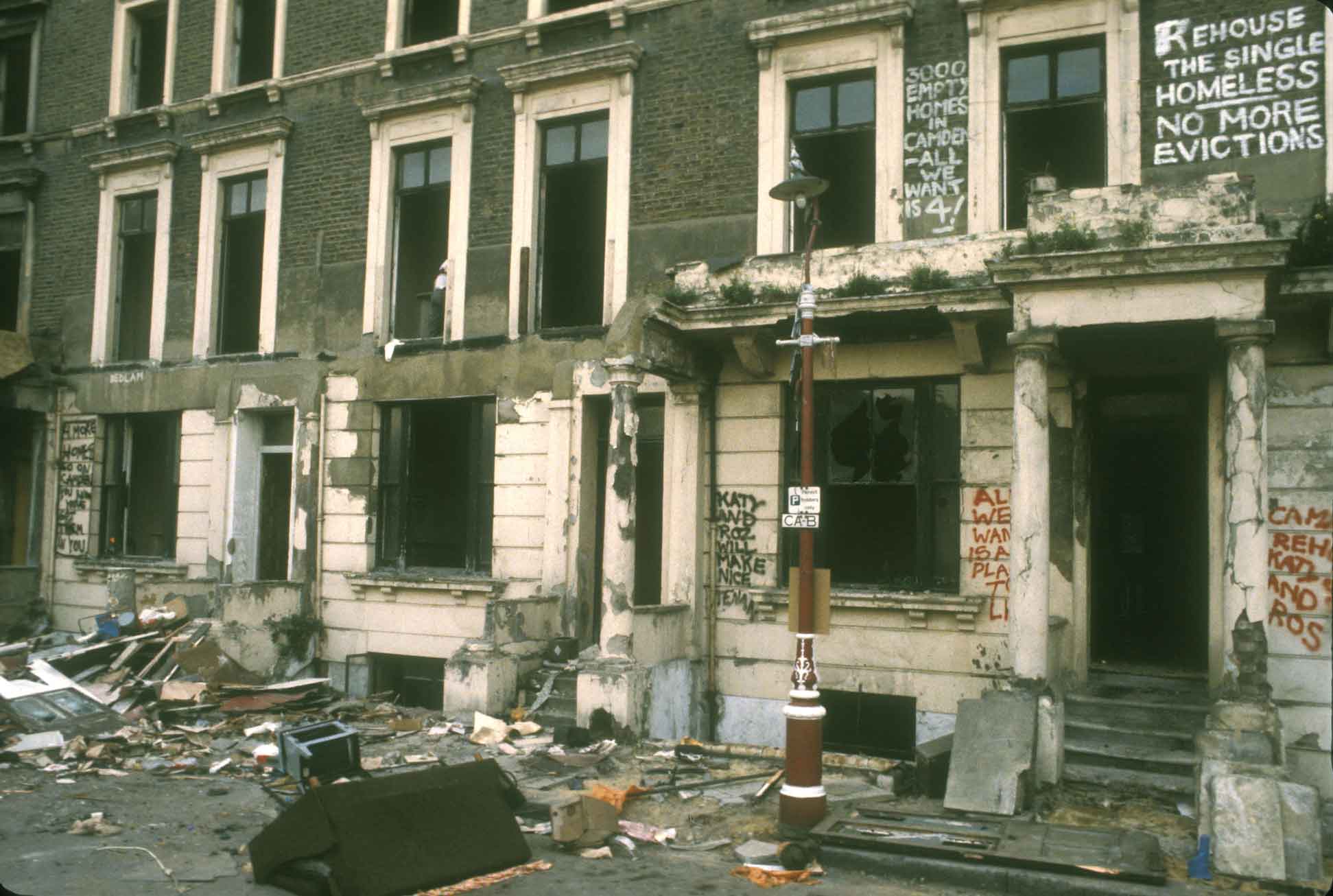
It was a turning point anyway; Thatcher had just come in and I knew it would all change in so many ways.
We moved first to a Council flat where we had managed to get re-housed. Too small. We had run that excellent last campaign in Tolmers for housing for single people – the slogan “Single people need it too” was funny and serious. We fought for the council to show loyalty to people who lived differently, in different configurations.
I now live in a large house in the centre of London, just down the road from Tolmers. We moved here in 1979. The house belongs to the British Museum, we pay rent. Seven of us live here, and my daughter.
Second-hand geyser does the job
As told to Patrick Allen in 2021
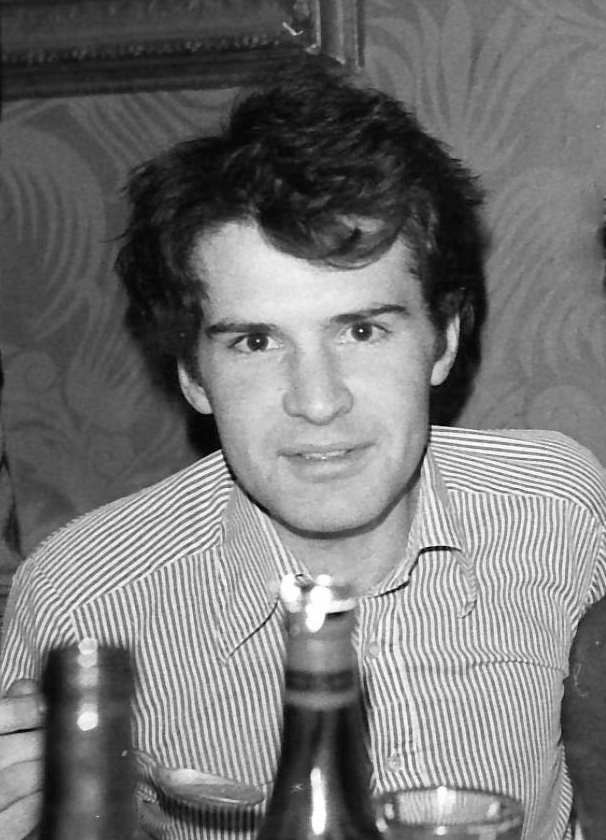
In 1973 I was living in Finsbury Park with my girlfriend Celia Potterton. I was a medical student. I had finished my first degree at Oxford in 1972 and was now studying for the post-graduate 2nd MB at St Bartholomew’s Hospital, Smithfield. Our bedsit accommodation was very unsatisfactory, and we were about to move out as it was nearing the end of the rental. I knew some people who were squatting, and I had been down to York Square, East London to check out a potential squat there, but this did not work out.
Then Patrick Allen, a friend from my college in Oxford, called me up. He said he had found a house to squat in Drummond Street, NW1, and wondered if I would like to join him. I was delighted to accept the invitation and the following weekend we set off in Patrick’s car, the Hillman Super Minx, to Drummond Street with a mattress on the roof, a lock and some tools. The front door of 119 Drummond Street was swinging open, so it was a simple job to walk in and then fit a lock, whereupon it would be ours.
Patrick then went off for more supplies and I was sitting on the stairs waiting for his return when the front door opened and in walked Barry Brookshaw, who I had not met before. He said “what are you doing here?” I said “I am just moving in to squat the house” and he said “I have been chasing it myself for a little while”. So I said, “well there’s plenty of room, when Patrick comes back we’ll sort it all out”.
Shortly afterwards Patrick returned, and we secured the front door with the Yale lock. We wandered around the house and looked for the water and electricity, and decided where everybody was going to be. Barry took the ground floor, Patrick the first floor front room and I was on the top floor at the back.
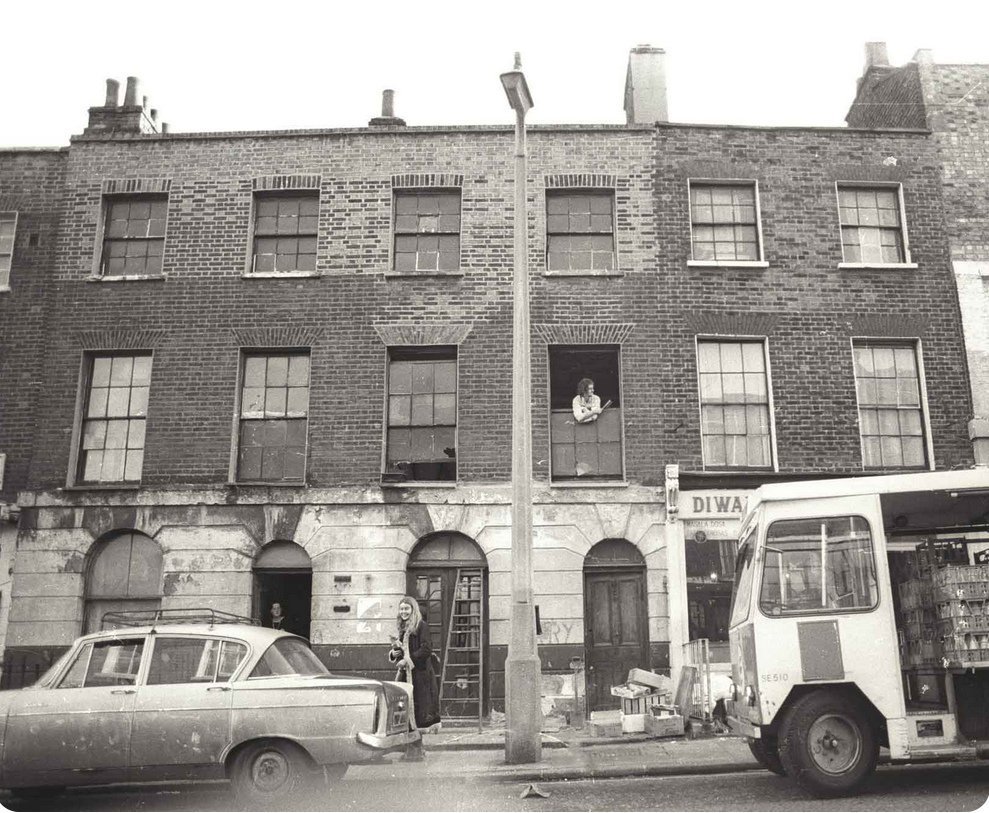
There were a number of immediate jobs to be done such as stopping the roof leaking and getting the water and electricity going which we did over the next week. We went onto the roof, patched it up with felt and tar and moved the tiles around a bit.
Barry made a trip to Woolworths in Camden Town to get plugs, sockets and wire, and I think he did the rewiring and some of the plumbing. We got the electricity connected by the London Electricity Board pretty quickly, and fairly soon we had water connected to our kitchen on the first floor at the back, and to the outside toilet in the back garden. There was an ongoing leak in the water supply to the lavatory, so Barry improvised brilliantly with an old tin bath which caught the leak and diverted it into an existing drain. He put some fish in the bath.
Next door at 117 they didn’t have a drain, so they collected all their slops in a tin bath – every now and then the window was opened, and they would empty it into their back yard. This was always fun to watch.
Patrick was the driving force behind the painting of the front of the house. I realised that this was a really good idea because we made the house look smart and quite respectable, and that reinforced our possession, our existence. There had been a lot of rubbish out the front and we tidied it all up and made it look nice.

Celia who was pregnant moved in, and Jesse was born in May 1974. They were on the top floor. I needed an electric geyser for the kitchen so we could have hot water. Jesse was born in the Whittington Hospital. There was a junk shop that I passed on my way to the hospital which had a geyser on the pavement which was exactly what I wanted. I bought it, stuck it on the wall in 119 Drummond Street and connected it. By the time Jesse came home from hospital we had a hot water supply.

I used to go to University College Hospital (UCH) for baths. You could go to Euston Station, but you had to pay 50 pence. There were some free bathrooms in the student union of UCH in Gower Street. I would go in the back way through the fire escape (with a bathplug).
Otherwise, I would go to Kentish Town public baths. But the thing with the public baths is that you get a fixed dose of hot water. The hot tap doesn’t work. You pay your money, then the attendant comes in and gives you a shot of hot water in the bath which is completely scalding. Then you put in the cold water and just the right amount because obviously you want to lie in the bath as long as possible without the water getting too cold.
Once I was lying in the bath at Kentish Town. I had stuck my watch up on the wall with a bit of blu-tac. Suddenly there was a crash and my watch fell from the blu-tac and shattered on the floor….
I got a job in the Mobil garage on Hampstead Road selling petrol. I was the night staff so I used to start at 8 pm and would finish at 7 o’clock in the morning. The job was not too busy so I could often sleep or do some academic work. I would come home, have more sleep then go to the hospital at midday then come back and go to the garage.
After two years we moved out of Drummond Street because we were told that they were going to redevelop it earlier than other houses and we all had to make other arrangements.
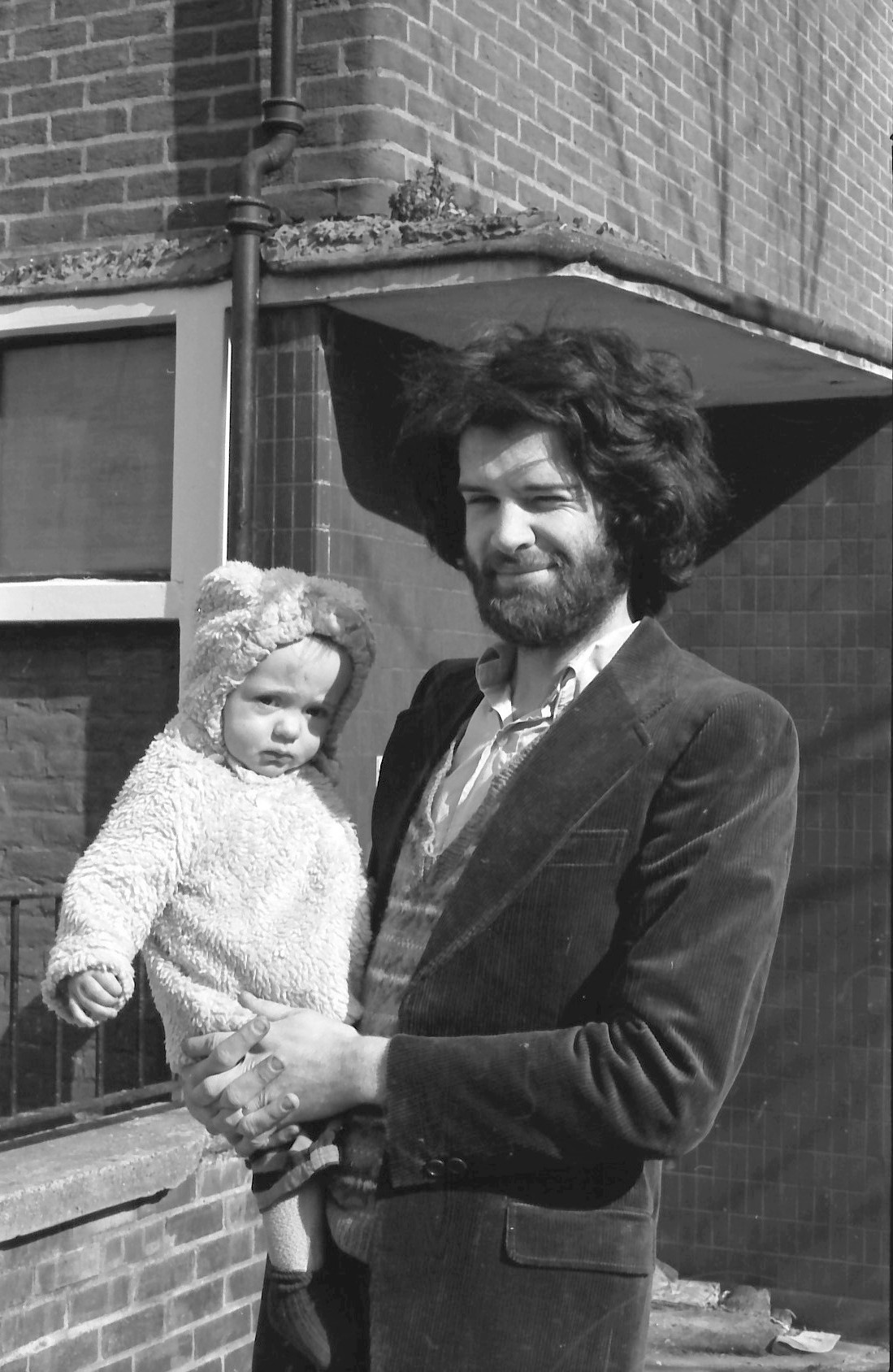
I opened up a house at 229 North Gower Street, which was in immaculate condition. I knew that it was becoming vacant and so I got in over the roof from another squat.
I dropped in, nipped downstairs and slipped a new lock on the front door – and there we were. It had running water and electricity, and it was all sound, but there wasn’t a bathroom there either. Celia moved in and she and Jesse were on the ground floor. There wasn’t much in the way of yard space. I was up on the top again, at the back.
I put gas into the kitchen, and a cooker and a sink. This was a busy time as I was working at the garage, appearing in the hospital and fitting out the house.
I moved to 12 Tolmers Square in 1976 where I stayed until the end in 1979. I moved in with Sacha on the first floor of number 12. Pedro and Sonia were on the ground floor and Patrick was next door. Dave Taylor was downstairs at the back. Cora upstairs at the front and Jamie in the basement.
The best thing about living in the Tolmers community was that it showed you what could be done, how you could put your mind to it and make things work. It showed you how you could work with people.
The food coop is a good example. Barry Brookshaw was a stalwart of the food co-op because he drove a van. Patrick also drove us in the Super Minx.
We used to buy bent cucumbers which were very cheap as supermarkets didn’t want them. We were buying a box of bent cucumbers and the guy needed a name for the invoice. He said “what’s your name then, oh I’ll put it down as ‘Whiskers’. This is because Barry Brookshaw had one of his intermittent beards. From then on whenever we had to volunteer a name, we were Whiskers.
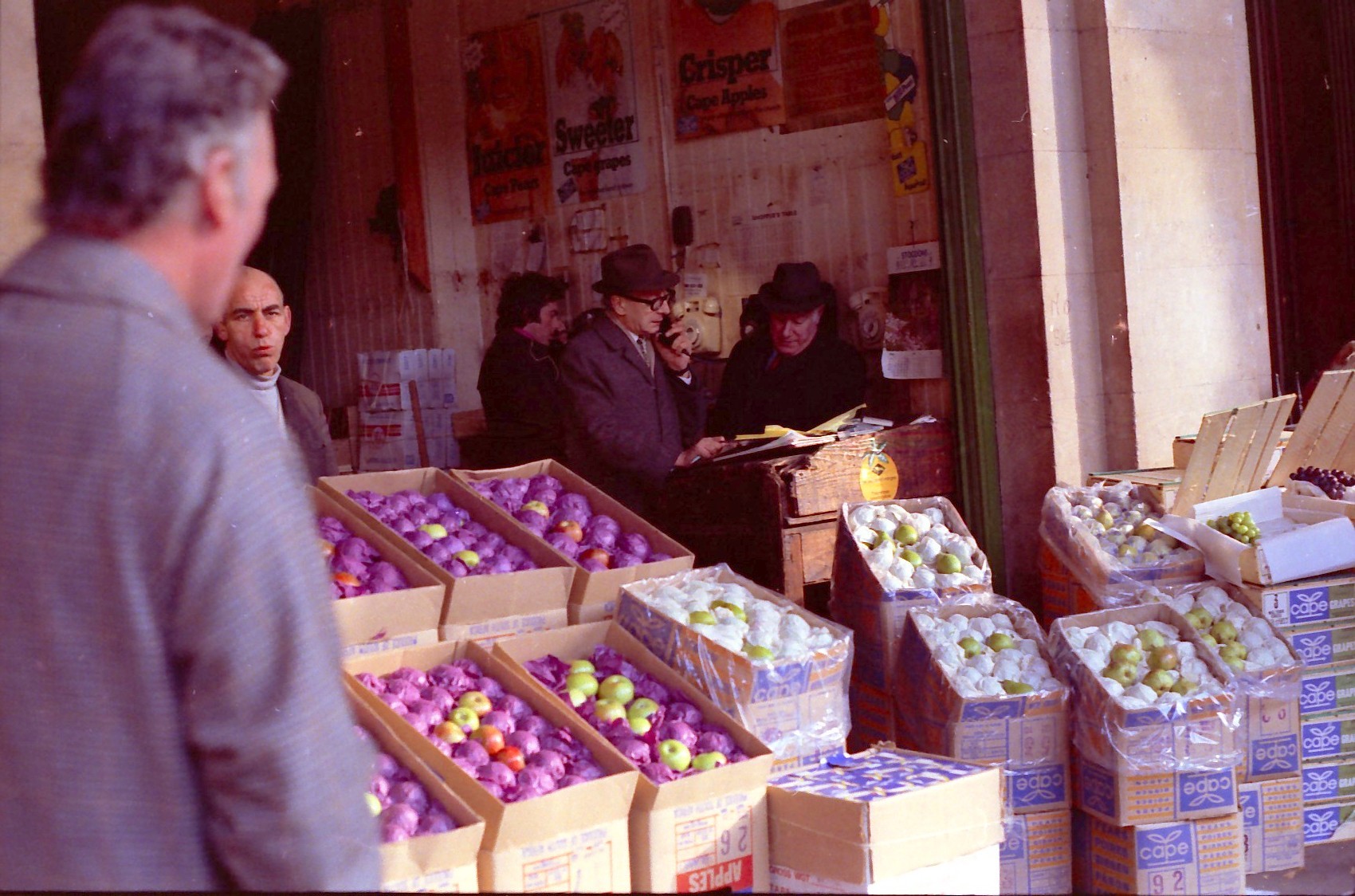
Back at Drummond Street, Oli’s mum Debby Banham used to help with all the bookkeeping of the food coop and the splitting up. Then we’d put it all out to sell.
Squatting was undoubtedly a formative experience. Was it enjoyable? Well, yes. If you were going to be having a hard time it was a good place to have a hard time in and it was brilliant to be without landlords.
In our previous bedsit the landlord would turn up on a Saturday morning and come into our room saying he’d come to check the meter. So getting away from all that and having control of things was marvellous. Perhaps we didn’t pay enough attention to it at the time. We didn’t know how lucky we were in that regard.
For example, my young brother Hamish came to stay for half term in Drummond Street. I remember he redecorated all the hallways. I gave him a pen and said if you want to draw your pictures, draw them anywhere you like, and he decorated the whole stairwell with all sorts of pictures that he liked.
I learned a lot of DIY skills. It was amazing to find out you could do it, but then when we moved in to Drummond Street, there were five or six sources of sheet glass a bus ride away. You didn’t need a car or anything, you could go and collect them. Its not the same now. Lots of jobs are quite difficult to finish because you can’t get the stuff.
I met many Tolmers friends recently at Barry Shaw’s funeral. I was glad to see them and we slipped into effortless communication, I felt uplifted by their presence.
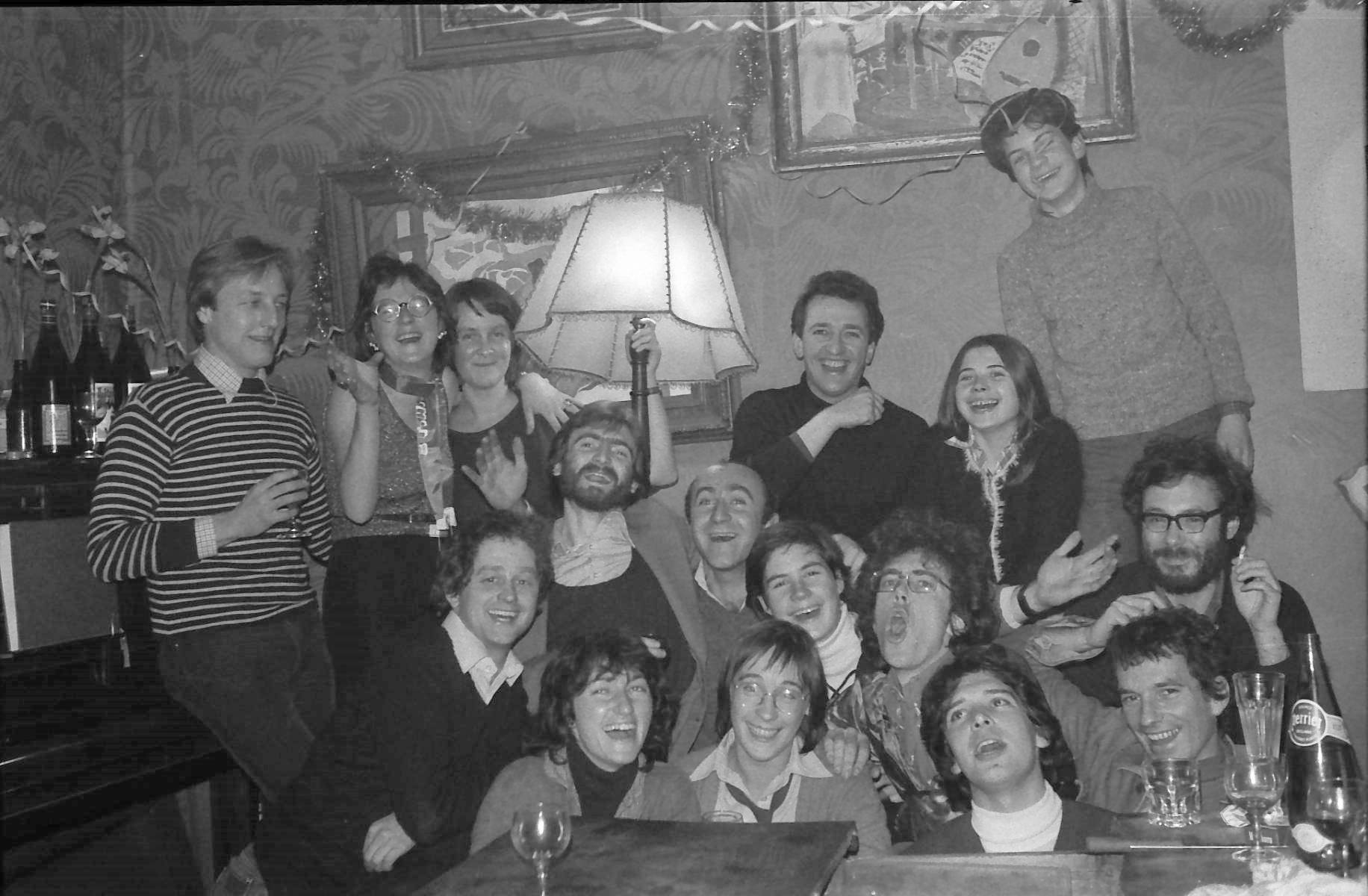
Did squatting change my life in some way? Yes. I’m not sure what I would have done to sort out the shortage of money. I didn’t have a grant because my father was bad at filling in forms and the Scottish Education Department which paid my grant had a policy of being difficult with people who went to foreign universities, i.e. in England. As a result I didn’t get a grant until I re-registered as a mature student. So if I hadn’t gone to Tolmers, heaven knows what would have happened. Maybe my parents would have paid something or I may have got some sort of job or I may have given it all up. Looking back squatting was critical to getting me through my medical studies.
Colin Ferguson January 2021
As told to Patrick Allen
The Christmas banquet 1975
In December 1975, the eight residents of 11 and 12 Tolmers Square decided to hold a Christmas banquet for their friends. This was a very ambitious project. Each person was allowed to invite up to 12 of their friends to make a supper for about 100 people. The menu was to be roast turkey, potatoes, peas and gravy followed by Christmas pudding. The venue was specially chosen – the Social Services Supply building at 142 Drummond Street, which was empty with a large ground floor space.
Corinne Pearlman designed the invitation:
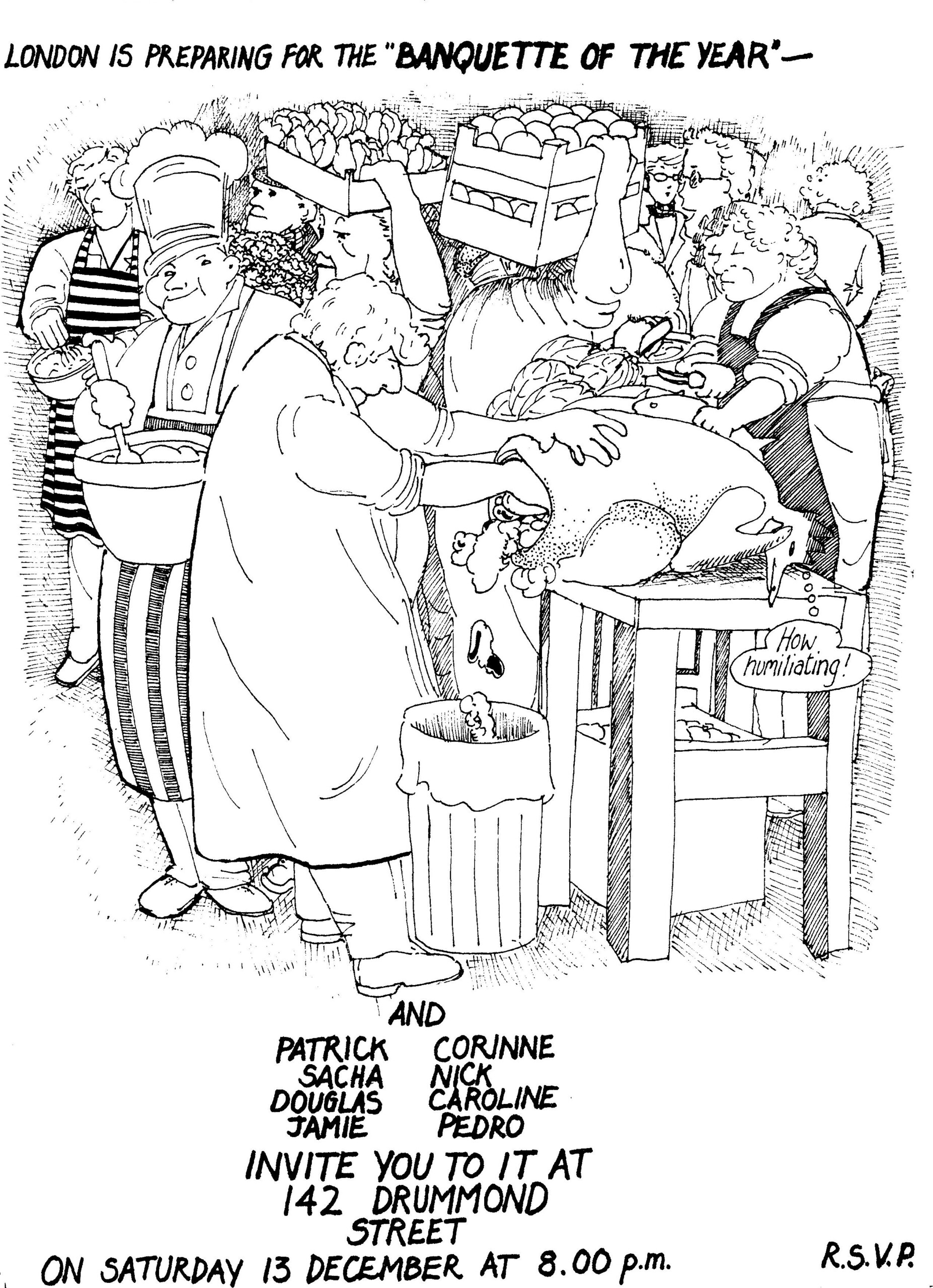
We took possession of 142 Drummond Street, swept it out and prepared it for the banquet. Four 20-pound turkeys were bought from Smithfield and these were to be cooked in four separate houses in Tolmers Square, then carried to the banquet and carved. We mistakenly considered frozen peas to be an easy option for a vegetable. We bought wine in large bottles from Oddbins. There was to be live music while people arrived – a wind quintet featuring me on flute and Nick Wates on French Horn. After supper there was to a be a disco and dancing.
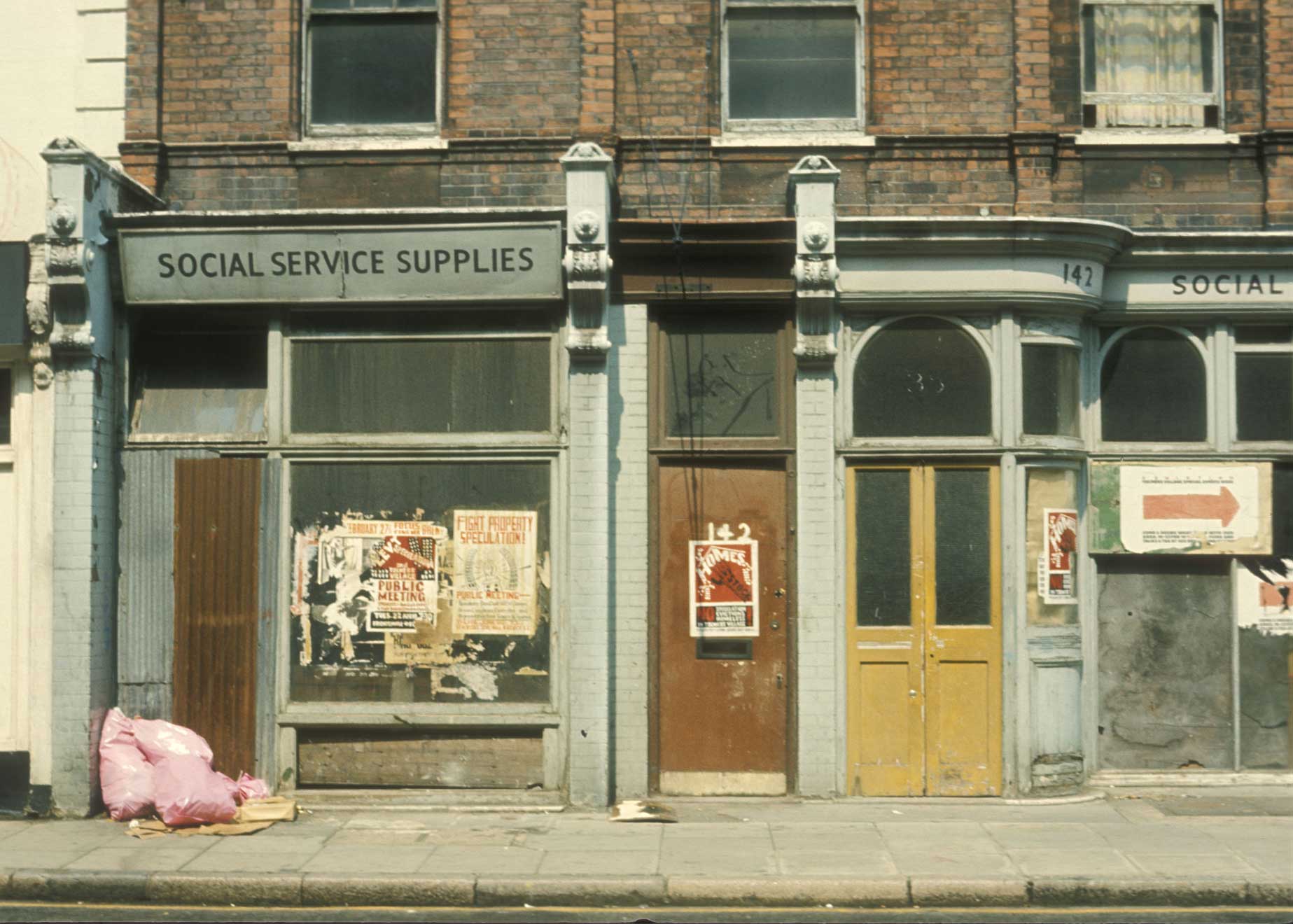
On the day we prepared the premises. We laid an open fire and set out long tables and chairs. We put up balloons and Christmas decorations. A large Christmas tree was installed and decorated. The turkeys cooked all afternoon in the four separate houses and were then carried across to Drummond Street with potatoes and gravy. Guests started to arrive. The peas were not as quick as we had thought – I was desperately stirring a vast saucepan of frozen peas, trying to get them to the boil in a kitchen on the north side of Tolmers Square as guests were sat waiting.
Finally the peas boiled and with help I carried the huge vat of peas from Tolmers Square to Drummond Street.
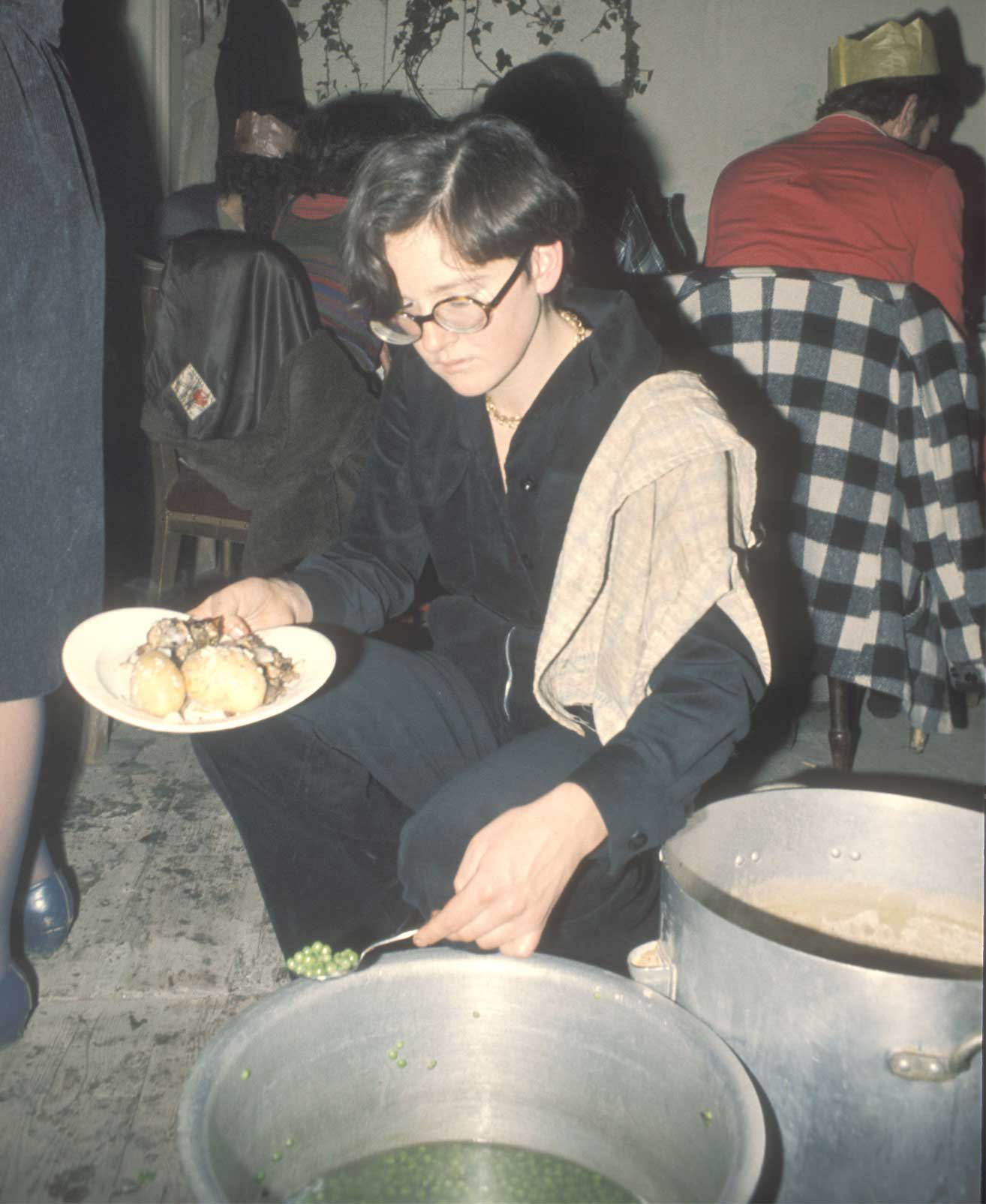
The quintet started up. Christmas dinner for over 100 people was served and was delicious in every respect.

After dinner, the tables were pushed back and the dancing began in front of the open fire.

The legal battle
In 1975, Stock Conversion & Investment Trust Ltd, which owned most of the property in Tolmers Square and surrounding streets, decided that negotiations with Camden on their redevelopment plans were not progressing to their satisfaction. As a tactic to move things along the company decided to evict all the squatters from its properties. One day in March 1975, High Court summonses were nailed on to 23 doors in Tolmers Square and adjacent streets affecting 81 squatters. The Plaintiff was Glennifer Finance Limited, a subsidiary of Stock Conversion. A date was fixed for a hearing in the High Court for 21st March 1975 for possession orders against ‘persons unknown’ who were resident in each property. I was still living in Drummond Street, a London Transport property so I did not receive a summons.
There was much anxiety in the squatting community at the prospect of so many people becoming imminently homeless especially as Camden, we thought, were likely to take over the development anyway. To fight this battle the community came together in a series of meetings and formed many committees – publicity, legal, fund raising and political. Camden Council were sympathetic to the plight of the squatters and persuaded Stock Conversion to postpone the hearing to 25th April.
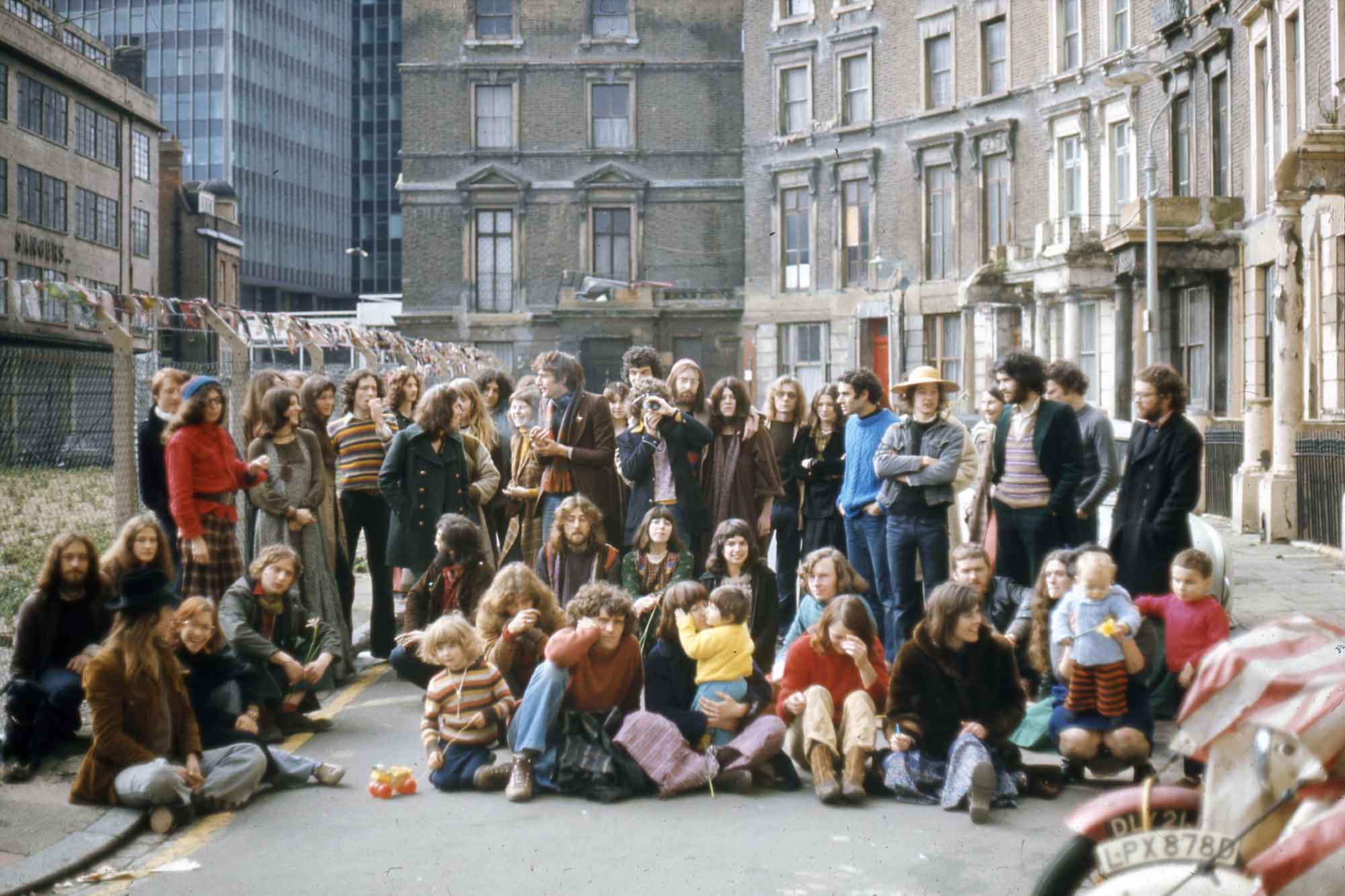
As the only resident with legal training and working for a law firm I headed the legal committee. I was in the first year of my training contract and not familiar with summary proceedings for possession in the High Court but was about to find out.
I contacted David Watkinson, a barrister from Bowden Street Chambers who specialised in squatting law. He agreed to come to a meeting in Tolmers Square one Saturday to advise us.
At this time, there was no criminal law against squatting (there is now). Taking possession of a property without the consent of the owner was a matter of civil law only and the police did not get involved. The owner could recover possession as long as they followed the procedure laid down in the High Court rules. Evicting anyone, including squatters, without a court order was a criminal offence.
The rules contained in Order 113, Rules of the Supreme Court, required owners to make reasonable enquiries to ascertain the identity of those in occupation. If no one was identified the case could proceed against ‘persons unknown’. If all the requirements of the rules were satisfied, a judge would make a possession order which was binding on anyone in occupation, identified or not.
We went to work on the papers. Luckily for the squatters and my law firm, Offenbach & Co of Bond Street, Mayfair, we were able to take advantage of the Green Form Scheme, the name given to the Legal Aid and Advice Scheme, to provide legal assistance. The Green Form Scheme was so called because the legal aid form consisted of a two page form coloured green. If the applicant satisfied a simple means test on the front of the form, solicitors could provide two hours of legal advice at no cost. I took instructions from all those who had received summonses and got them to sign the green forms.
With advice from David Watkinson, we filed 45 statements or affidavits challenging the evidence of the enquiry agents for the Plaintiff who claimed that they had made multiple visits to each property to identify the occupants, banging loudly on the door each time but strangely in each case, no one had been in at the time.
On the appointed day for the hearing, 25th April 1975, about 50 squatters marched behind banners from Tolmers Square to the Royal Courts of Justice in the Strand.

The legal team – me and David Watkinson, assisted by Nick Wates – found our way to the court room where we encountered about 30 lawyers – barristers, solicitors and staff from Stock Conversion – ready for battle.
We three occupied the left hand side of the benches and the opposing 30 the right hand side. The usher called ‘all rise’ and the judge, Mr Justice Croome-Johnson, came in and sat down.
Three cases were heard by the court and although the evidence was challenged each time, the judge was not persuaded and granted possession orders. Then the evidence for one property at 217 North Gower Street was placed before the court and the enquiry agent was called to the witness box. He was questioned about his visits and swore on oath that he had come round to the house three times and each time banged loudly on the front door but no one had answered. He demonstrated how hard he had banged by banging his fist on the court bench in front of him.
The defence then called witnesses – Michael Fitzpatrick, a medical student at the Middlesex Hospital, and Joanna Rose–Innes, a student at the Royal Academy, studying flute and guitar, who told the court that she had been at home practicing the flute on the morning in question and heard no one banging or knocking at the door. This was persuasive.
The case went on until the afternoon and at 3pm the judge gave his judgment. He explained that this procedure under Order 113 was unusual in allowing a case to proceed against unidentified parties. It was essential therefore that the court had to be satisfied that all the technical aspects of the court rules were complied with before granting possession.
On this occasion, having heard the evidence, the judge said he was not satisfied that the exacting requirements had been met so he was dismissing the summons with costs.
Outside the court there was relief and jubilation for the squatters, consternation for the property company and their lawyers. There was no time for the remaining summonses to be dealt with.
The Plaintiffs and their lawyers went off in a great huff but the cases were never restored for hearing……
For a detailed account of this day in court see The Battle for Tolmers Square by Nick Wates, page 180.
Stock Conversion resumed talks with Camden Council and quickly came to a deal. Camden bought Stock Conversion out, having decided to go ahead with its own development.
Camden Council, led by Frank Dobson (later to become MP for Holborn & St Pancras) then had communications with the Tolmers squatters saying in effect our development will be better than the one proposed by Stock Conversion. Most of the houses will be preserved and renovated, new social housing will be built where there are gaps or the houses are unsound and have to be pulled down. You can all stay where you are until we are ready to start work i.e. you will now be licensed squatters. But we invite you to leave in an orderly fashion when the time comes which will not be for a least three years.
This meant that all the squatters were left in peace from 1975 until 1979 when the demolition took place.
It was sad when the time came to leave as it was the end of a unique community. Camden’s development turned out to be a grave disappointment. The terrace of fine but crumbling Georgian houses on the Hampstead Road was replaced by a terrace of new housing, characterised by a long line of ugly, brown grills at street level. Most shocking of all was Camden’s decision to demolish Tolmers Square itself, having decided that they had to build an office block to pay for the rest of the development. The Camden scheme actually ended up with more office space than the much panned Stock Conversion scheme. The new office block of mirrored glass was not an ugly monster like the Euston Tower but was unexceptional. The magnificent houses of Tolmers Square with their balconies and porticos were demolished. The square became a smaller, confusing, misshapen space dominated by the office block and with no obvious exit. It has a tree, a small hump of grass and wheelie bins adjacent to housing of no distinction which has not aged well. The loss of Tolmers Square is a tragedy that resounds to this day and a reminder of the loss of the magnificent Euston Arch which marked the entrance to Euston Station, just round the corner in Drummond Street, from 1837 until its scandalous demolition in 1961.
Ringside seat
In the summer of 1975 I realised that my time would shortly be up at 119 Drummond Street and I would have to find another home. London Transport gave us early warning that they wanted possession to demolish the property.
For my second squat I chose the first floor flat at 11 Tolmers Square. This consisted of two interconnecting rooms with a pair of French windows facing South. It had been empty for some years and the French windows needed repair and new glass.
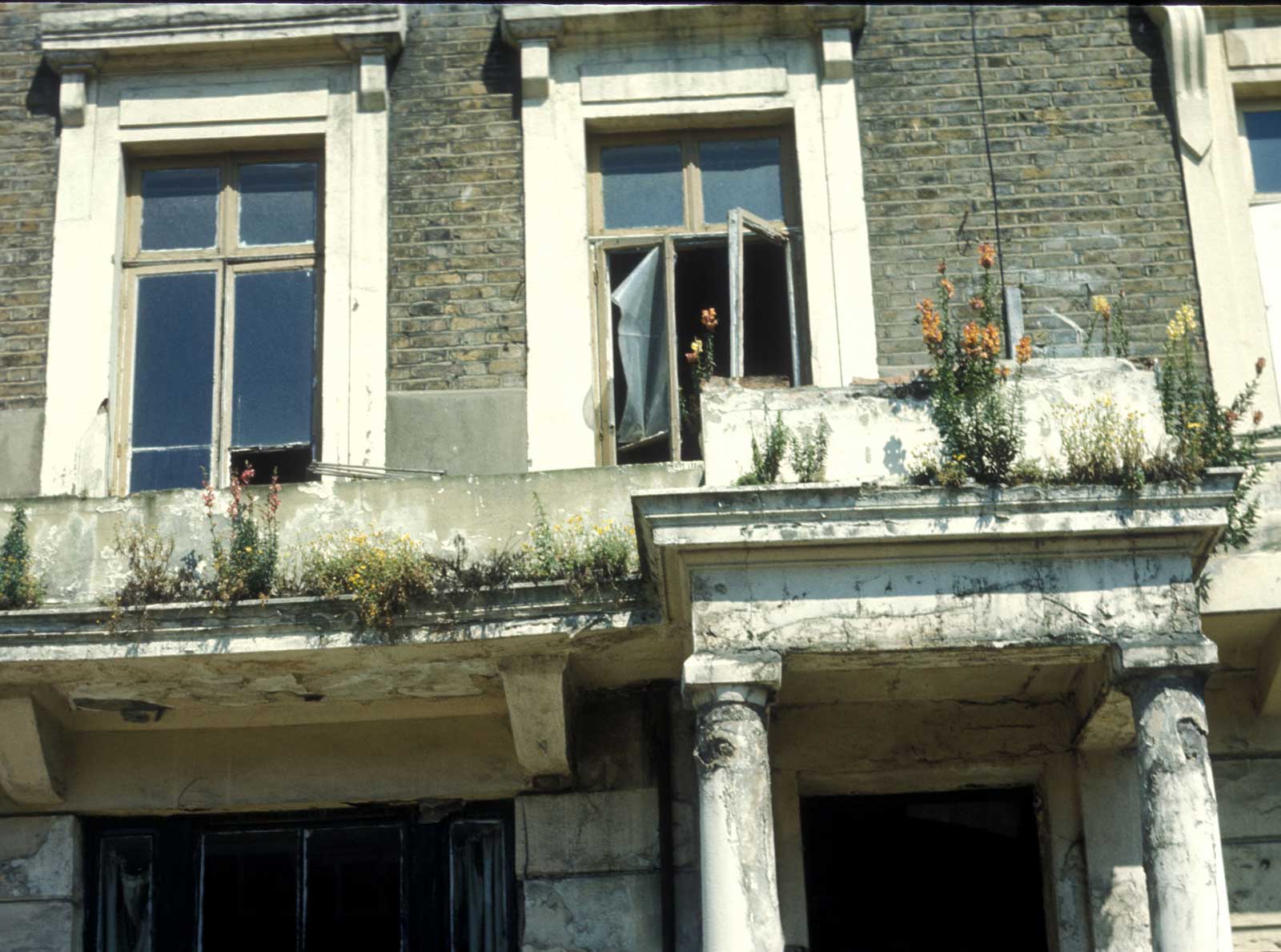
The great advantage was easy access – I could enter the flat from the balcony of 12 Tolmers Square which was occupied by other squatting friends.

In fact there was about to be a big change over at 12 Tolmers Square. Nick and Caroline were going off travelling, Barry and Atalia were moving to 6 Tolmers Square and Sacha, Cora and Jamie were moving in from 117 Drummond Street as their house was about to be demolished too.
My plan was to share cooking and meals with Sacha, Doug, Jamie, Cora and Pedro in number 12 as well as cook some meals in number 11 with my own kitchen so having the best of both worlds – communal living and private space, peace and quiet. The flat had a panoramic view over the square so you could see the comings and goings of everyone and the balcony was big enough to sit out on and eat with a small table and chairs. I began work on the flat and decided to do a thorough job.
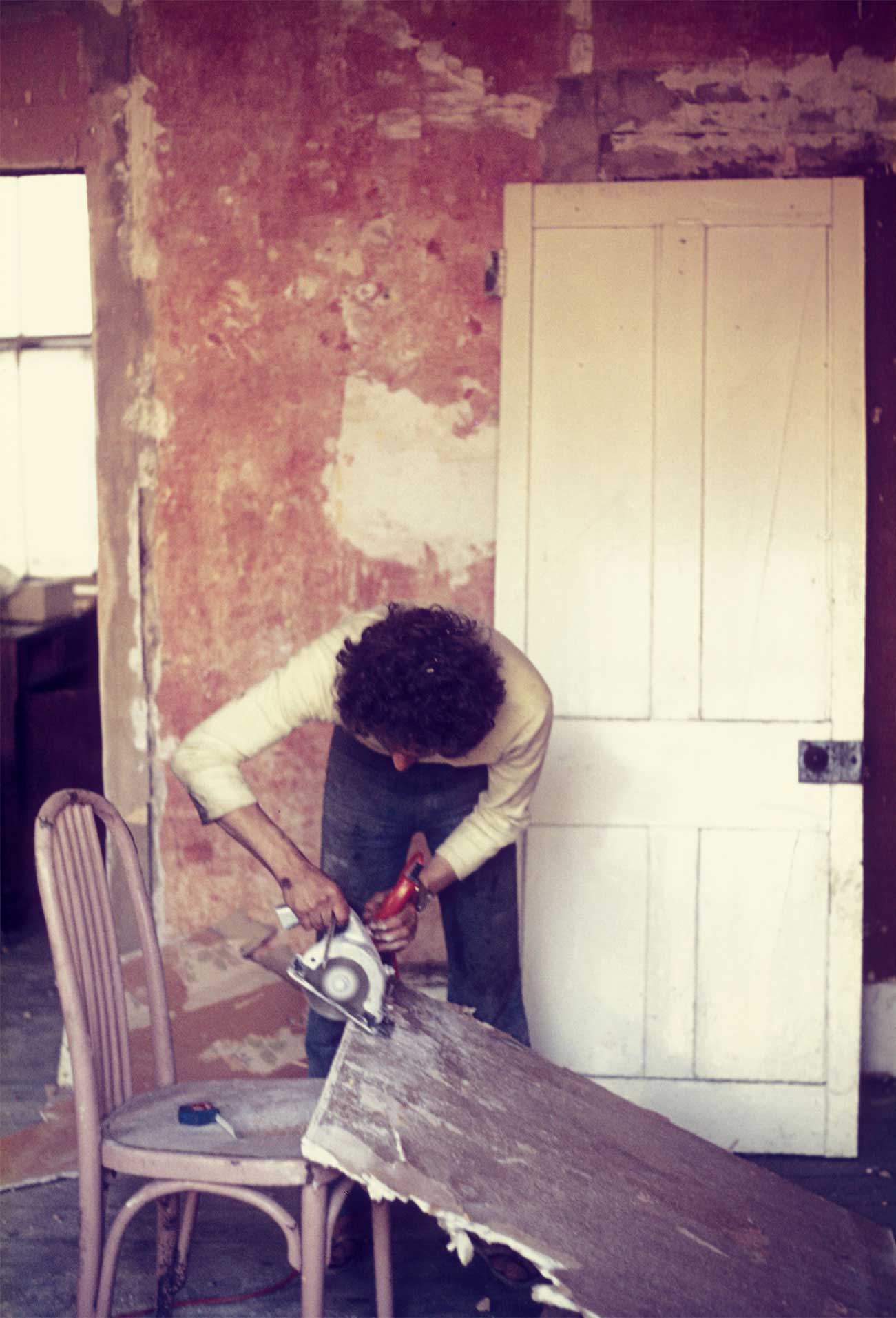

Replacing the broken glass in the French windows to make them weatherproof and secure was the first job. Then I stripped off layers of wall paper, lined the walls and painted them.
I turned the back room into a kitchen and dressing room with a shower. There was a 1950s New World gas cooker which was in the flat when I arrived so I got that connected.
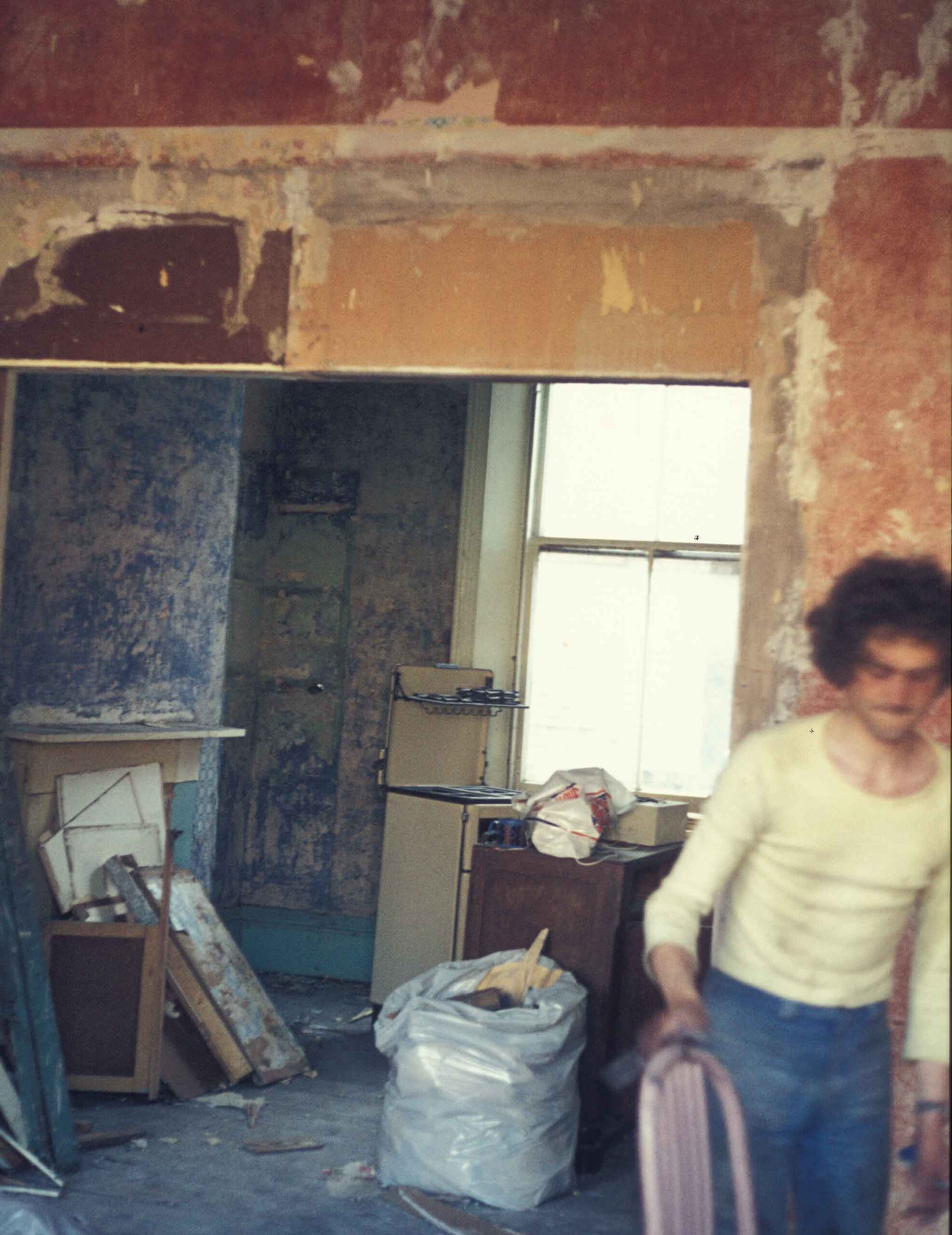
I installed a kitchen sink with worktop. The shower was a big project in itself. I put in a shower tray in the back corner. Kay Weller, the mother of my friend Chris Weller, worked for a tiling company and she generously gave me some grey mosaic tiles which lined two sides of the shower cubicle. You can see the tiles in this picture. For hot water I adapted a Sadia 2-gallon water heater, installed it above head level and plumbed it into a mixer with cold water. This worked extremely well but you had to plan ahead. The heater provided 2 gallons of piping hot water about one hour after switching on. Mixed with cold water this provided a shower for about three minutes only. So you had to be ready with the shampoo – wash and rinse the hair first then two minutes left for soaping and rinsing the rest. It worked! And this was luxury compared to 119 Drummond Street where we had had no bathroom at all.
I moved in during the summer of 1975 and had a telephone installed. This was essential as I was part of an overnight rota giving telephone legal advice for people held at police stations for Release, the legal charity and advice centre.
There were actually two tenants still living in 11 Tolmers Square – Joan on the 2nd floor and Mrs Gillick on the ground floor. The other rooms were all empty. Mrs Gillick had recently moved to a new flat nearby in Robert Street and only visited her room during the day.
I met Mrs Gillick and her son who came upstairs to see what was going on. I explained that I was a trainee solicitor, intended to be there for a few years and was making a nice job of renovations. I said it would be great if I could use the front door and proposed that I change the front door lock then give everyone a new key. They agreed so I no longer had to access the flat only by the balcony.
Later I was invited down for tea in Mrs Gillick’s front room where she was entertaining with her friend Ted who was working as a messenger delivering letters and papers in the City.
Joan on the floor above me was a delightful Irish woman and we soon became friends. Often as I was working in the flat putting up wall paper, filling, sanding and painting there was a soft knock on the door to the landing. When I opened it, there would be Joan holding a tray with a three course meal for me, all beautifully arranged on a lace mat.
I completed the work after a few weeks and enjoyed living at number 11 in some comfort for the next 4 years, only leaving in January 1979.
Number 12 next door was the social centre where all our big meals and parties took place with regular sing songs round the piano.