In 1973 I had finished my A-Levels and was living in Oxford with my parents. My friend Jamie Gough, the nephew of my mother’s great friend Evangeline, my godmother, told me he was moving to London and invited me to join him when he had found somewhere to stay. Jamie had finished his doctorate in physics but now wanted to specialise in town planning. He found a place on a planning course at the Bartlett School of Architecture, part of University College London. I was in limbo, having failed to manage to take up the place I had been offered to do Art History at Sussex.
Jamie met Nick Wates, a student at the Bartlett. Nick told him that people were squatting in Euston just over the road from the College. Nick took Jamie on a tour of the area and showed him an empty house at 117 Drummond Street which Jamie loved. He was thrilled, especially with the early 19th century Georgian architectural details, and called to say that he had found a house and that his friend Corinne Pearlman would be moving in too.
My father John Craddock accompanied us on the day of our move. John quickly took off the corrugated iron on the front of the house with a jemmy. The house was beautiful but had nothing in it at all. No gas, water, electricity or furniture. The first night I slept on a mattress with my mother, Sally, and Jamie. With no water in the house I would cross the road to the house opposite, the Tolmers Community Centre, to bring back water in a jug. There was a lavatory in our back yard, but no water to flush it. However Mr Patel who owned the restaurant next door allowed us to use the toilet in his front basement area, or we would use the Superloo at Euston Station.
Jayant Patel was the owner of the Diwana Bel Poori House at 121 Drummond St . He was very kind to us. To clean my teeth I would go down the wooden stairs in his front area, avoiding the men who were peeling potatoes for the dosas and bhel poori. I would try not to slip on the potato peel in my night things with my sponge bag. In the customers’ toilet was the most minute triangular basin. Jayant was fantastic and became part of our life. His was the first Southern Indian vegetarian restaurant in Central London. He served the most gorgeous, delicate, ‘deluxe dosas’ – a crepe wrapped around potatoes with a sharp and comforting coconut flavour.
I don’t recall being uncomfortable in 117 but it was cold. We huddled round an open fireplace burning coal dust that my father had provided from the open-cast coal mine where he was working. This slightly smelly fire was not at all hot! Our kitchen sink did not have a waste pipe so our cooking slops went into a large tin bath under the table. We found a table for our kitchen, The Vines who ran the grocers shop next door found us a couple of chairs. The house rapidly became organised . Patrick and Barry at 119 next door discovered the water stopcock in the pavement and connected us to it with a pipe across our back wall so now we had water and our own loo. More people moved in. Corinne Pearlman, then Orlando Gough (Jamie’s brother) and Celia Keyworth, created a very smart room in the front basement.
The Vine’s shop next door made shopping for food easy. We would buy bread, butter, milk, Woodbines and the newspaper there. We could get other food and meat from the Indian shops. Then go to Camden to the market in Inverness Street for vegetables. There was a fantastic bakery there with Turkish, Greek food, and lovely, big flat loaves.
I loved living communally in the Tolmers integrated community – with squatters, tenants, and people running local businesses. I got to know the people working in the street.
We quickly became friends with Nick, Caroline, Barry , Atalia, Pedro and Doug, all architecture students at 12 Tolmers Square, and Patrick and Colin who moved in next door at 119 Drummond St.
Strangely, Corinne and I had not actually met before we moved in together at 117 Drummond St. Jamie simply assumed that as friends of his we would get on. In 2023 Corinne and I celebrated having lived together for 50 years, and it all started in Drummond Street.
My parents were coming and going, and loved it. John continued to bring more horrible coal for our fire. Corinne’s mother was shocked to begin with because it was not at all comfortable.
Jamie and I became involved in left wing politics. Meetings mainly took place 19 Tolmers Square, a centre for comrades in the International Marxist Group (IMG). Famous Marxists such as Tariq Ali and Robin Blackburn would visit for meetings, and socially.
There were differences between us squatters over deep questions involving Troops Out of Northern Ireland and the Miners’ strike, for instance .
I found a job as an ancillary worker at University College Hospital, and became a trade unionist shop-steward for NUPE and then branch secretary. It was a massive responsibility. There were women cleaners from the Philippines or the Caribbean. I would ask whether they would be able to support the miners’ strike, and they would say “well no, not really…”
I was required to sell the IMG newspaper, the Red Weekly – “Red Weekly, read all about it”. My friend Anna and I found this hard work because we were embarrassed calling out. We got into trouble for poor sales.
In 1975 , two years after our arrival, Jamie, Cora and I left 117 Drummond Street and moved into 12 Tolmers Square. We had a new set-up, communal living, but bigger space, with more people. We were now together with Doug, Pedro, Nick and Caroline. I had the second floor with Doug , where we knocked through the wall between one room and another. We were at 12 Tolmers Square for about four years until they demolished it in 1979.
Big communal cooking was our speciality and we all became good cooks. It was competitive and we loved creating big meals for large numbers.
Jamie became involved in gay politics. He was the organiser and leader, holding his meetings in number 12. Sometimes he would start cooking a great vat of food for those coming to the meeting and would then say “can you keep an eye on the chick-peas while I have the meeting”.
We also had Tolmers Square meetings at the time of the court case . There was a huge campaign and many meetings – legal , fundraising, dirty tricks, political, After the eviction threat was over and Camden said we could stay, life became more normal.
Our house, and in fact all of Tolmers Square, became quite notorious, to the point where Michael Heath the cartoonist did a cartoon in the Evening Standard showing a blue plaque, not to someone dying here, but “I had dinner at number 12”.
Jamie, Cora and I had a lot of discussion about the sitting room wallpaper for number 12 . In the end we chose a dark green design with palm leaves or ferns. It was very beautiful and it was poignant and heart-breaking after we were evicted, being on a 24 bus and seeing it after some of the building had been pulled down. I was devastated – there was our wallpaper on the wall exposed to the open air.
We eventually installed a shower in number 12 at the foot of the staircase. It was dark and cold and I don’t remember enjoying it particularly. There were other places to go and shower, particularly at Euston, and there were student showers we could use.
We had many pubs to choose from. Initially the favourite was The Lord Palmerston on the Hampstead Road. They served something strange called white port, sweet and we could spend the evening there, and everybody in the area came to meet and discuss things. Later we became regulars at the Exmouth Arms where you could sit outside in the summer.
It was a fluid and highly creative community with a wide variety of people, including academics, people involved in architecture, planning and housing, Then we had the intellectual, left-wing comrades. Dave Taylor’s journalist group set up the Leveller Magazine . Lots of musicians…
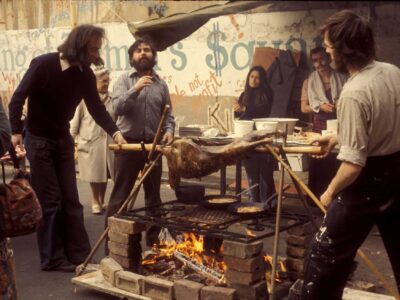
The carnivals were incredible events covering the Square and surrounding streets. A carnival committee would organise it. There was a stage, live bands, classical music, featuring my sister Dominie on violin and Patrick on flute, and other musician friends of theirs. Jayant Patel would come with these huge saucepans of food. Everyone would dance.
After leaving Tolmers Square , I eventually ended up at 89 Great Russell Street with Jamie, Cora and Dave Taylor. We carried on communal living just like at 12 Tolmers Square, which I have done ever since. So the experiment in communal living at Drummond St and Tolmers Square turned out to be the foundation for the rest of my life. Cora and I are still there. We still have big communal meals, and the house is rather cold in winter – so nothing has changed .
As told to Patrick Allen
Share this post
Read more about the author Sacha Craddock
More stories
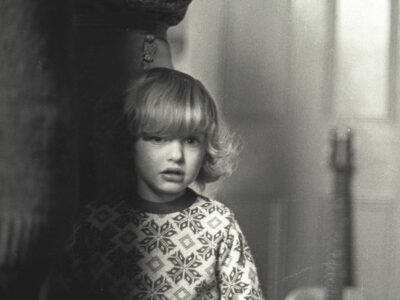
Tolmers picaresque
by Oli Arditi
Tolmers Village was a great place to be a kid—sometimes a dangerous place, for members of the small gang I ran with, and for the adults we occasionally terrorised.
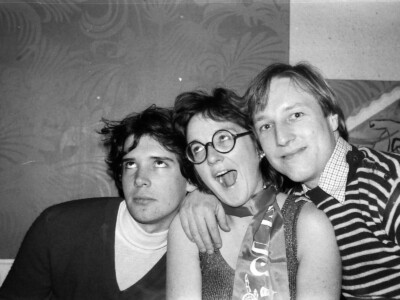
The best thing I ever did
by Douglas Smith
Number 12 was damp and stank of cats, the ground floor window was bricked up and there was water but no plumbing.
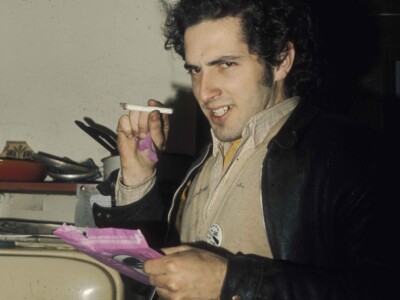
From Lisbon to Tolmers
by Pedro George
Tolmers made me realise that people are important in planning, you have to involve communities in decisions. If you fight a good fight, collectively, people can change their environment.
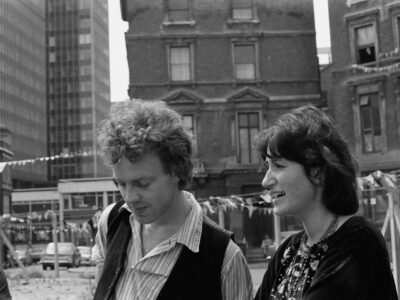
Bourgeois squatting
by Corinne Pearlman
It seemed like the right way to live. It felt very comfortable for me, living with a lot of people. I’ve got various lives in different places, but that communal life is really important.
Traveller’s tale
by Rod Smith
Instead I went on a ‘teaching English as a foreign language ‘ course so I could travel the world.
No shame
by Tim Davies
A squat. I didn’t even know what that meant. I had to look it up – in the days before Google. Encyclopaedia Brittanica in those days.