I first came to know Tolmers Square not through the peeling front door of a squatted Georgian house but via television. In 1973 I was a researcher on the BBC2 documentary series, Man Alive and, although pretty much still a novice — I’d joined the previous year, straight out of university — I was asked to research a highly topical and in some ways quite intricate Camden story.
This was terrific as it was my home patch — I was born and raised in the borough. The story was about property developer Joe Levy and his Stock Conversion company’s attempt to make a deal with Camden Council, buying a great swathe of central London property for a pittance, in return for a sprinkling of housing (to which the Newspeak word ‘affordable’ hadn’t yet been prefixed).
Our programme, ‘Sitting on a Fortune’, focused on the counter-proposal dreamt up by the investigative journalist, Christopher Booker, and the wealthy businessman, Bennie Gray, and my job consisted of grilling them about the origin, logistics and feasibility of their proposal, writing a series of detailed research reports, setting up the filming — and being taken out for an upmarket meal in Chelsea by Bennie Gray (who drove me home in his Mustang).
I can’t remember much about the filming, except that I got so completely immersed in both the programme, issues and its politics that Frank Dobson, the Labour leader of Camden Council, called me an apparatchik (not, I think, as a compliment)
Our film was billed thus: Scratch a modern millionaire and underneath you will probably find a property developer. Since 1954 the boom in commercial property development has spawned oblong office blocks by the thousands and new fortunes by the bank load. To amass their private fortunes, the property tycoons must enlist the willing co-operation of local government councillors – some of the hardest-working, unpaid public servants in modern Britain. For it is in the power of local authorities to grant, or to withhold, the necessary public permission to speculate on making a private fortune, and broadcast on November 28, 1973.
It was enthusiastically reviewed in The Observer by their TV critic, Clive James, who remarked that “As always in such programmes, there was a young local councillor (for Camden on this occasion) whose articulateness, kindness and manifest good sense made you wonder why he wasn’t running the country at £1,000 a week instead of working himself to death for zero financial reward in the effort to stop a hunting-pack of bloody-mouthed developers ripping his borough to pieces before selling it back to themselves. Christopher Booker and Bennie Gray, intelligent men both, are convinced that the only hope is for councils to organise their own developing and so reap a benefit in amenities. But what emerged most forcefully — no surprise this, just a further instalment of the aching awareness we have all shared for years — was the extent to which the Government favours the plunderer against the plundered. To indicate just how well the Government thought everything was going, there was some full-frontal footage of Geoffrey Rippon enjoying a protracted spasm of complacency: not a pretty sight” (9.12.73)
As for me, the programme led to my becoming the series’ resident specialist housing researcher, routinely called upon to find a homeless person who was presentable, articulate, without speech impediments or any sign of intoxication and definitely not stoned.
It was later, when Corinne began to squat first in Drummond Street and then in Tolmers Square, that my second encounter with TS began. I’d shared a flat with Corinne in our second year at university. We met on our first day and I can remember exactly what she was wearing: an oyster-coloured, billowing satin blouse under green velvet Mr Freedom dungarees, with rainbow-striped eye shadow — she was basically the coolest woman in Oxford. I wanted to become her and copied everything she read, listened to or did (only invariably, by then, she’d moved on to something new). But by the time that she moved into TS, I’d researched enough squats to know that I’d reached my imitative limits: I needed privacy, couldn’t abide the cold and, despite my fascination with anarchism and the works of Bakunin, Kropotkin and Colin Ward, and sympathy with Proudhon’s assertion that la propriété, c’est le vol (property is theft), I was prepared to take to the barricades to defend the sanctity of the toothbrush — mine was not for sharing.
So no communal living or squatting for me, but the next best thing: I became a dipper-in to TS, or what today might be called a lurker. This enabled me to enjoy all of the pleasures of the emerging community without any of the drawbacks. I was generously included in or invited to all kinds of different gatherings and events and later brought my partner, Peter, along. What a vibrant group of people found their way into the Square: you could almost bottle the energy. They came from everywhere — their reasons diverse, their politics shared. And the parties! The Square was a perfect setting for communal events, collective exuberance and all-round conviviality. So much laughter, music and creativity. I made new friends there who are now old friends.
For some in the community, the squat was the only way that they could afford to live in central London. For some, but not all: another lurker recently confessed that she used to drive there in her father’s Alpha Romeo but park round the corner — she didn’t want anyone to know how bourgeois she was — until the dynastic surnames of some of the squatters made her realise that she wasn’t the only one. Here were white professionals-in-waiting, on their way to becoming, lawyers, town planners, doctors, editors and architects. The slogan that Corinne painted on the wall of no.12 put it succinctly: ‘This house is full of bourgeois fuckers’.
The Tolmers Square squat, if a touch self-mythologising, became a significant part of a celebrated campaign which, in its own exuberant way, marked a particular moment in the history of UK housing. What then seemed like the start of something — a merciless new model for the purloining of public assets for private wealth — also marked an ending, or the beginning of an ending: looking back now, the mid-70s seems like a housing nirvana, when you could still live in central London relatively cheaply, even without recourse to squatting, and Hackney hadn’t been overrun by those for whom it was but a short hop to the City.
Estimates vary, but then, broadly speaking, you could buy a property for the equivalent of 3.5 times your annual income; today that multiplier stands at 14. The brief history of the housing market drawn up by the estate agents Savill’s shows the brutality of the increase in house prices: up by 238% between 1977 and 2022; by 61% between 2001 and 2008 alone.
As to renting, the regulated tenancies provided by the 1965 Rent Act became history when rent controls were abolished in 1989, while the arrival of the buy-to-let mortgage in 1996 saw housing identified unabashedly as an alternative to shares or pensions. Meanwhile the Right to Buy guaranteed interminable waiting-lists and a permanent housing crisis by overseeing the dwindling of social housing stock without replacement.
Rachmanism has now disappeared: associated with an unscrupulous, supposedly rogue Polish landlord in the 1950s and 60s, the term became redundant in successive decades, because the whole system had gone rogue, the very structure Rachmanic. Today, in an era in which the private developer and private landlord enjoy almost unfettered freedom, essential workers be damned: a young hospital registrar, working for a central London Teaching hospital whose partner is also a doctor, assumes that they’ve been priced out of London but is now left wondering whether they’ve been priced out of Essex as well. Planning battles these days are haggles over the dregs, often later renegotiated by the developer down to the dregs of the dregs. No one talks about property speculation anymore; it’s built into the system. ‘Redevelopment’ has become the euphemism de nos jours. There isn’t a word in the English language for wryfulness, but if there were, the Tolmers squatters must be drowning in it when they read today’s Euston Area Plan, with its proposed demolitions and tower block.
In the 50 years since the battle for Tolmers Square, the climate emergency has become the most pressing issue of our time; perhaps this has escaped the notice of Camden Council, which persists in giving planning permission to projects that blithely ignore meaningful limits to developments that contribute to greenhouse gas emissions and privilege profit over people.
I look back fondly and gratefully to my experience of Tolmers Square, and to the uncommodified, in-person fun to be had there in droves. A moment when the Vietnam War had ended and punk started, when political protest could be playful, Tolmers for me meant radical politics and a lot of alcohol. But I never managed to turn into Corinne.
Share this post
More stories
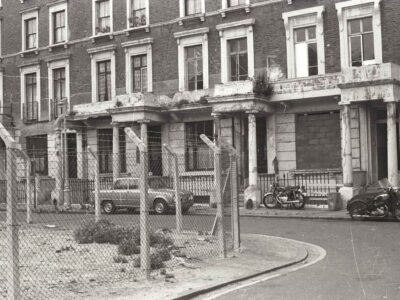
Squatting under the bridge
by Andrew Milburn
I chose London because … well, London. I had grown up in a coal-mining town “up north” and wanted to go to the big smoke, where the ground-breaking stuff was happening.

Academic leg up
by Tim Wilson
I changed from being a straightforward academic and amateur lefty to being someone who believed that the skills I had could be put at the service of urban communities.

Come together
by Paul Nicholson
When he learns that a chicken has been cooked in the oven he is horrified and says he cannot use it to bake bread, explaining to its baffled makers that the spirit of the chicken remains inside.
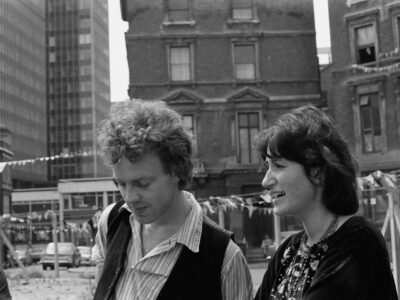
Bourgeois squatting
by Corinne Pearlman
It seemed like the right way to live. It felt very comfortable for me, living with a lot of people. I’ve got various lives in different places, but that communal life is really important.
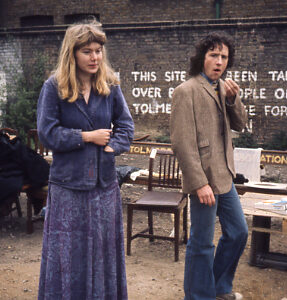
Turning point
by Suzy Nelson
It was a turning point in my life. I was wanting to find an alternative way of living and engaging in community politics.
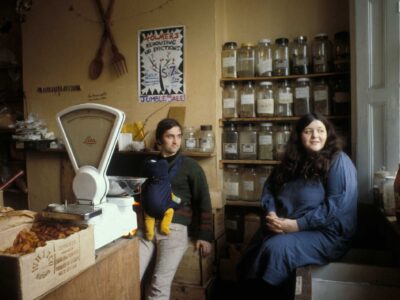
Rebirth through fire
by Alex Smith
I liked the dynamics of Tolmers Square. I was now on the South side where we were eccentric and unconventional, a bit wacky.