Joe Ravetz
See all photos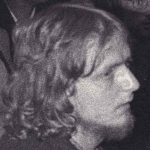
Joe Ravetz arrived in London in Autumn 1974, fresh from a year hitchhiking around the Indian subcontinent. He shortly moved into 60 Euston Street, with Ruth Milburn and Alex Smith, a house without water, sanitation or electricity, but with a unique quality of life.
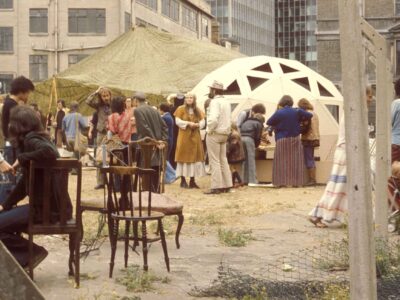
Within his first year at the Bartlett School of Architecture, with help from Ches Chesney and Paul Nicholson among others, he organised a four-day ‘Phoenix’ – a conference / festival of self-directed education on the future city, with themes on politics, economics, environment and cultural transformation (see programme and poster). The highlight of this was the construction of a geodesic dome, which was then transported across Euston Road to feature in the Tolmers Carnival of 1975. After the event it was carried down Drummond Street to live temporarily at the community garden at the junction of Drummond Street and Cobourg Street. After some violent confrontations with dossers who wanted to ‘squat the squat’, a massive thunderstorm then blew off the polythene covering and reduced the dome to a mass of pulp.
Joe made a living as a self-employed general builder, and serviced many of the shops, restaurants and other squats up and down Drummond Street and in the area. He then moved to Hebden Bridge in 1977, in search of stability, fresh air, and the formation of the Calder Valley Free State.
After six years of activism and activity, building a house and starting a business, he returned to the Bartlett in 1981 to finish the architecture degree. This led to collaboration with the RIBA Community Architecture Group, which opened the door to community planning / development, regional economic development, and then following the Rio Summit of 1992, a new ‘sustainable development’ agenda.
Working with the Town and Country Planning Association, Joe set up the world’s largest feasibility study on sustainability at that time. The Sustainable City Region Programme was based in Greater Manchester and engaged with public sector, private sector, civic and academic communities locally and nationally. The result was published in ‘City Region 2020’, which helped to bring funding to start the Centre for Urban and Regional Ecology at the University of Manchester.
After a decade of projects, promotions, presentations, think tanks, and so on, it began to emerge that a ‘linear’ version of sustainability policy and research was really not enough. From then, the concepts and methods for exploring a more dynamic and co-evolutionary ‘collective intelligence’ began to emerge, with a book ‘Deeper City: collective intelligence and the Pathways from Smart to Wise’, and the Mind-Lab (Laboratory for Collective Intelligence) to follow it up.
In hindsight, this owed a lot to the experiments which were focused in 1970s Tolmers. Behind the practical issues of recycling and local exchange, the themes of liberation pedagogy and self-directed learning, synergistic pathway design, and experimentation are now core issues in ‘urban living labs’. These were all tested at a naive and early stage in the ferment of inner-city London in the 1970s.
In particular, this raised the principles of self-organisation, pointing towards systems thinking and its application in collectivist, cooperativist and anarchist forms of governance. With more hindsight, and from research programs around global North and South, it’s clear that squatting was not only a colourful lifestyle choice for students in expensive cities. It is, by default, a way of life for large sections of the global population. And in that sense, it is interesting to trace some of the key principles: security of tenure, stability of governance and investment, and infrastructure which is appropriate and responsive.
These are all issues which were live and urgent in the squatting era: we can hope to reflect and learn from the lessons of this movement, its many ups and downs and its many contradictions, and use such insights to help us all move forward.
Stories by Joe Ravetz
Pathways to the future
by Joe Ravetz
Tolmers was a fantastic experimental zone - a unique vision and orientation, which helped me and many others to make sense and move forward;
50 year reflections
by Joe Ravetz
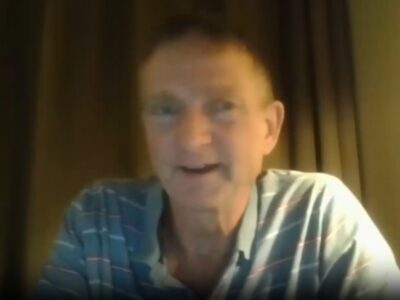
Looking back 50 years is an intriguing prospect. Most people in this 50th reunion were quite young in the 1970s… including myself, naive, chaotic, restless. Now we are 70-ish, maybe slowing down, maybe on the spectrum of retirement?
Photos featuring Joe Ravetz
See all photos-
Artist’s studio
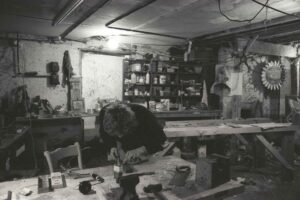
Artist's studio in the basement of 142 Drummond Street, 1976
Categories
-
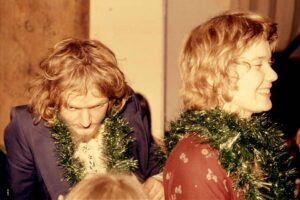
Banquet
Christmas banquet at 142 Drummond Street, 1975
-
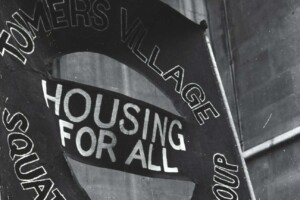
Tolmers banner
Tolmers banner on demonstration to the High Court in the Strand.
Categories