The Bartlett factor
It was the good fortune, or some might argue misfortune, of the Tolmers area of central/north London that it was ‘just across the road’ from what University College London’s website describes as ‘one of the most influential, exciting and innovative architecture schools in the world’.
The photograph below was taken from my bedroom window when I was squatting in 12 Tolmers Square. Glimpsed above the Avis vans in the gap between 14 Tolmers Square (right) and the rear extension of 183/185 North Gower Street (left) is the building in Gower Street which housed the studios, lecture halls and workshops where I and many others learnt about architecture, planning, building and environmental studies. It was that near.

The Bartlett building glimpsed from Tolmers Square.
Temporarily renamed the ‘School of Environmental Studies’ (SES), the institution was in the 1970s going through a radical phase when students were exploring working on their own projects within a module structure. Due to this experimental era and the physical proximity, the Bartlett influenced the way that the Tolmers saga developed and, in turn, the Tolmers experience influenced the lives and careers of those involved.
Bartlett PhD student Xinyue Tian is, in 2026, researching the SES phase of the Bartlett which inspired me to write this story. I hope it will be helpful. SES was an interesting experiment in architectural education.
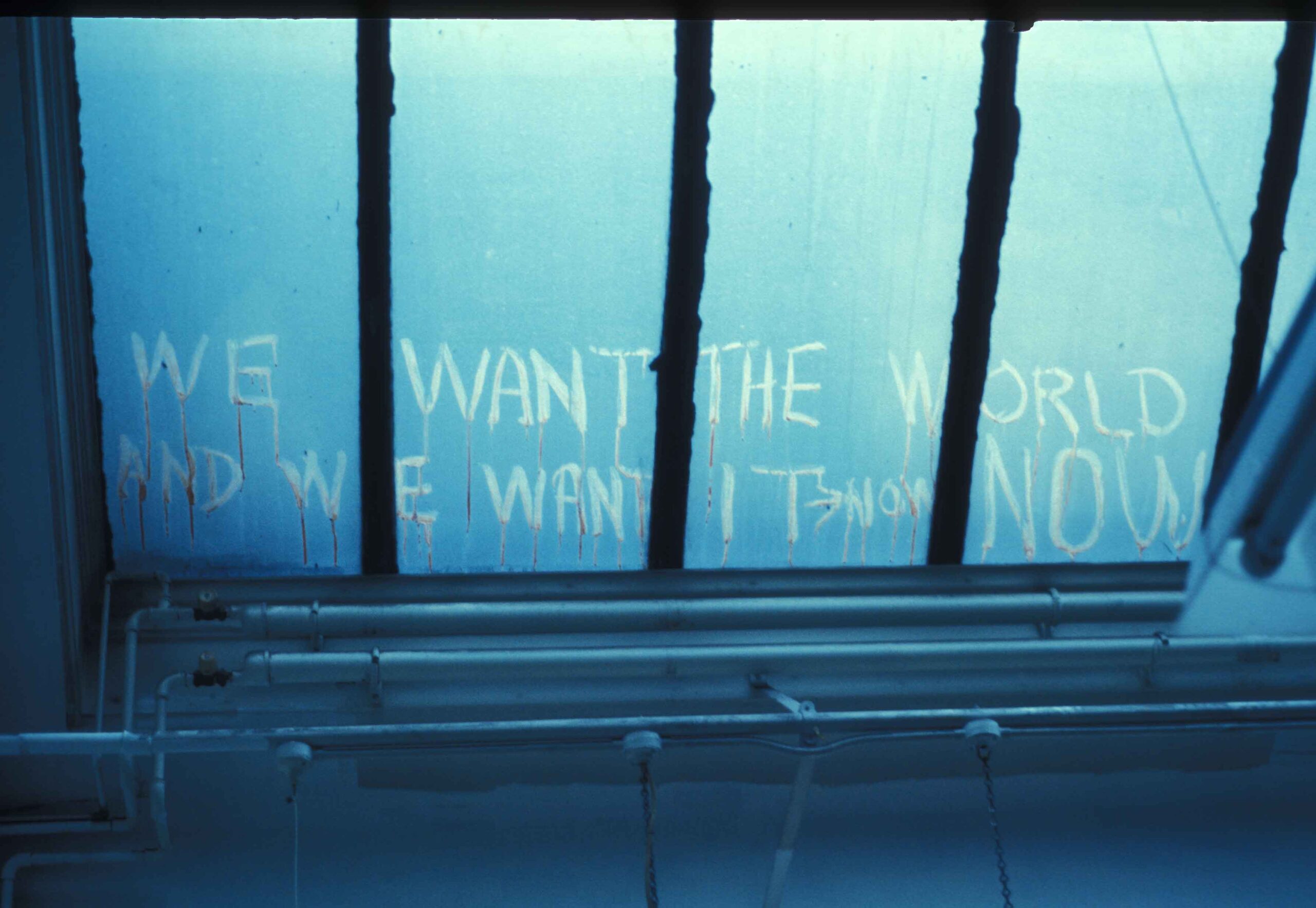
Graffiti on a skylight in a Bartlett Studio
Here is a remarkably long list, compiled by Paul Nicholson and myself, of Bartlett undergraduate students known to have lived in, worked in or (in brackets) frequently visited Tolmers. Grouped by year of entry to the school and with links to people’s profiles on this website if we have them. Please advise of errors and omissions:
1968 or earlier
1969
(Alan Robinson)
Andrew Milburn
1970
Barry Shaw
Caroline Lwin
Doug Smith
Nick Wates
Pedro George
(Richard Rankin)
(Vaughan Davies)
1971
Ches Chesney
(Daphne Ingham)
Frances Holliss
(Keith Bothwell)
Suzy Nelson
1973
Alex Smith
Carla Drayton
Danielle Pacaud
Lynne Farrow
Paul Nicholson
1974
Diploma architecture students included some of the above and:
Mphil planning students included:
Staff at the school who took an active interest in Tolmers included:
Michael Edwards
Mike Macrae
Reyner Banham
Rodney Mace
For me the most exciting feature of the SES course was that we were able to work on real projects with real people in real places. In contrast to much architectural education at that time which involved working on fantasy projects for a fantasy population in fantasy places.
Here is my Bartlett/Tolmers story in brief.
We were first made aware of the existence of the Tolmers area and the problems it faced by Andrew Milburn, a Bartlett student who lived there, during a student organised week of activities in November 1972 called XSES week (see programme). Then, in the last term of our degree course, five of us decided to collaborate on a project to find out more precisely what was going on.
Under the tutorship of Mike Macrae we did a detailed survey of the area and researched the planning situation. (The results are available in a report and appendices.)
At the end of the project we invited some local people we had met during our work into the Bartlett studio for the traditional crit. They then decided to form a community association and two of the student team, Pedro George and myself, decided to continue our involvement after our university course ended by going to live in the area as squatters. I successfully applied for a grant from Rowntrees which enabled me to work as Coordinator of the association in a rented shop in Drummond Street.

Nick Wates at the Tolmers Village Association (TVA) office in Drummond Street, 1974
Several ex and current Bartlett students and staff helped develop the shop/office and an exhibition about the area. Mike Macrae, still a Bartlett tutor but then presumably acting in a voluntary capacity, brought in graphic designer Kate Hepburn who designed a distinctive shopfront fascia and window graphic, and a photographer, Michael Anne Mullen, who made a photographic survey of the people and place. Macrae also provided practical support, bringing his TV to an open air jumble sale so that jumblers didn’t have to miss a football match and wielding a paint brush to start the graffiti wall in Tolmers Square, a not insignificant design challenge well executed.
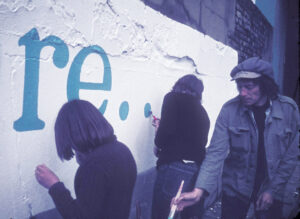
Bartlett tutor Mike Macrae helping start the graffiti wall in Tolmers Square.
The exhibition (see photos) was created collaboratively as if in a Bartlett studio. The huge amount of minute text now seems ridiculous but the messages were and remain spot on, albeit a little naive. (Transcribed panel text can be found in the photo information.) The exhibition content drew heavily on the Bartlett student project work .
Professor Reyner Banham was the most high ranking supporter from the Bartlett establishment. His daughter Debby became a squatter. Banham made occasional visits and helped raise profile with articles in New Society (The purified aesthetic, 26 June 1975; Tolmers Cenotaph, 17 June 1982)
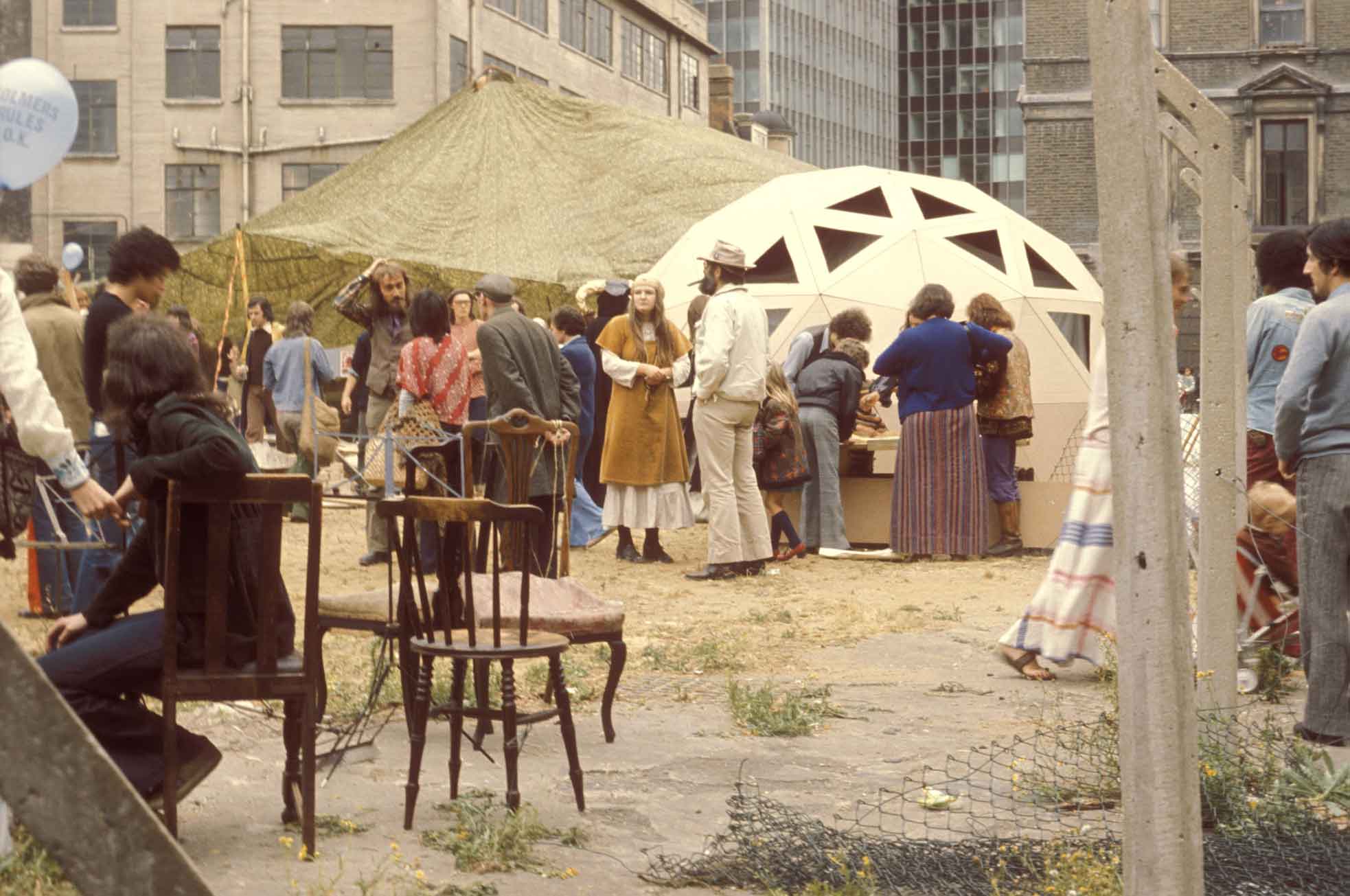
History Professor Reyner Banham at Tolmers Carnival 1975 with his daughter Debby in front of a geodesic dome made in the Bartlett workshops by student Joe Ravetz
In 1976 the Bartlett provided a room in the new school building in which to produce a book about the Tolmers issue. At the time I was squatting in Tolmers Square so it was really important to have a less chaotic environment ‘just across the road’ to work in. Thank you again Bartlett. As with the exhibition, Bartlett people helped with the book, ‘The Battle for Tolmers Square’ (Routledge, 1976), by producing graphics, supplying photos, writing text and commenting on drafts (thanks Barry Shaw, Caroline Lwin, Doug Smith, Jamie Gough, Michael Edwards, Mike Macrae, Rodney Mace). They later played a key role in producing the Tolmers People’s plan.
The Tolmers experience was invaluable for my later career. Experience of running a community design centre, mounting an exhibition of local ideas, producing an alternative plan equipped me for my work on community architecture and community planning. And I learnt invaluable life skills like fixing things, makeshift design, publishing, campaigning, talking to people and so on.
The importance of Tolmers for the Bartlett was recognised in an article commissioned for a special Bartlett magazine published for the institution’s centenery. It was brilliantly titled ‘We all live in Tolmers Square’. Tolmers was also featured in the Bartlett’s 2026 London Intersections exhibition as part of UCL’s bicentennial celebrations.
As time passes it is increasingly clear that Tolmers symbolises the moment when people said enough is enough. The pointless destruction and mismanagement of our cities, towns and villages by aloof professionals would no longer be tolerated and placemaking would be done collaboratively and better from now on. That is a legacy of Tolmers and of the Bartlett.

Graffiti in the Bartlett, 1972
Read more about the author Nick Wates
More stories
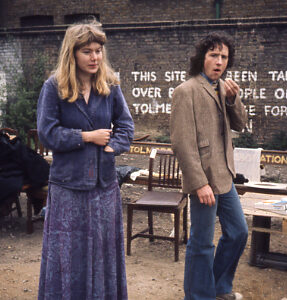
Turning point
by Suzy Nelson
It was a turning point in my life. I was wanting to find an alternative way of living and engaging in community politics.

American architecture student
by George B Bryant
My living conditions were primitive but there was electricity, water and mail delivery. I don’t know what I would have done had I not been able to live there.
Afterlife
by Alison Ravetz
It's wonderful to know that all that work and struggle are not relegated to a museum of good ideas, but are still being carried forward.
No shame
by Tim Davies
A squat. I didn’t even know what that meant. I had to look it up – in the days before Google. Encyclopaedia Brittanica in those days.
Pathways to the future
by Joe Ravetz
Tolmers was a fantastic experimental zone - a unique vision and orientation, which helped me and many others to make sense and move forward;
Israeli outpost
by Atalia ten Brink
Barry rang and told me he was moving into a squat in Tolmers Square. In Euston, walking distance from the Central. Would I like to join him?